EPISODE 20
Why Bach Is a "Rorschach Test"
Violinist Owen Dalby (St. Lawrence String Quartet, Stanford artist-in-residence) on why Bach's music works like a Rorschach test — and how it became his spiritual home.
with Owen Dalby | violinist; co-artistic director, Noe Music; artist-in-residence, Stanford University
Owen Dalby has spent a lifetime leading an extraordinarily multifaceted musical life — performing at the highest levels while pushing the bounds of how classical music relates to community. For much of the last decade he toured the world as a member of the St. Lawrence String Quartet. Before that, he co-founded Decoda, a Carnegie Hall–affiliated collective formed around a single question: how do we make this art as relevant, as meaningful, as helpful to as many people as we can?
That question runs through everything else in this episode: his early training with Anne Crowden at Berkeley's Crowden School, where chamber music was treated as a foundation for social-emotional learning; his discovery of baroque instruments and historical performance practice; the St. Matthew Passion, which he calls his "spiritual home" despite not being a believer; and his current work as co-director of Noe Music, the San Francisco chamber series he runs with his wife, violist Meena Bhasin.
ARIA
Laß mich kein Lust noch Furcht von dier from BWV 177
PERFORMERS
Nicholas Phan, tenor
Owen Dalby, violin
with Ruckus Early Music
Doug Balliett, viola da gamba | Clay Zeller-Townson, bassoon | Elliot Figg, harpsichord | Joshua Stauffer, theorbo
SOUND (BWV 177 only): Lolly Lewis | VIDEO: Clubsoda Productions
This episode was filmed in partnership with Noe Music.
This project is a fiscally sponsored project of FRACTURED ATLAS.
To find our more information and to make a TAX-DEDUCTIBLE donation to support the continuation of this project please click the button below
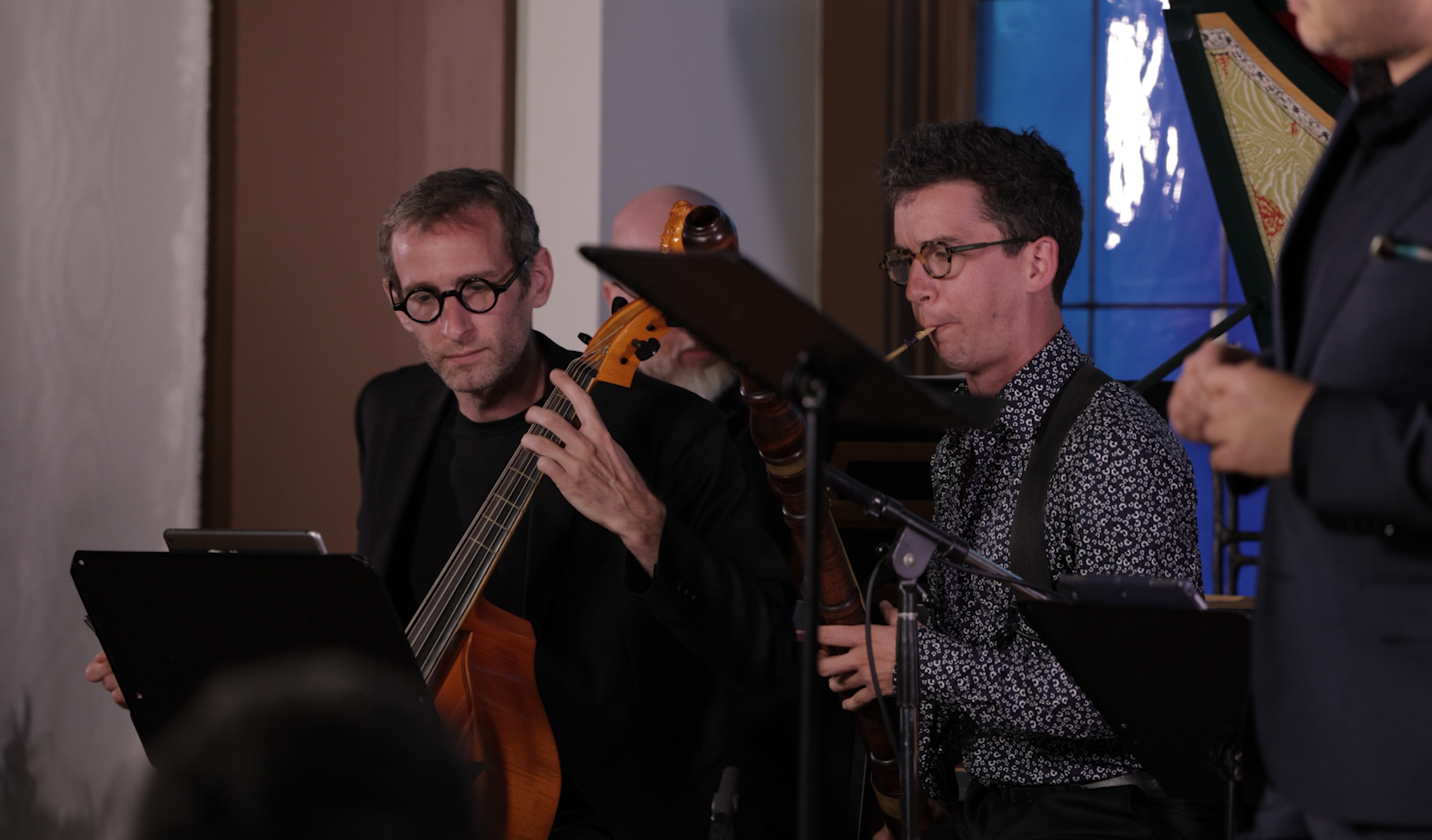
Doug Balliett (viola da gamba) and Clay Zeller-Townson (bassoon) of Ruckus Early Music perform at Noe Music in May, 2022
TRANSCRIPT
[00:00:00] M HUANG: I can't remember a time in my serious training where I wasn't learning a prelude and fugue.
[00:00:07] S MCGINNIS: My earliest memories of playing serious music were playing Bach minuets, then later preludes and fugues. It was so exciting as a very young musician to be able to put my hands on music that wasn't simplified for me as a young musician.
[00:00:27] It just, it was the music, right? And it felt so serious and important and legitimate in a way that, that was important to me.
[00:00:38] J BLUMBERG: It feels like solving a puzzle, and I think, I bet instrumentalists would say the same thing. There's so much work you have to do to wrap your voice and your brain around certain phrases and certain styles that you get in this kind of music that once you put in all that work, then it's more gratifying to just send it off the page because it's, you've put it in your body, you've put it in your voice.
[00:01:00] And then it's time to communicate.
[00:01:02] M HUANG: There is just a truth to his, his music where you cannot hide. And in order to play all the voicings that are in his music, you have to have complete mastery of your fingers, not just in being able to play the notes, but if you're trying to voice one line over another, the, the control of your, you know, fingertips, it demands, you know, absolute, absolute mastery.
[00:01:32] S MCGINNIS: It's amazing that Bach is one of these composers that can stay with one for their entire training and career and never, never be finished, right? I don't think anyone could actually be a f- a complete expert on it, and that- that's, there's something really exciting about that, too.
[00:01:52] J BLUMBERG: I think that can be off-putting to some people who think like, "Where's the heart in it?
[00:01:56] Where's the communication in it?" But I think it's all intermixed somehow. I think there's no... Th- you can't solve the puzzle unless your heart is in it, and you can't give heart to it unless your mind has solved the puzzle already.
[00:02:13] N PHAN: Hi, I'm Nick Phan, and this is Bach 52.
[00:02:21] Owen Dalby has spent a lifetime leading an extraordinarily multifaceted musical life, performing at the highest levels while also pushing the bounds of how classical music relates to our communities. For much of the last decade, he toured the world as a member of the St. Lawrence String Quartet, and before that, he co-founded the Ensemble Dakota, a collective of world-class artists from around the globe affiliated with Carnegie Hall, formed around a single question: How do we make this art as relevant, as meaningful, and as helpful to as many people as we can?
[00:02:55] The groundwork for this path was part of Owen's trajectory from almost the very beginning. He was enrolled as a child at Berkeley's Crowden School, which centers musical study at the heart of its curriculum. While he was a student there, he remembers that the music of Bach was central to the teaching, something foundational not just for technique, but to develop an artistic voice.
[00:03:17] At Crowden, music itself served as what Owen calls an organizing principle for its students, with chamber music forming the foundation of the school's approach to social emotional learning. Owen describes Bach's music as a Rorschach test, noting that it reflects something back that's important about you, whether you are a player or a listener.
[00:03:37] In addition to his role as artist in residence at Stanford University, Owen is also co-director of NoeMusic, the San Francisco chamber series he runs with his wife, violist Mina Bassoan, where through their innovative and excellent programming, they are continuing to ask the same question when they co-founded Dakota.
[00:03:56] How do we make this art as meaningful and as helpful to as many people as we can? Owen and Mina were some of Bach 52's very first partners. They partnered with me to film the first arias for this project as part of their main stage series at NoeMusic back in 2022, with Owen playing baroque violin. I'm so grateful to both of them for their support of this project.
[00:04:19] Be sure to stick around for the aria at the end of this episode, filmed live at NoeMusic as part of that concert that became Bach 52's first set of aria recordings. Thank you so much for doing this.
[00:04:32] O DALBY: Pleasure.
[00:04:34] N PHAN: Again, it's, like, been a long time in the making because, you know, you were part of the very first...
[00:04:39] You facilitated the very first recording sessions- That's right, yeah ... for this project, so thank you again.
[00:04:44] O DALBY: Yeah. So exciting to see how it's, far it's come in the... What has it been, three years?
[00:04:49] N PHAN: It's been almost four.
[00:04:50] O DALBY: Wow. Wow.
[00:04:52] N PHAN: We're moving slowly.
[00:04:53] O DALBY: Yeah.
[00:04:54] N PHAN: But whatever. Life has happened, and that's okay.
[00:04:56] O DALBY: But time is a, is a circle anyway, right?
[00:04:59] It's- It's a
[00:04:59] N PHAN: construct.
[00:05:00] O DALBY: Yeah.
[00:05:00] N PHAN: Yeah.
[00:05:01] O DALBY: As I hope we'll talk about.
[00:05:03] N PHAN: Yeah. So generally, we- I start these interviews by just a basic question, which is, like, how did Johann Sebastian Bach enter your life?
[00:05:11] O DALBY: As a toddler, I would sit underneath my dad's Chickering piano, and he would play... My father's a, a very accomplished amateur pianist, and, uh, would play Well-Tempered Clavier.
[00:05:25] That, and at the time, he was also teaching himself the cello in his 30s. Um, so Prelude to the First Suite is, uh, deeply embedded in my sort of cosmic musical background. So-
[00:05:42] N PHAN: So it's
[00:05:43] O DALBY: always
[00:05:43] N PHAN: been there.
[00:05:43] O DALBY: Yeah. It's... Oh, definitely, yeah. Since, um, since, since I was a small child. And, you know, and then discovering, uh, the LP collection of my, of my parents that was full of Bach, which I, you know, keep and treasure and sometimes play.
[00:05:58] So yeah, it's, it's been there what seems like forever.
[00:06:02] N PHAN: And so do you remember your first experiences with the- as a player?
[00:06:06] O DALBY: Yeah, so my first Bach as a player was probably, um, was probably the A Minor Violin Concerto, maybe the Double Concerto, which, you know, we'll, I hope we'll talk about kind of the emotional content and what it kind of has meant to me and, uh, you know, to you too.
[00:06:28] But the blend of, you know, call it thinking music and feeling music is, is so perfect in Bach, and I kind of got into it through the, the feeling music side. You know, that slow movement from the Double Concerto is, you know, one of the great arias of all time. And, um-
[00:06:50] N PHAN: You're not the first person on the series to say that.
[00:06:51] O DALBY: Oh, really?
[00:06:52] N PHAN: Yeah.
[00:06:53] O DALBY: Yeah. And so then as, as I, as I got older, in discovering the solo works, I mean, those are a kind of Mount Olympus for violinists. Like the suites for the cello, although they're, they're, I think, technically more challenging. Cellists would even admit that. And, and so, you know, working my way through those as a student and listening to and being influenced by all kinds of people from all over the world, not just violinists, but singers, conductors, pianists, harp, keyboardists, organists, uh, you name it- There's always more to be said and more to, more to dig and more to be pleased by in, in his music.
[00:07:40] And so that, um, that's been a, yeah, a constant journey. The solo works. And then I would say the Junior Bach Festival in the East Bay. Have, has anyone talked about this yet?
[00:07:53] N PHAN: No. What is that? Okay. I don't even know what
[00:07:54] O DALBY: that is. So the Junior Bach Festival, uh, is it still going on? I'm not, I'm not sure. I think it might be.
[00:08:00] It's a festival where you audition, and every year, as, as kids, you know, me and my cohort at the Crowden School would, would, um, would audition and, and it would be this week-long festival of Bach performances by kids, you know, from ages five to 18 probably. So lots of, you know, little pianists with their inventions, violinists really starting to grapple for the first time with the sonatas and the partitas, kids' choirs doing, uh, cantata movements.
[00:08:29] It's a beautiful thing. It was run out of UC Berkeley and provided the sort of focal point for the study and enjoyment and we all do this kind of nature of Bach's music, which I think is so, um, important to kind of the, the flavor of it. We all do this. This is a communal, uh, um, experience.
[00:08:50] N PHAN: Yeah, there's something central about his, experiencing his music- Yeah
[00:08:54] is communal, congregational.
[00:08:56] O DALBY: Yeah.
[00:08:58] N PHAN: So can... How old were you when you started?
[00:09:03] O DALBY: When I started-
[00:09:03] N PHAN: Playing?
[00:09:04] O DALBY: Playing the violin? Uh, five.
[00:09:06] N PHAN: Okay.
[00:09:06] O DALBY: Five, yeah. And
[00:09:07] N PHAN: did you start, and did you start at the Crow- Crowden-
[00:09:09] O DALBY: Crowden School? Yeah. Uh, no, I began when, um, my, my family lived in Hong Kong at that time. Okay. And so I began there.
[00:09:16] Um, and then I had a series of teachers, and then when I was nine, I began studying with Ann Crowden in, here in Berkeley, and, and she was a pedagogue who set my path for life and is, you know, to this day, top, one of the top three people outside my immediate family who kind of influenced me. And I studied with her for, uh, almost a decade before I went to college.
[00:09:38] And she taught many, many people, uh, since the '60s when she arrived here in California. Bach was central to her, you know, in a, um, in a more significant way than I would say, you know, most, most teachers it's, you know, learn your Bach, it's kind of like eat your, eat your Wheaties. You just kind of do it. But for her, it was something truly foundational to violin technique, to developing an artistic voice.
[00:10:06] I kind of learned all of that through the music of Bach.
[00:10:11] N PHAN: And that was because of her philosophy? Yeah,
[00:10:12] O DALBY: that's right.
[00:10:13] N PHAN: That's beautiful.
[00:10:13] O DALBY: Yeah.
[00:10:15] N PHAN: That's a big statement to say that it's a central tool to figuring out and developing your artistic voice. I mean, what do you think it is that drew Hurt to his music for that, as opposed to like, you know, Mozart or Beethoven or Anybody else?
[00:10:33] O DALBY: I- one of my big regrets is that I, I got to know her as an adult, when I was an adult, for only a brief time before she died. Mm. 'Cause this is the kind of thing I would've loved to, to dig on a little more. And of course, you know, I had a further journey with Bach after, after leaving her tutelage, you know?
[00:10:51] Mm-hmm. It teaches you... His music teaches you sort of everything there is to know about yourself.
[00:10:59] N PHAN: Can you talk about the Crowden School and- Yeah ... what it is? And I mean, y- uh, how amazing you had this experience with this, the founder and this woman.
[00:11:07] O DALBY: Yeah. It's been a, a kind of a foundation in my life and my family's life.
[00:11:13] Founded in the early '80s by Anne Crowden, who saw that there was a, uh, a real dearth of quality, uh, education for middle schoolers in particular. Her, her goal was to, uh, teach music and, and train musicians, but it was also to kind of nurture kids of a particular age. Uh, she noticed, I think, before she founded the school, that that was the age when, you know, social pressures and academics or, you know, the lack of seriousness or the overly...
[00:11:48] Things would just kind of fall apart for kids. And, and music could be this sort of centralizing, organizing principle. And so she founded a school in which, you know, every morning for two hours you did music technique, but also ensemble music, chamber music. So it was kind of chamber music as the foundation for socio-emotional learning.
[00:12:09] The rest of the day would be day school. But chamber music, then the art of collaboration was kind of baked in from a, you know, we just do this kind of every day, uh, practice way. So I went there. My sisters went there. I had the kind of special dose of being a violinist and getting to study with, with her privately as well throughout.
[00:12:31] When I was there, there was a kind of a... My cohort, there's, it was a golden age, really. Several of my buddies from seventh grade are, you know, major orchestra concertmasters or, you know, in, in, you know, worldwide touring chamber ensembles, soloists. Also scientists, you know, authors, writers. Happy, connected social people.
[00:12:58] There was really something, um, yeah, quite special about the place and continues to be. It's alive and well in Berkeley.
[00:13:07] N PHAN: It's, it's funny. It sou- it sounds a little bit, I mean, like akin to sort of this philosophy around Suzuki training, right? Which is not really- I think Americans tend to think Suzuki training is, at least my parents did, was, like, about learning the instrument.
[00:13:21] But actually it's really about family time, and it's about connection, and it's about learning how to connect as a human with other humans and building community around music. And I mean, it makes sense in a way that she would center so much of the music education around the music of Bach, which is also meant...
[00:13:37] It was composed to, like, bring communities together and bring people together in a place. And I don't know, it's very beautiful, this idea that it's not really just about music, but about learning how to be with each other and, like, making it the center of an educational system that branches out into other things.
[00:13:55] O DALBY: Yeah. That's totally right. It's, it's funny because, you know, the core repertory of chamber music, I mean, yes, the, derives from the, the s- for example, the string quartet will be derived from, from a trio sonata or earlier forms, but you know, what we think of as chamber music is sort of a bit of a later phenomenon than- Mm
[00:14:16] than, um, than Bach's time period. So there's this, this sense of like, you know, reaching, reaching back into music history into the closet, kind of bring forward the lessons into, um, into the more contemporary practice of chamber music. I realized at, at a certain point in college that to be deeply involved with Bach, to be- to further my involvement with Bach would require, uh, using the tools that Bach knew, which is to say, namely the Baroque instruments.
[00:14:55] You've got strings, the different shaped bows, all of that. So that was a side of, of, um, historical performance practice was not particular focus of Crowden or of Anne, but is something I came to a little bit later and that became a whole new portal, uh, towards, you know, appreciation, enjoyment, kind of sitting with letting it marinate in my, my bones.
[00:15:17] N PHAN: How did it change your experience of the music, having the different, you know, the, the period- Mm-hmm ... instrument in your hands? It's funny, my- Well,
[00:15:26] O DALBY: yeah ...
[00:15:26] N PHAN: when I was studying violin, I found it super disorienting because my teacher w- you know, wanted me to experiment with-
[00:15:32] O DALBY: Yeah ...
[00:15:32] N PHAN: you know, a Baroque bow and, and a Baroque...
[00:15:36] I mean, the instruments are basically the same, it's just, you know, we- the way you hold them is different and the strings are different, but-
[00:15:40] O DALBY: Yeah ...
[00:15:41] N PHAN: I found it super disorienting. Like, I didn't know how to relate to the instrument anymore.
[00:15:45] O DALBY: Yeah. Well, so there's, there's like various humps to get over. I think when you're, you know, adapting something you've done for so long- Right
[00:15:53] and changing something which seems minor but is actually fundamental, the composition of the strings, they react completely differently. The shape of the bow does certain things automatically, doesn't do other things that you're used to it doing. So the aspect of, you know, being, being a beginner again, humbling, but, uh, so deeply good for you and- Mm
[00:16:15] rewarding once you're kind of over that. Or at least, you're never over it, but, but, but constantly sort of feeling into what things suggest, what they, what the tools themselves want how to be played. Right. You know? The lower tension on the strings made playing chords easier. The shape of the bow f- mimics the shape of the bridge.
[00:16:36] There's a kind of natural, you know, primacy of the down bow gesture that, you know, relates to rhetoric, relates to dance. Mm. You know, all of this kind of information, it was suddenly like music of the Baroque, but Bach in particular, was like Technicolor.
[00:16:52] N PHAN: Mm.
[00:16:52] O DALBY: So that's one side is, is actually feeling, feeling the difference with the, with the tools.
[00:16:58] But then I was able to involve myself in- His best music
[00:17:04] N PHAN: Mm-hmm ...
[00:17:04] O DALBY: which is his, you know, church music, right? The cantatas, the passions. That was a absolute revelation. Life-changing.
[00:17:15] N PHAN: So say more about that. I mean, a- again, you're not the first person to say that, like, encountering the cantatas and the church music is a, is life-changing, and that's something that I find really fascinating.
[00:17:25] I mean, were you raised in a religion?
[00:17:26] O DALBY: No.
[00:17:27] N PHAN: So even more fascinating that it was life-changing. Uh, can you say more about that?
[00:17:30] O DALBY: Yeah. I mean, it's ironic that it, this music is so deeply Christian, so deeply religious, and it's not a, a, a story or a tradition that I'm personally... I'm not a believer in that sense.
[00:17:47] But the honesty and, and truth that comes through his Faith?
[00:17:59] N PHAN: Mm-hmm.
[00:17:59] O DALBY: Through his music. I mean, that, that is, that's something I can relate to, and have found my spiritual home in my life through his music in that, in that way. There's a, um, a humanity t- to, to that, and, uh, a connectedness both above and out that I completely jive with, and that's, that was, that was taught to me by his music.
[00:18:27] You know, particular, you know, Matthew Passion, which I remember doing for the first time, um, in a production. You maybe know the Jonathan Miller production. It's done in street clothes, uh, in English. Mm-hmm. Sorry, English. Mm-hmm. In the round. There was a, a production at BAM, Brooklyn Academy of Music. I think we did nine or 12 performances in a short span of time.
[00:18:51] And I was a n- sort of new New Yorker at that point. And I remember... And I'd just gotten my Vespa. Brand new. And I was living in Astoria, Queens, and that was in Brooklyn. So I would, I would take my Vespa down through Williamsburg, through the Hasidic neighborhoods, across the bridge. And normally, of course, I'm going through Manhattan for everything.
[00:19:13] N PHAN: Right.
[00:19:13] O DALBY: But so all of these kind of associations of the place and time early in my career, discovery, discovering myself, you know. Who am I on this bike with my violin and my... Like, it's a- You know, trying things on. And then arriving at this, this place. Well, you know, you have a run of, of, of concerts or a show that repeat.
[00:19:34] I mean, that's pretty unusual. That's, like, almost feeling like you have a real job-
[00:19:38] for a brief time. So everything felt kind of new and interesting. And, and then to be immersed in, in his music. And of course, I don't speak German either, so hearing it in English, Bach purists would, um, would scoff. But I thought it was so, so powerful.
[00:19:59] And I'm, you know, I'd, I'd dare say so did the audience. You know, you, you could zoom in on so many different moments, but even just that opening chorus, for example, where, you know, time, time just stands still I was reading a, uh, an analysis by Carol Berger of this, of this opening chorus in St. Matthew Passion, and among many things that make it amazing, he has this, you know, these various, uh, he has da capo structure and these choruses that, that sing this material in succession.
[00:20:38] And then at the very end, the final da capo brings everything together such that it's not a series of events anymore, but it's, it's time as this eternal now. Things are just happening now. There's no, there's no stress about the future or, or, uh, lament of the past. It's, it's all happening in the moment. So I think that's, that's also for me an experience that is palpable when you're listening to it, when you're playing it, so deeply in the moment.
[00:21:13] Pe- I guess you could call it the flow zone-
[00:21:17] N PHAN: Yeah ...
[00:21:17] O DALBY: or something. But I've never felt that more aligned than when playing Bach.
[00:21:22] N PHAN: No, there's something about his music that demands it too- Yeah ... right? 'Cause it's like you have to do so many things and process so many things at once that if you get distracted for even one second, you're, you're lost.
[00:21:34] N PHAN: At least that is w- Yeah ... my experience of it. It's so great to hear about your experience as a player. I, I wanna go back to this idea you're talking about, like how he roots you in the moment.
[00:21:47] N PHAN: Is that part of why you think he's so unique in terms of helping someone find their artistic voice- Hmm
[00:21:54] in terms of development?
[00:21:56] O DALBY: Interesting. Yeah.
[00:21:56] N PHAN: I mean, it's, he's got a unique ability as opposed to other composers, right?
[00:22:01] O DALBY: There's a lot that's like, frankly formulaic about Bach, right? The structures, the capo arias, the, you know, dance forms, like understood. And- I guess it's always that balancing act of knowing, knowing what you're doing, knowing where you are, knowing, you know, what, who you are.
[00:22:29] And then, you know, the opportunity to step out or leap out from that. You know, Bach is- it's consoling, but it's also daring you. At least I've- this is how I've come to appreciate or approach his music now. It's like, what's, what's set and what's flexible?
[00:22:50] N PHAN: Mm-hmm.
[00:22:51] O DALBY: And I've been so delighted to hear other people's Bach interpretations for that reason, right?
[00:22:58] Like, Yunchan Lim has a, a live at Carnegie Hall complete Goldberg Variations from last year. Have you heard it?
[00:23:07] N PHAN: Mm-mm.
[00:23:08] O DALBY: Monumental.
[00:23:09] N PHAN: Wow.
[00:23:09] O DALBY: Just astonishing. So much so that I had to, like, research to find out whether it was actually just one night or whether, you know, live recording-
[00:23:18] N PHAN: Wow ...
[00:23:18] O DALBY: recorded over three nights, right?
[00:23:20] Spliced together. No, I think it was just one night. And so one performance and, you know, that gives it an extra sort of, sort of frisson or whatever. But I mean, that piece runs such a, a, a gamut of, of styles. Just the sheer number of options-
[00:23:40] N PHAN: Yeah ...
[00:23:41] O DALBY: you know, that you can, you can take, uh, as a interpretive approach.
[00:23:46] That was what was so, um, so thrilling. It was kind of like jaw-dropping. Like, you can do that? And, and why not, right? Yeah.
[00:23:53] N PHAN: Right.
[00:23:53] O DALBY: I, I think that that grounded-ness and the daring to push, push out from there, that's a s- really special, um, kind of quality of his music. And there's sort of room for everyone in it.
[00:24:08] N PHAN: Yeah. I feel that. There should be at least.
[00:24:13] O DALBY: Yeah. Yeah. Yeah, and this has probably been said many times on this series already, but, you know, Bach on the marimba sounds great, as does Bach on the, in the saxophone quartet, you know, as it does- Mm-hmm ... on the organ, right? There's a, a universality to the music that is a little bit, uh, able to be kind of de-layered from the instruments that it was composed for.
[00:24:40] N PHAN: Yeah. It's interesting how it can kind of... It transfers well between instruments in a way that almost nobody else's music does.
[00:24:47] O DALBY: Yeah. Why do you, why do you think that it does that so well?
[00:24:53] N PHAN: You know, I don't know. I, I... It's funny, you are not the first person to notice it, but it's, it's, it's, it, that's funny.
[00:24:58] It does also... I don't know. No one's actually really scratched the quest- I should be asking people why.
[00:25:04] O DALBY: Mm. Mm.
[00:25:04] N PHAN: But I, I mean, part of it is, at least for me, is there's something about his music that is purely about the notes and the rhythms. You know, he's not necessarily after sounds.
[00:25:17] O DALBY: Mm-hmm.
[00:25:17] N PHAN: Like, so much of the genius of so many other o- composers is, like, the way they orchestrate or the way that they, you know, the instruments that they choose and the way they in- you know, kind of arrange things.
[00:25:30] And he's really just about the notes somehow. Yeah, yeah. And there, and I think that's why some singers complain that it's not very vocal. It, it feels too instrumental, you know? I think it's why wind players especially can struggle with it at times 'cause, you know, there's just no chance to breathe 'cause everybody feels like he's treating them like they're an organ with an endless supply of air.
[00:25:53] You know, as long as the pump is going. And I, you know, I wonder if sometimes he does relate to it that way because he's a keyboardist. You know, there's something about the instruments he was playing. They're a little bit like musical computers.
[00:26:05] O DALBY: Mm-hmm.
[00:26:05] N PHAN: You know, no matter how viscerally you interact with the instrument, it doesn't really change the sound.
[00:26:10] I mean, those are, those are all guesses at why. But I don't know. It's also just kind of his- Yeah ... unique, special genius.
[00:26:17] O DALBY: Interesting. Yeah. The, those of, those of you that require air- ... I'd never really, um, thought about how, how, how special we, we are and just kinda keep playing.
[00:26:30] N PHAN: Yeah, you just change tone.
[00:26:31] O DALBY: Yeah.
[00:26:31] Yeah. Yeah. And of course there is stuff that's, that's awkward, but nothing is unplayable.
[00:26:39] N PHAN: Well, and that's the thing about his music though from a vocal standpoint. I mean, it's, it's not unplayable for wind players, and it's certainly- Right ... not unsingable for singers. It may be really difficult, but unsingable is not a word I would associate with it. You have a unique experience, I think as a, or special experience as a musician because not only are you playing at this, like, really elite concert level, but also you're associated with a lot of community efforts around music.
[00:27:06] I mean, there's a... You know, what you did. You, you're one of the founders of CODA- Mm-hmm ... at Carne- that was associated with Carnegie Hall- Mm-hmm ... and probably still is. Mm-hmm. And, you know, there seems like there's a community aspect to that, and that was born out of what was ACJW, I assume. That's right. So, you know, there were, must have been community aspects to that.
[00:27:26] Yeah. And then I also, uh... You know, it seems to have translated, seems to have translated throughout your career into, um, what you run now at, at NoeMusic. I mean, NoeMusic is such a unique beast of an institution that I think is quite special. And so I just wonder if you could talk about those things.
[00:27:45] O DALBY: My favorite way of making music is in community with others, and that's sort of a kind of truism.
[00:27:52] It kind of goes without saying for a lot of people, I suppose. But-
[00:27:55] N PHAN: Well, I don't know. Not pianists.
[00:27:56] O DALBY: Yeah. Maybe not.
[00:27:58] N PHAN: But go on. Sorry.
[00:27:58] O DALBY: Yeah. A kind of chamber music ethos, I suppose, has infused my whole life. So I would draw a line, you know, back to the very beginning there through, you know, my training years and into, uh, early professional career through what is now called Ensemble Connect, but at the time was ACJW.
[00:28:18] That was a program connecting Carnegie Hall and Juilliard and the New York City Department of Education to create an ensemble of, of, of artists who knew how to, you know, both perform on Carnegie stages but also embed themselves deeply into the fabrics of the communities. And what better way than through the schools?
[00:28:41] And to get to know, uh, New York City through its, its, uh, its school communities was, was unbelievable. Then, you know, crafting a, um, a professional vehicle out of that that kind of would take flight on its own, but at the core of it, it's the question: How do we make- this art as relevant, as meaningful, as helpful as we can to as many people as we can.
[00:29:07] And so that, that was sort of the guiding question that, you know, led the creation of Dekoda, which of course still exists, still a New York-based thing, but now 12... No, almost 15 years later, the members are scattered all over the, the country and the world. But we come together to do not just concerts, but these sort of deeply important and meaningful community residencies.
[00:29:31] So whether that's in a, in a school or at a shelter or at a prison or, you know, places where music of great caliber is rarely experienced or used as this bridging material to connect and draw people's stories out and, and, and improve their lives. I mean, that, that's kind of the focus and always has been.
[00:29:51] And when I, uh, moved out here to join the St. Lawrence Quartet and, and kind of live that life, that was the, the coming true of a, of a childhood dream I'd had really of, of, of playing quartets at the- You know, you could call it at the highest level, but what I really mean is just for the most number of minutes in a day.
[00:30:15] Because, you know, I just don't... When you, when you're sitting in conversation with three other people with, with respect and, and a score of genius between you, there's just no better feeling in the entire world. So it was sort of selfish on, on that score. But here I was joining a- an ensemble that I admired for ever, and it was itself so deeply committed to making everyone feel included in that experience.
[00:30:45] The quartet happened to be the vehicle, but, um, it's one thing I think really made that quartet stand out from, from other-- from its peers. People would always say how, how viscerally connected to the music they felt when listening to St. Lawrence Quartet. The fact that I could join that and influence it, dream come true.
[00:31:06] And so I had five good years of touring with the ensemble before COVID shut everything down, and then subsequently Jeff's illness and death, and that kind of laid the, the groundwork for our retiring the group in 2024. But meantime, you know, getting to know this place. I grew up in Berkeley, but had never lived in San Francisco.
[00:31:27] So it was familiar, but also very different to come back to my home area, but to discover new, new things about it. Uh, to bring my wife, Nina, who is a dyed-in-the-wool New Yorker who, you know, took, took some time to feel comfortable here, but now feels totally at home. And then, you know, to understand what the university context of Stanford is like and how many people are, are so passionate about music and how it creates this...
[00:31:56] You know, it's this interstitial-- It's this, um, it's this connective tissue- Mm ... for so many people doing so many interesting high-level intellectual things. Music is somehow connecting so many of them to each other and to the work they do. Uh, so that was the, the niche that the quartet kind of filled at Stanford, was exploring those connections and celebrating them, and of course, performing and teaching.
[00:32:20] But a total-- Being part of that was a total master class in, in sort of- It, showing how, how music matters in daily life for people. And it's not just this, you know, cloistered practice room experience that so many of us who, you know, may have grown up playing an instrument kind of associate with it.
[00:32:44] Deeply, deeply communal, community-based, and that's the entire point of it. So at the same time, NoeMusic has, has become this... Well, I should say it started out as a very neighborhood grassroots chamber music concert series in the early '90s, founded by Karen Heather, who was a administrator at the San Francisco Conservatory and a pianist.
[00:33:05] And when she wanted to retire, they, they thought they might kind of wind the thing down. Uh, Mina and I were more or less just in the right place at the right time, and they offered to basically let us take the organization in any direction we wanted to. Um, so that was in 2018. So what began as organizing concerts by friends of ours between my own concerts out of town has become, become this really sort of weighty or impressive collection of, like, musical events that people are, are, are clamoring for.
[00:33:40] Besides which we have, you know, a series for kids. Oh yeah, meantime, we had two kids. Uh, and, and a lot of other community-based music happenings are the, are the focus of Noe now. We have a lullaby project that connects new parents with professional artists, singer-songwriters, to compose and record lullabies for their new, uh, new people.
[00:34:04] It strengthens parental bonding. It's incredibly beautiful program that we took inspiration from, uh, Carnegie Hall back, back from the days when we, we worked there. It's a varied, rich, deeply satisfying life in music because it's so connected to community.
[00:34:25] N PHAN: That's amazing. And that's
[00:34:26] O DALBY: kind of where I am now.
[00:34:27] N PHAN: It sounds like a through line through your life.
[00:34:28] O DALBY: Yeah, I think so. Of course, it's not really been planned that way. It's always a series of, you know, happenings and you follow your nose.
[00:34:36] N PHAN: That's really how life works usually. Yeah. Suppose so.
[00:34:40] O DALBY: It's, you know, an analogy also for Bach, right? And how, how his approach...
[00:34:46] I mean, who knows what Bach re- I mean, that's another thing about Bach, right? He was, he was such a work-a-day guy.
[00:34:52] N PHAN: Right.
[00:34:52] O DALBY: You know? He was like- Putting an anachronistic kind of gloss on it, like union member, right? Like clocking in, clocking out, and just churning out this stuff. So that kind of practice, that everydayness of, of his life example is something I find really useful to think about and, and try to adopt.
[00:35:17] It's not, it's not about like, you know, the one supernova artistic expression. Of course, there are those. But it's about the daily diet. And, and so having music as part of the daily diet is something I find so useful for myself, and I want to give to other people, too, and encourage in our society.
[00:35:40] N PHAN: That's beautiful.
[00:35:41] So we always work our way up to this question, which is the central question of this series. But do you think the music of Bach is for everyone, and what does that mean to you?
[00:35:51] O DALBY: Hell, yes. I mean, pretty clearly I do. I think the music of Bach is, is for everybody. It's a Rorschach test. You know, you see what...
[00:36:03] It, it reflects, uh, something important about you as a listener, as a, as a player. You know, there's, there's-- It's this arc. There's room for all interpretations. There's room for all kind of, uh, spiritual, emotional experiences with it. And again, because it is so-- it was so designed with community in mind- There's a place for everybody within it.
[00:36:33] N PHAN: I love that. That's a beautiful answer.
[00:36:37] O DALBY: Well-
[00:36:38] N PHAN: Is there anything you wanna add?
[00:36:40] O DALBY: Probably, but I'll remember it when I'm driving away.
[00:36:44] N PHAN: Well, I really appreciate you taking some time to- Yeah ... sit down and chat about this
[00:37:00] So the aria for this episode is part of where Bach 52 began. In May 2022, Owen and I joined the early music band, Ruckus, at Noe Valley Ministry, a few blocks from my house here in San Francisco. And we recorded the first footage for this project as part of Noe Music's main stage concert series. This aria ended the first half of that concert.
[00:37:21] It's the fourth movement of Bach's Cantata 177, Ich ruf zu dir, Herr Jesu Christ. In this aria, underneath the voice, Bach writes for an unusual duo, solo violin and solo bassoon, trading lines back and forth with the tenor. The text, "Let no pleasure or fear turn me away from you," asks something that Bach seems to return to again and again.
[00:37:44] Asks for constancy. It makes me think of the kind of daily devotion that Owen talked about in his interview when he described Bach as a work-a-day guy, just clocking in and clocking out. And as you can hear in this aria, there is tremendous joy to Bach's devotion to his daily trade, which is perhaps an indicator of why he composed so much music.
[00:38:03] Enjoy this aria, Lass mich kein Lust noch Furcht von dir, from Cantata 177, with Owen Dalby, violin, Clay Zeller-Townson, bassoon, and the early music band, Ruckus.