EPISODE 21
BACH AS A BRIDGE-BUILDER
cultural diplomat Carla Dirlikov Canales on identity, curiosity, and music as a tool to connect across borders
with Carla Dirlikov Canales | mezzo-soprano; founder, The Canales Project; fellow, Harvard Kennedy School
Carla Dirlikov Canales and I have known each other since we were teenagers growing up in the twin towns of Ann Arbor and Ypsilanti, Michigan — we even sang together as fellow voice majors at the University of Michigan. Since then, Carla has built a career turning music into a tool for cultural diplomacy: a State Department cultural exchange mission to Mexico led her to found The Canales Project in 2016, and in 2023 she became the National Endowment for the Arts' first Senior Advisor and Envoy for Cultural Exchange. She's currently a fellow at Harvard's Kennedy School.
In this episode, Carla and I talk about identity, curiosity, and how Bach — a working musician employed by the city of Leipzig — offers a surprising model for thinking about music's power to build bridges between people and cultures today.
Stick around to the end for the aria: the tenor aria "Bleibt, ihr Engel, bleibt bei mir" from Cantata BWV 19, Es erhub sich ein Streit, featuring Dominic Favia on period natural trumpet.
NOTE ABOUT THE TRUMPET in BWV 19: Dominic Favia, our trumpet player for this aria, played this on a true period instrument, which is to say that it has no valves and no finger holes. These instruments, which is how trumpets were designed in Bach’s time, are only able to play notes that occur naturally in its own overtone series, which means that some of these notes don’t quite line up in the same ways our ears are accustomed to hearing in our time of equally-tempered modern pianos. This is not a mistake by any means, but just the physics of the instrument and is what we imagine would have been the same sound Bach’s own trumpeters would have made and what Bach himself would have been accustomed to hearing.
Learn more about Dominic's trumpet at https://www.dominicfavia.com/about-the-natural-trumpet
ARIA
Bleibt ihr Engel, bleibt bei mir from BWV 19
PERFORMERS
Nicholas Phan, tenor
Dominic Favia, trumpet
with San Francisco Conservatory of Music Baroque Ensemble | Elisabeth Reed & Corey Jamason, directors
Violin 1: Pauline Kempf (leader), Carla Moore, Annemarie Schubert, Eliana Estrada
Violin 2: Cynthia Black, Luke Chiang, Alexandra Santon
Violins: Jennifer Redondas, Caitlin Keen
Cello: Hasan Abualhaj, Octavio Mujica
Violone: Farley Pearce, Lalita Perez
Organ: Corey Jamason
SOUND (BWV 177 only): Lolly Lewis | VIDEO: Clubsoda Productions
This episode was filmed in partnership with the San Francisco Conservatory of Music.
This project is a fiscally sponsored project of FRACTURED ATLAS.
To find our more information and to make a TAX-DEDUCTIBLE donation to support the continuation of this project please click the button below
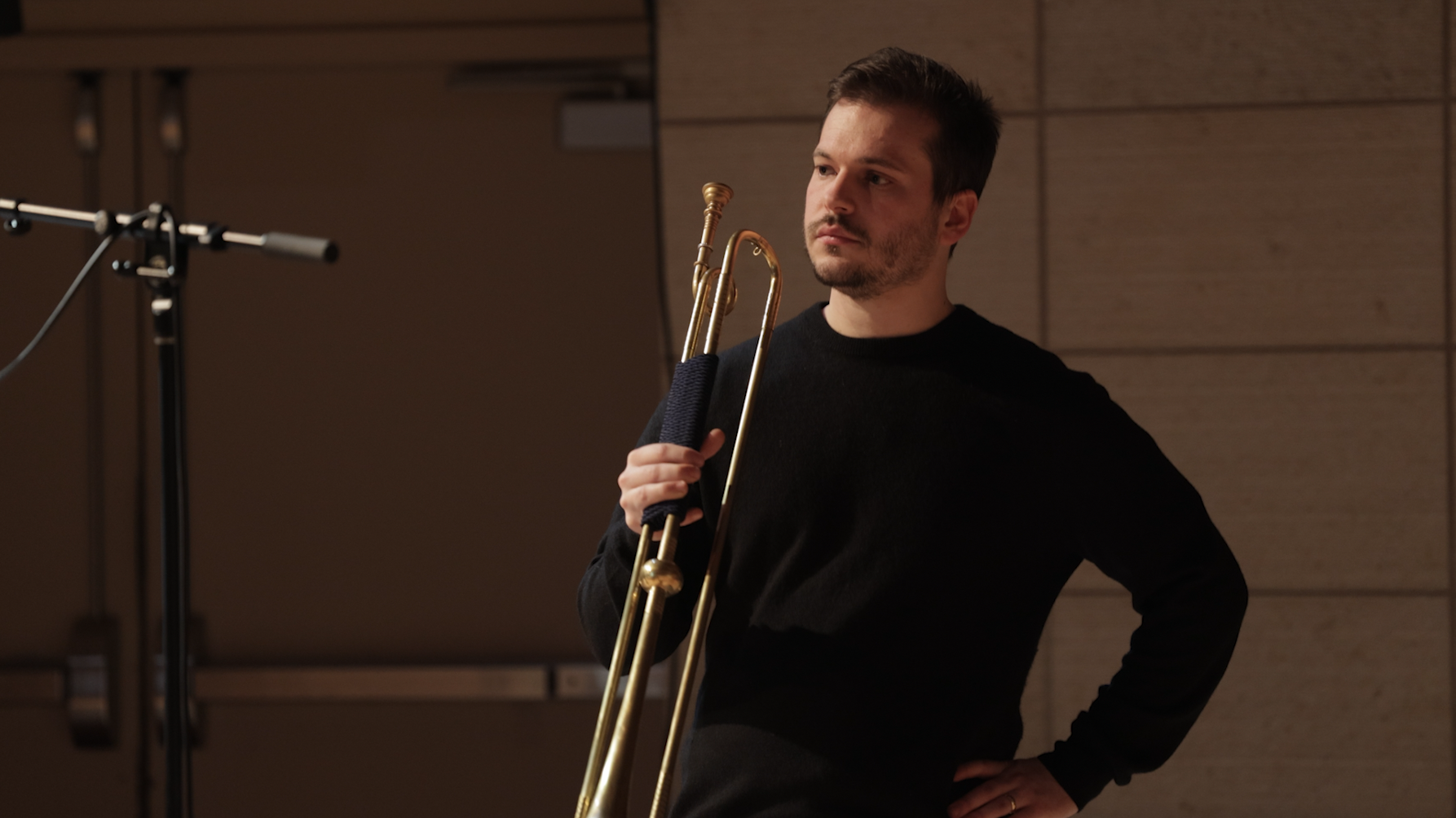
Dominic Favia recording BWV 19 at San Francisco Conservatory of Music in January, 2023
TRANSCRIPT
[00:00:00] Z REAMS: I listen to Bach when, when I'm, not when I'm going through something, when I'm on the up of coming out of something. In a way, it feels like battle music to me. It's like inner composure battle.
[00:00:20] STUDENT 1: Wh- when I, like, finish an aria, I do feel, I feel humble. I feel grounded. Like, phew, we got, we got through that.
[00:00:27] Like, it really elevates your soul. Like, I have to be present here, right? Like, my singing system, but also, like, in my heart, I have to be open and make myself vulnerable.
[00:00:38] STUDENT 2: The whole idea of, of Jesus kind of being this anchor between humanity and divinity, and us trying to find our place in the midst of that, is something that I think about every day of my life.
[00:00:53] And I think that Bach is just always talking about this, and always, like, you know, struggling to sort of make sense of all these things.
[00:01:01] F BARRON: The music, I think when it's done really well, it's very, it's incredibly soothing. Like, on a, on a sort of soul level, it's touch- it touches you.
[00:01:11] Z REAMS: When I'm on the up, I'm like, "Okay, we're gonna get it together.
[00:01:15] I'm gonna put on some Bach, and we're gonna move through. It's time to go. It's time to get up." And that's like my little inner personal like, "Okay, girl, we've had enough. We did our little crying moment. Time to raise up, turn on some Bach." And it feels like, okay, I'm gonna continue. That's wh- how Bach has kind of, uh, integrated into my life.
[00:01:37] So I feel like that's kind of a powerful tool if anyone wants to try it.
[00:01:46] N PHAN: Hi, I'm Nick Phan, and this is Bach 52
[00:01:54] I've known Carla Delle Coffe Canales most of my life. We grew up in the twin towns of Ann Arbor and Ypsilanti, two neighboring cities in southeastern Michigan. And we met as teenagers when Carla was organizing a group recital in what was both our senior years of high school. After graduating from our respective high schools, we became classmates at the University of Michigan together as fellow voice majors.
[00:02:16] Carla went on to pursue a master's degree in opera at McGill University in Montreal. And as she finished her studies there, she was invited by the U.S. State Department to go on a 10-day cultural exchange mission to Mexico. While on that trip, she was working with a children's choir in Campeche, and she discovered a deeper purpose to her musical life, that music can be a tool to build bridges between people and between countries.
[00:02:41] That trip set her on a path that she's still navigating to this day. Inspired by her work with the U.S. State Department, she founded The Canales Project in 2016, a nonprofit devoted to exploring questions of identity and culture through music and conversation. She became the National Endowment for the Arts' first senior advisor and envoy for cultural exchange in 2023, and she's currently a fellow at Harvard's Kennedy School.
[00:03:05] I caught up with Carla at her home, where we sometimes have guest appearances by her dog, Grizzly. So don't be surprised if you see him come into frame from time to time during the interview. If you're listening to the podcast version of this, you will also hear us greet him at one point as he barrels into the middle of our setup.
[00:03:22] I've been wanting to speak to Carla as part of this series for a while now because Bach was basically a city employee whose boss was the town council in Leipzig. And like Carla, Bach was a musician working at the intersection of music and government. And the way his music was made to serve his community, from births, weddings, funerals, to town council events and other municipal functions, it mirrors how Carla thinks about music's bridge-building powers.
[00:03:48] Carla's work represents what one modern-day version of this might look like, and it was fascinating to hear her insights about the power of music to connect and her hope that music can inspire curiosity in an age when it seems like fewer and fewer people are curious. I hope you enjoy this conversation with Carla, and be sure to stick around for the aria at the end of the episode taken from Cantata 19.
[00:04:12] So this project, Bach 52, is centered around asking this question, do you think the music of Bach is for everyone? But I always sort of start off with, you know, what is, what is your personal journey with Bach's music? You know, has... When did he enter your life?
[00:04:30] MUSIC: Mm.
[00:04:31] N PHAN: Has he played a role in your life, you know, if any?
[00:04:34] And, um, kind of how that music has sort of impacted your life, so.
[00:04:40] C CANALES: Yeah. Well, that's an interesting question. I'd never thought of it in those terms, but actually Bach entered my life when I was a violinist, uh, just as a kid really. I played violin before I ever sang a note. And I remember, you know, growing up in Ypsilanti, we grew up very, very similarly, um, I would have a violin teacher I would go to, and she gave me a lot of Baroque music, Vivaldi, and then I sort of advanced to Bach, and I found those melodies so compelling.
[00:05:10] She would have me sing the melody before playing.
[00:05:13] MUSIC: Hmm. And
[00:05:13] C CANALES: I enjoyed singing the melody, and then she would say, "Why can't you just play the way you sing?" Hmm. You know, she would get frustrated, and at a certain point I sort of thought, "I wish I could just sing it. I wish that that was it. I wish I didn't have to translate that into this complex bowing, uh, structure here."
[00:05:30] And, you know, that was sort of the first time, I guess, that I started to think, "Hmm, maybe I should be looking at singing." I never really considered it. From there I, you know, was lucky to go to a great high school choral program and so on, but I do recall exactly where and when that happened, and that was with, uh, a Bach piece on violin.
[00:05:50] So thank you, Bach.
[00:05:52] N PHAN: Which one was that? Do you
[00:05:54] C CANALES: remember? Oh my gosh, I, I don't remember the number. I just, I just remember playing it and having it be in my lesson, so yeah.
[00:06:01] N PHAN: It's funny. Bach is, comes up a lot in these interviews as, like, part of our music education- Yeah ... because he's so fundamental.
[00:06:07] C CANALES: Yeah.
[00:06:07] N PHAN: You know, between the Anna Magdalena notebook and then also, you know, the Bach Violin Concertos- Yeah
[00:06:12] like, for us string players, or former string players, 'cause
[00:06:15] C CANALES: I- Definitely former. Yes.
[00:06:17] N PHAN: Yeah, same.
[00:06:17] C CANALES: For me.
[00:06:19] N PHAN: 100%. Nobody wants to hear me play either. But yeah, no. I mean- Yeah ... I had a very similar thing. And yes- Oh ... we did, we, we basically have parallel childhoods in, like, this- Yeah ... neighboring two twin towns of Ann Arbor and Ypsilanti.
[00:06:32] It's very funny.
[00:06:32] C CANALES: Yeah. But I mean, I, I also remember meeting you, and for me in high school growing up where I did, and Ypsi, albeit some consider, you know, uh, an underserved community, what have you, I wasn't exposed to a lot of people who had a multicultural background back then.
[00:06:50] N PHAN: Mm.
[00:06:51] C CANALES: I graduated high school in, in, uh, '97, which I imagine you probably- Yep, same
[00:06:56] did too. Don't mean to give it away, but, um-
[00:06:58] N PHAN: It's okay. It's on Wikipedia.
[00:07:00] C CANALES: I just remember that those violin lessons and music as a point of entry really played such a tremendous role for me in, in elementary school and in middle school, and then in high school because it was a place where I could escape the questions associated with my, my identity, my cultural identity.
[00:07:21] I, I sort of, taking a page from Yo-Yo Ma, probably the greatest or one of the greatest living, uh, Bach interpreters, you know, I, I remember reading that he said he felt he was born into the state of cultural confusion.
[00:07:34] Z REAMS: Hmm.
[00:07:34] C CANALES: And I so identify with that. My mother is Mexican, my father is Bulgarian, and I'm the first-born American in my family.
[00:07:42] And so I felt like I had these two vastly different cultures and traditions to learn about, and their languages, and then a new one, a third one to assimilate to, which was the American culture. And of course, as many, you know, multicultural kids, first generation Americans feel, I wanted to fit in. I- Mm ... I just wanted to be normal in the Midwest.
[00:08:04] Yeah. And when I would go to music lessons, albeit violin or then, you know, singing, I felt like I didn't have to ask those questions. I felt like I could just be in a place where it was all about the emotion of being human, about the human condition rather than a, a checkbox of what identity or a passport or a language, a particular language.
[00:08:30] It was really about the essence of being human. And I guess I'll add one other thing. You know, the complexity of this, particularly in the sort of high school years of figuring out who we are, you know, all of the sort of teenage angst of the time. I think when I switched to singing I've only realized it more recently.
[00:08:52] It was a way for me to let out a scream, like that teenage scream ... that, that, that anxiety and that, that complexity of carrying all of those emotions, particularly related to my identity. And all I had to do was sort of camouflage it in a way to sound like singing. And of course, opera singing is supposed to be loud.
[00:09:14] So I think eventually, that's what directed me on that journey. I had a lot of that sort of passion or strong, fervent emotion, which led to that sort of loud and dramatic or operatic trajectory, let's say. But it really stemmed from just trying to figure out, who am I?
[00:09:34] N PHAN: And so when you started making the switch from...
[00:09:36] I mean, you obviously were like, "I would like to sing these melodies that I'm loving so much. I'm playing on the violin, these Bach melodies." Did Bach come with you over that switch or not?
[00:09:46] C CANALES: That's a good question. Not directly, but sort of inherently later. So in Ypsilanti, at the time, there was a, a really stellar, uh, choral program, and this was public school.
[00:09:58] It is, I know, now considered, I think, among the very lowest performing public schools in the state of Michigan. Oh, really? So it was not a... Yeah, I mean, the, the, the sort of... I think there were connotations of like, it's the wrong side of the tracks, and, you know, kids from Ypsi don't necessarily go to college or don't go on to do great things.
[00:10:15] At least, that was something I, I heard. I was al- I was always met with like, "Oh, you're from Ypsi?" That kind of thing. But, but the one thing that no one would dispute, at least back in the mid to late '90s, was that this choral program had won all sorts of awards. I know during my tenure, I, I sang at the White House.
[00:10:34] It was the first time I came to DC. Wow. Sang at the Vatican, sang on the Garrison Keillor show. So I sort of also saw that as such an incredible opportunity for me to explore my musicianship, and it was gradual. You know, switching from violin to voice. But, but when I did, I felt like I had landed home. Mm.
[00:10:53] I felt... I- it just felt much more natural. And then along that journey through choral singing, of course, Bach plays such a big role in that, and- Right ... you know, one thing led from the choral singing to, you know, singing with church choirs and singing, you know, more sort of sacred music, where of course, again, Bach just plays such a big role in that.
[00:11:13] And then eventually to auditioning for, for university and, and for more of a soloist trajectory.
[00:11:18] N PHAN: Right. It's funny, as I'm listening to you talk now, I'm... Full disclosure, we went to college together.
[00:11:24] C CANALES: Yes, we did. Yes . Yes. We've known each other a long
[00:11:27] N PHAN: time. A long time. And I, I'm remembering now that I- one of my first, like, big memories with singing Bach was singing Komm, Jesu, Komm, the motet in chamber choir.
[00:11:38] Mm-hmm. Were you in chamber choir that year? Yes. I think you were, yeah.
[00:11:40] C CANALES: Yes.
[00:11:41] N PHAN: I mean, I just remember being so blown away by that experience- Yeah ... 'cause it felt like such a I don't know, as a string player, there's something about I missed playing chamber music- Yeah ... and there's something about that choral writing that feels-
[00:11:53] C CANALES: Definitely
[00:11:53] N PHAN: very chamber-like. And yeah, that moment that we shared. Oh, yeah. I remember, it's funny, I'm like thinking about it now. Like I'd forgotten that we had sung that together until just now.
[00:12:05] C CANALES: I think... Did we also go to Interlochen together maybe?
[00:12:08] N PHAN: I, we were definitely there the same summers.
[00:12:09] C CANALES: I think we were there the same summer.
[00:12:10] Yeah, yeah. Yeah. But I recall from the chamber choir experience that for me, coming from, you know, a household that wasn't really musical, like my parents were not musicians, uh, or my siblings or no one in my family. And you know, the, the, we had this good high school choral program, but I was the only one like going forward to it.
[00:12:29] So then all of a sudden within the span of like a few months, I was surrounded by these incredible musicians at, at U of M.
[00:12:37] STUDENT 2: Right.
[00:12:37] C CANALES: And singing together in that, in that chamber music context and just, I, back to that sort of point of humanity of like looking to my left, looking to my right, and feeling like, "Oh, my gosh.
[00:12:50] This is from us, from us human beings." Mm. It, it sort of felt one step more connected to that ethos of, of truth through music that I had felt in terms of the search of my identity. With violin, I, I... as much as I loved it, it did feel like an extra layer. Mm-hmm. You know? There was the me inside and then there was this, this layer that helped me sort of express the music, and then there was the music.
[00:13:20] But with singing, what really attracted me was it just comes directly from you-
[00:13:24] N PHAN: Yeah ...
[00:13:24] C CANALES: anytime, at all times. And the, the pros and cons that come with that, of course. Uh Sure.
[00:13:29] N PHAN: You can't put it back in the case.
[00:13:31] C CANALES: You can't put it back in the case. You gotta stay healthy. But there is an authenticity to that that is quite powerful, I think.
[00:13:39] N PHAN: Yeah.
[00:13:40] C CANALES: Yeah.
[00:13:41] N PHAN: So, you know, since college you've, you've gone on to accomplish incredible things, and part of the reason I wanted to talk to you is that, you know, y- your work in music is much more than just being a performer. And I wondered if you'd talk a bit about that. And part of the reason I, I see this parallel, because, you know, Bach was a city employee.
[00:14:01] MUSIC: Mm.
[00:14:01] N PHAN: You know? It's some- and like we think of him as this like genius on a pedestal, but this is something that I keep coming back to in all of these interviews- Mm ... which is that he is, he was this employee of the city of Leipzig. Mm. His boss was the town council.
[00:14:14] MUSIC: Mm.
[00:14:14] N PHAN: You know? He, his job was, of course, being music director of the church, but he was therefore responsible for educating the boys in the boys choir.
[00:14:21] Mm-hmm. He was responsible for compo- composing music for all sorts of civic functions and- Mm ... and religious functions. Mostly religious functions, but they all-
[00:14:29] C CANALES: Yeah ...
[00:14:30] N PHAN: there's, they were so blended in that community. And- So much of your work is so parallel. So I mean, you're not- Mm ... a city employee by any means, although you have worked for-
[00:14:39] the government. But, you know, you, your work is in the space where you are thinking about music as a diplomatic tool. You're thinking about music as a space for cultural exchange- Mm ... and the power of, and importance of cultural exchange, and I just, I would love to hear, like, how did... What led you to that?
[00:15:01] You know, how do these experiences of, these, that you, these formative experiences that you talked about kind of spawn that?
[00:15:07] C CANALES: Well, yeah, I mean, that's, that's a journey that I'm still on and trying to figure out every day. I guess a couple of things. Firstly, it was being a musician, being a singer was always tied to, I think, this quest for me to resolve or understand my own identity.
[00:15:27] MUSIC: Hmm.
[00:15:28] C CANALES: Sort of as I explained, there was a lot of feeling for me around that. But when I sang, I felt like I could just be, and celebrate, and, and sort of swim in the emotions of, of the human condition. Interestingly, though, the questions of identity through my singing continued to challenge me in ways I didn't necessarily expect.
[00:15:51] So for instance, I sought an education that was very international. I mean, sort of by default, but I wanted to learn languages and, and, you know, be able to, um, really dive into, like, the history of, of the repertoire. And, you know, I recall, for instance, doing my master's in McGill, at McGill in Canada, and I was cast as Cherubino in Le nozze di Figaro at Banff.
[00:16:16] And at the time, there was a big story that, that was in the press about how was I taking a job away from a Canadian. Like, in other words- Hmm ... as an American, did I have a place or a right to do that in an all-Canadian cast? Similarly, I was cast in things in Mexico, which is a country that I hold citizenship in, and I was looked at like, oh no, there's an American coming here to take the job from a Mexican.
[00:16:45] So all... Even more so, these questions of identity, um, you know, challenged me in different ways. And then I think- W- throughout all of these experiences of travel, what I found was that as much as I was, you know, starting the career because I loved chasing sound and, you know, the craft of it, eventually in my mid-30s what I realized is that I had changed, and my passion for singing had shifted from, you know, that, that desire and that hunger for a nice juicy sound and interpretation to how can I help people?
[00:17:26] MUSIC: Hmm.
[00:17:26] C CANALES: How can I, as a singer or otherwise, be of service? And what role do I as a musician, or do the arts at large, play in society? What role can we potentially play? And so that led me to start asking questions really. I mean, the questions just fueled more questions and more questions. And I talked to a lot of people.
[00:17:50] I would, I would seek moments, whether it was on a bus or at a public park, to just turn to the person next to me and say, "You know, when's the last time you had a moving experience with music?" Or, or just even, "What kind of music do you listen to?" Hmm. "Have you ever listened to classical music? What do you think of classical music?"
[00:18:10] And I found that I... That sort of shifted me from, let's say, being at the musicians' table or eating lunch with my fellow musicians to being often the only musician at a table of non-musical people, where I would learn from all of these different experiences and viewpoints. And the more I, I shifted, the more I realized, "Oh, my goodness.
[00:18:33] We have a lot of work to do," because I, I felt like as musicians, or at least myself, I had sort of stayed in this cocoon, this bubble of, you know, the wonderful conversations and the journey with other people who were very much like myself. I loved that feeling when I went to Interlochen, when I went to U of M.
[00:18:52] It was, it was again a feeling of, of kind of home. But as I ventured into these more uncomfortable situations, I realized, A, there are a lot of problems facing the world today.
[00:19:04] STUDENT 2: Hmm.
[00:19:04] C CANALES: And I think to a certain degree as a musician, I had just sort of hid in my cocoon and practiced and searched for that sound rather than really being as aware as I could've been about, you know, inequities, injustice, wars, uh, climate change, you name it.
[00:19:22] But also specifically understanding The lack of connection that I think the arts were starting to have in society.
[00:19:32] STUDENT 2: Mm-hmm.
[00:19:33] C CANALES: It's not necessarily always historically been that way. We look at, you know, Bernstein and the Young People's concerts or, you know, certainly different parts of history where classical music or music in general has had a more, um, sort of a, a different, a different connotation, um, and a different role to play in people's lives.
[00:19:52] But then I think with the advent of the internet, with the advent of so much of the technology that's now available, things have shifted, and they were shifting very quickly in, in these last 20 years. And so I saw all of that, and at a certain moment I had a choice to make, and that was do I wanna spend two hours today working on my soft palate on that A vowel and an A flat or whatever, or do I wanna take those two hours and go and sing for some kids in a public school, or go give a talk to, you know, a, a, a group of folks that wouldn't necessarily interact with an opera singer?
[00:20:31] And so I started to make some different choices. That led me on a very different journey, and I sort of wanna wrap to your question to say, you know, now in my mid-40s, I wonder in terms of identity, should I even call myself a singer? I still sing. I mean, I still sing, you know, um, at least a dozen performances a year, but not in the way I used to, which was like 300 days a year on the road.
[00:20:59] And it all ties back to identity. Am I a singer? Uh, how Mexican am I if I don't go to Mexico every year? How Bulgarian am I if I don't speak Bulgarian? You know? So, so there are all of these layers, and I think ultimately what I've learned in this journey of trying to understand identity is the most important thing is the quality of the questions that we're asking ourselves, and having that dialogue with ourselves in the search for our own understanding and authenticity.
[00:21:32] I, I've tried to refrain from too much judgment- Hmm ... at this point.
[00:21:38] N PHAN: Hi
[00:21:42] He's adorable.
[00:21:43] C CANALES: I think he'll be okay.
[00:21:44] N PHAN: He's fine. I just wanna make sure he doesn't knock the cameras, but otherwise we're good.
[00:21:49] C CANALES: I think he just wants to come and be on his couch, or here. Hi, Grizzly.
[00:21:52] N PHAN: Hi. Hi, you wanna be in frame? I love that you're in frame right now.
[00:21:58] C CANALES: He's a little bit of an attention-
[00:21:59] N PHAN: You're a little bit of an attention whore
[00:22:02] attention seeker. That's okay. We're singers. We know how that goes. Hi. Thank you.
[00:22:07] C CANALES: Hi. Now just set- settle down. Sit down. Good boy. And he'll pop down in a minute. Come on, sit. Good boy. Sit.
[00:22:19] N PHAN: Interesting. So I mean, it sounds like your work is a lot about, like, searching for identity, but also searching for music as service.
[00:22:25] C CANALES: Yeah.
[00:22:27] N PHAN: Can you just tell me about some of the programs that are, like... kind of tell us about the Canales Project and, like- Yeah ... the ways that this is manifesting.
[00:22:33] C CANALES: Yeah, I mean, the Panales... Canales Project stemmed a lot from the work I'd gotten to do for government. So again, my trajectory's just kind of been really serendipitous and amazing and unexpected.
[00:22:46] When I finished McGill and got my master's, I was basically asked by the State Department to do a tour, um, a mission in Mexico. So that was a tremendous honor. I mean, my parents, you know, came here sort of with this American Dream, and, you know, I was so excited to do that. But what does that mean exactly?
[00:23:06] Well, it means going to Mexico and doing, like, a... I think at that time it was a 10-day program or so that was rather unscripted, right? And really the only mission was the goal was to connect to people- Mm-hmm ... to share something about American culture, and to learn something about Mexican culture. Now, in many ways it was ironic, because I hold both citizenships and I spoke the language.
[00:23:28] But what I saw very quickly was that I loved using music as a tool to build bridges, and that experience was one that really impacted me. I, I worked in a s- small area back then. This was my first gig with State. It was 21 years ago, um, in a city called Campeche. No McDonald's, no Starbucks, like, smaller area.
[00:23:50] A lot of folks speak Mayan. And I worked with a very, um, much underserved kind of small nascent children's choir, and invited them to do a concert at the end, and it got a lot of attention. A year later, they were opening for Andrea Bocelli when he came through, uh, to perform in Mexico, and two years later they won something called the Coming Up Taller award at the White House.
[00:24:16] MUSIC: Wow.
[00:24:16] C CANALES: So all of a sudden I could see how just as it had been in my own life where music had touched me and sort of opened the world to me in many ways, these musical experiences I had had with the kids were opening up new worlds for them. And also, quite frankly, opening up relationships between our two countries.
[00:24:37] So- That was my first taste of the work, and as I progressed and sort of when I got to my mid-30s and I realized, well, I want to be doing more of that kind of thing, that was what led me to founding the Canales Project with a mission of exploring issues of identity and culture through music and through conversation.
[00:24:53] Because the experiences I had had were, were really primarily through State Department, and what I learned was in order to build more opportunities like that, I kind of had to build the platform-
[00:25:04] N PHAN: Mm-hmm ...
[00:25:04] C CANALES: back then. Now we're in our 11th year. Now I think we're seeing a lot more people, which is so delightful, really looking for ways to create social impact through the arts and through music and it sort of become something that's much, much more relevant today, which is exciting.
[00:25:22] But back when I was starting this, I, I didn't necessarily want to start a not-for-profit. It's a, a tremendous amount of work, but I didn't see a lot of avenues to try to do this work. A- by the same token, I was trying to learn more about it. I mean, cultural diplomacy is not a new concept. This has been around certainly since Bach's time.
[00:25:41] I mean, uh, Beethoven's Ninth was composed really to celebrate the Treaty of Westphalia. I mean, so, so many instances or examples I could give of, of how cultural diplomacy has played a role in a lot of major international events, yet it's not something we really study in music school. It's not something that's really studied very much in, um, non-music academic programs.
[00:26:06] And so that's where I am now, is wanting to devote myself more to the study of, to the understanding of this field, and to bringing people together to create more shared resources on it and more opportunities for us to, you know, combine our interests and do more of this work.
[00:26:22] N PHAN: It's interesting, there is this sort of liminal space where we've siloed these, you know, these pillars of academia, right?
[00:26:28] Yeah. So there's the arts and there's music- Yep ... and then there's social history and there's social justice. And, you know, it's... They're so separated- Yeah ... and it seems like you're trying to fill the gaps.
[00:26:39] C CANALES: Yeah.
[00:26:40] N PHAN: And also kind of uplift the overlap in the Venn diagram.
[00:26:44] C CANALES: Yes. That's exactly- Which
[00:26:45] N PHAN: has been totally ignored.
[00:26:47] Yeah.
[00:26:47] C CANALES: Yeah.
[00:26:48] N PHAN: At least it was ignored in our music educations, I think. I mean-
[00:26:50] C CANALES: Yeah ...
[00:26:51] N PHAN: so proud of, like, what we learned there. Definitely. But th- there was a gap there. It's interesting, my partner, uh, Noah, you know, often s- he'll be, you know, talking in, like, circles of music people and he'll just be like, "You know, I don't understand why social justice education isn't a part of what it is that-" Yeah
[00:27:06] you know, your ed- your more broad music education- Yeah ... because there is overlap. Do you have any o- examples- Yeah ... from, like, Bach's time that jump to mind? S-
[00:27:15] C CANALES: Oh, I'll have to... I mean, I think just even his example of his life and the work he was doing. I, I actually will admit I did not know that he was a public servant in that way.
[00:27:26] Mm-hmm. I, I... Of course it makes sense now when you, when you frame it that way. But- You know, that's a direct example of someone who was employed essentially by government to utilize their craft to try to make the world a better place, right? And we're seeing things like this pop up now, and I, I mean, it makes me want to go back and, and investigate and research.
[00:27:49] Maybe this will be a summer project. But over the last 10 years or so, we're seeing a lot of cities in this country create a director of cultural affairs position.
[00:27:59] N PHAN: Mm-hmm. And- They just appointed a new arts czar in Boston, I think. Yeah ...
[00:28:02] C CANALES: yep, our- yep, in Boston. I believe San Francisco has one. Yes, we just got one.
[00:28:05] San Jose, Minneapolis. I mean, I- when I was in government serving under the Biden administration, I, I got to work with a lot of them, and that's a fascinating role because we're seeing a recognition of not just the power of the arts, but I think also of the creative sector at large, and the economic impact that that sector can have.
[00:28:26] Unfortunately, it does kind of go back to the economics often, to making that argument in order to sort of stabilize a position for the, for the creative sector.
[00:28:35] Z REAMS: Right.
[00:28:35] C CANALES: But what I'd love to see is this taken a step further, where not only could we have a director position, but perhaps an artistic position as well.
[00:28:44] And that's the magic of cultural exchange and cultural diplomacy, is when the diplomats can work with the artists. You know, if a, if a diplomat gets up in front of an audience or a group or a politician, people often think, "Oh, they're gonna ask me for something. You know, I better have my checkbook." Not that anyone uses checkbooks anymore.
[00:29:03] But like, they're gonna, they're gonna come and they're gonna ask for, for some- something. When an artist stands before a group- We normally have an expectation from the audience perspective that the a- the artist is gonna give us something.
[00:29:16] STUDENT 2: Mm.
[00:29:18] C CANALES: And wouldn't it be powerful if we could work together to achieve great things?
[00:29:23] In, in, again, in a, you know, obviously a righteous way, a way that's authentic. But that's where I think that cultural diplomacy can be extremely powerful. Last thing I'll say about the creative sector is, you know, this is also one of my, my little campaigns here, something I'm very passionate about. From the time you and I were in college, I mean, when we were...
[00:29:43] I, I think of it like dinosaurs roamed the earth now. But I remember- ... like, we... No, we had to go and, and listen to CDs at the library. Yeah. We couldn't even check them out at the beginning, uh, right? I mean, I remember someone, like, at the dorm getting a new CD, and we'd all go to their room 'cause we wanted to hear it.
[00:30:01] And you know, now of course, you have music available on Spotify or YouTube anytime. But of course, the way that the system is structured in terms of the educational disciplines is still the same. It's symphonies, operas, ballets. It's the sort of classical musical education, and the sector is defined as such mostly.
[00:30:21] And even at the National Endowment for the Arts, we have these categorizations that are not interdisciplinary really. They're, um, jazz, opera, you know, symphonies, theater. I would love to see us in the next few years, in the near future, redefine the cultural sector as a creative sector that encompasses Fashion, encompasses food, that encompasses gamers and tattoo artists, and you know, all, all of the creatives.
[00:30:56] I think, A, we're much more powerful in numbers, and who am I to say that what, you know, a sh- a great chef, a Michelin chef does is less artistic than what an opera singer does, you know? I'd love to see more inclusivity. And B, of course, it gives us a much stronger economic argument to say the arts are important and here's why.
[00:31:18] This is, this is the space that we take in the economy. And I think that those arguments are super important when it comes to making the case for policy change on the Hill.
[00:31:29] N PHAN: It's interesting. I mean, we do swim in capitalist waters, right? We're swimming in a capitalist ocean, and so you have to kind of go with the current.
[00:31:35] And it's interesting, you- I mean, first of all, coming to your point about building inf- like, financial infrastructure to make an artistic life sustainable.
[00:31:43] C CANALES: Yep.
[00:31:43] N PHAN: So much of the surviving correspondence that we have from Bach is him arguing with his bosses at the town council for more money so he can hire- Mm-hmm
[00:31:52] more musicians. And a lot of it is, like, financial correspondence and, like- Yeah ... bickering about budgets. Which seems so boring, but at the sa- and banal, but at the same time, like, it speaks to how- Yeah ... how much has changed and how much has not changed.
[00:32:04] MUSIC: Right. Right.
[00:32:05] N PHAN: And it's interesting, you know, I think when we talk about economic impact, it's really interesting that that's such the priority.
[00:32:11] Of course, like, that's the thing that's gonna move policy on the Hill because people are... You know, everything comes down to everybody's pocketbook at the end of the day. Right.
[00:32:18] C CANALES: Right? Right.
[00:32:19] N PHAN: But at the same time, it's interesting, you know, at these arts institutions, there's so much dialogue about, like, earned revenue.
[00:32:24] C CANALES: Yeah.
[00:32:25] N PHAN: And I'm always like, "Is earned..." I mean, yes, earned revenue is, of course, important because money is important. Right. But also, like, when we're looking at something like ticket sales versus how many people were actually at the event-
[00:32:35] C CANALES: Right ...
[00:32:35] N PHAN: aren't we just really interested in people being at the event to demonstrate- Yeah
[00:32:38] that we have impact as an art form?
[00:32:40] C CANALES: Yeah. I mean, it is a sort of lesson that has stood the test of time. Artists have always been underfunded. And yet, somehow, I think because of the love that we have for what we do and the s- the strong belief that we have in that the arts does make the world better, the, the, the arts do matter and that they have a great impact, we sort of keep going, right?
[00:33:03] But isn't it time to change that? And let's learn from those who did it before and, and what their arguments were. I fear that, you know, certainly in the last few years it's undeniable that we're going backward a little bit in this regard. Right. And that, that is not a good feeling to have.
[00:33:18] N PHAN: No, it's not a good feeling, and it does feel a little bit like people are taking advantage of- Yeah
[00:33:22] our passion for the things that bring us joy, and also the ways in which we contribute to the world. I mean-
[00:33:27] C CANALES: Totally.
[00:33:27] N PHAN: Yeah ... as you say- There is a contribution that's made by artists- Right ... whether or not we're compensated for it. I also... You know, something that really interests me is that your approach even back to your first experiences of going to Mexico- Mm-hmm
[00:33:40] and like working with, you know, this young choir. It's so often... One of the things I'm really interested in exploring with, with the series is kind of how Bach is put on this pedestal, and he is sort of treated like he's fiber- Mm-hmm ... like cultural fiber.
[00:33:55] MUSIC: Mm-hmm.
[00:33:56] N PHAN: This is good for you. Yeah. It's good for your heart health.
[00:33:58] And there is something in particular with just sort of Western classical-
[00:34:05] C CANALES: Yeah ...
[00:34:05] N PHAN: canon culture. It's such a fine balance between there's so much value there that can be cross and transcultural.
[00:34:12] C CANALES: Yeah.
[00:34:13] N PHAN: And at the same time, it's like a fine line between that and sort of kind of approaching it with a colonialist mindset of- Right
[00:34:19] you know. Was that entering your mind at that time when you were taking your own singing to this, these communities?
[00:34:25] C CANALES: It's funny. Back then it wasn't, and that was 2005. I think though in the subsequent years it certainly has. Um- Thank you. So I, I've been more aware of this issue in my travels to China, which were very unexpected to me, um, given that, you know, I trained in this sort of Western classical art form, and I sort of, as a student anyway, I thought, "Okay, I'll probably do a lot of work in Europe or, or maybe in the States."
[00:34:57] But what I have seen, you know, much to my surprise, is that actually Asia, in, in particular China, has had a booming interest in classical music. And I got to experience that the first time through the State Department in, I think, 2010, and subsequently I've been back to China as often as three or four times a year to perform.
[00:35:19] And so I've really seen not only the infrastructure there grow for, for classical music... I mean, they're... The National Center for Performing Arts, for instance, in Beijing, that egg-shaped building. I think the opera hall is, it's bigger than the Met. I wanna say it's 4,800 seats.
[00:35:35] Z REAMS: Wow.
[00:35:35] C CANALES: Um, and now that's even small compared to some of the newer spaces.
[00:35:39] They're always sold out, and there're always young people in the audience, which is tremendous. But I, I will say that finding the balance with the authenticity in terms of this conundrum is something I faced much more there. I don't like the idea of one art form being viewed as superior to another.
[00:36:01] Right. In particular, an art form that has a history of colonization, um, versus an art form, let's say, that has perhaps a history of, um, indigenous traditions, let's say. What I've seen and I've really sought to learn more about on my trips to China in particular is, you know, what the history of Chinese, Chinese opera, Chinese traditional opera is like, or incredible singing techniques that have come from, you know, some of the, the more rural communities and groups.
[00:36:32] Just even boiling it down to that singing, what's, w- fascinates me about singing even still is that we have this human ability to make sound, right? We're born as... the minute we come out as babies- Right ... making the sound. And the fact that we can shape it and morph it and do all these things with it, and that across cultures, across time, singing has played a role.
[00:36:56] For lullabies, for dirges, for weddings, for birthdays. We see that, that role of singing in, as a commemorative role or a celebratory role or a, just an important marker. And when I look at it through all of the different traditions I've gotten to experience, and then others I've just been fascinated by online and so forth, I'm interested in learning more and I'm interested in using what I know about Western music sort of as an exchange, right?
[00:37:23] Saying, "Okay, I can show you my technique or my form of singing, but I really wanna learn about yours," rather than what we call park and bark, right? Right. I'm gonna park on stage, I'm gonna bark at you in my Western opera, and you're expected to clap at exactly these times-
[00:37:39] N PHAN: Right ...
[00:37:39] C CANALES: and, you know, think it's great and pretty.
[00:37:41] Well, you know, that, that just seems very antiquated now to me.
[00:37:45] N PHAN: Yeah. And I mean, did you learn that lesson the hard way? Or did... I mean, was there, like, resistance to, or was, were you presented with some... Were you challenged in some ways
[00:37:54] C CANALES: in China? I... Yeah, I mean, I've definitely had my, my fair share of challenges.
[00:37:57] Yeah, I, I, I have had moments where I just realized, gosh, there's so much we're missing.
[00:38:04] N PHAN: Hmm.
[00:38:05] C CANALES: There's so, so much I, I don't know. You know, to be very candid, I love the work for State Department. I've always felt very honored to get to do it. But I'm not usually asked to brief when I come home, like, "How did the trip go?"
[00:38:20] or, "What did you learn?" And/or I'm not necessarily asked to share my insights with others.
[00:38:28] N PHAN: Hmm.
[00:38:29] C CANALES: So there's a missed opportunity there. That's where I say I think we can do better.
[00:38:33] N PHAN: Yeah.
[00:38:34] C CANALES: I think we can all do better. Certainly there's a report on, like, what did I do? What did I sing? How many people were in the audience?
[00:38:41] Sort of that numerical- Right ... um, inputs/outputs model, right? But that's not the deeper part. The deeper part is Five years later, who am I in touch with still?
[00:38:54] N PHAN: Yeah, right.
[00:38:55] C CANALES: Right? And, and when I came back to the US, where did all those lessons and conversations and things go? Did I share it with other people?
[00:39:02] Did I just forget it? Did... How do you keep those lessons alive? And sort of, sort of more the quantitative things are, are always more difficult, but it's up to us. It's, it's really not... I don't, I, I don't know, maybe it's just the frame of mind I'm in now, but I think I could sit here and spend all day writing a list of things to do or writing a list of things I hope to change or, or address or, or, you know, calls to action that I have for myself on different topics.
[00:39:36] But I don't wanna write the list. I wanna go do it.
[00:39:38] MUSIC: Mm-hmm.
[00:39:38] C CANALES: You know? I, I really feel a sense of urgency, like there's so much to do and so little time, that rather than point a finger on all of the things that we're doing wrong, I'm more interested in rolling up my sleeves and just starting to try to make some of the wrongs right and implement what I've learned and, and lead through example, I guess.
[00:39:57] That's, that's a big one for me. And that, that involves a lot of, again, self-analysis. Um, it might seem like navel-gazing. Maybe it is. I don't know. But I, I just know that if I'm not living by the principles I believe in, then I have no place, you know, trying to, to spew any knowledge or teach others or, you know, it's, it's...
[00:40:21] It starts with the man in the mirror. It's, or maybe it's, again, our upbringing and that time. Yeah. But I, I really feel like that's the most important, critical thing. So a lot of those lessons and a lot of those people, I mean, I'm still in touch with those kids from Campeche. It's 21 years. A lot of them have gotten married and gone on and e- even a few of them, you know, went to college.
[00:40:41] It's, it's incredible to see that. And that's the s- the stuff you don't see in the reports, but that's the stuff I'm most proud of.
[00:40:49] N PHAN: Interesting. So coming back to Bach, I'm curious to see where you take this question, you know. Do you think the music of Bach is for everyone? And, like, what does that mean for you, and Well, let's start there
[00:41:05] C CANALES: Yes.
[00:41:05] I mean, there's no question in my mind answering that is an easy, that's an easy question. Yes, it's, it is for everybody. But the question for me is, will everybody have the curiosity or the desire to seek it out? And that's, again, one of the things that's like sort of forefront on my mind. I think a lot's happened in the last 20 years since we entered this field 20, 25 years ago.
[00:41:33] Maybe more, geez. And the number one thing that makes me nervous about the future isn't the nuclear war, the, the lack of diplomacy or any of these bigger things, topics which I'm not an expert in, but I, I'm concerned about. It's the lack of curiosity that's being exhibited right now. I really, really worry about that.
[00:41:56] We're, we've sort of started to stay in these silos. And so let's say that I had never heard Bach's music somehow. Unless someone in my silo introduced me to it, how would I hear it? How do we forge channels, bridges that will infuse others who may not have access, not only with the music, but with the curiosity to listen for longer than 30 seconds, for longer than a TikTok swipe.
[00:42:33] And to really sit with it and ponder the bigger questions, the analysis of the self, the sort of, you know, what does life mean? Man's search for meaning, all of that. That to me is why I turn to Bach. And maybe I'm unique in that way, although I very much doubt it, but when I have something big to grapple with, there is n- no one else, nothing else, no work of visual art, no other composer, even Mahler, who I love, I wouldn't, I wouldn't put there.
[00:43:08] The only one that helps me make sense of life is Bach. What a tool. What a gift, particularly in this day and age. And so I hope so much that not only other people will access his music, but that they'll take the time to sit and listen. If you can sit and listen for a while, you'll un- I promise you'll understand more about yourself, but you'll also understand more about the importance of listening and the lessons of life and all of these sort of critical things.
[00:43:43] So, you know, I'm almost sounding scriptive, but if there's one remedy, I think, for so much of what's happening right now, like literally medicinal remedy, it would probably be that. If I could offer one recommendation to the world on what to do at moments that seem very bleak and hard, I s- I just know what I do, and that's I turn to Bach's music and it helps me get through.
[00:44:09] N PHAN: You're not the first person to say that you turn to Bach's music in a moment of bleakness or, you know, a down. And it's int- you know, I, again, I think some of this is, it speaks to his genius- Mm ... and it speaks to his, you know, artistic vision- Mm-hmm, mm-hmm ... and, and his, his artistic abilities, but also it speaks to this again, he was writing music in service of the church most of the time.
[00:44:35] Yep. And when you do that, you're there for people's birth, you're there people's weddings- Right ... you're there for people's, you know, graduation. It's, you're there for people's every stage of life.
[00:44:43] MUSIC: Yeah.
[00:44:44] N PHAN: And until the end, and then through the death.
[00:44:47] MUSIC: Yeah.
[00:44:47] N PHAN: And when on top of it- Something else that has been coming up a lot in these interviews is that time in which Bach was living, you know, is not so dissimilar to ours in terms of like- Mm
[00:44:59] the amount of turmoil and the amount of change that was happening at a rapid pace. Um- Yeah ... you know, I mean, by the time he died, he was outmoded.
[00:45:07] MUSIC: Yeah.
[00:45:07] N PHAN: You know, which like that's speaking a lot. So it's... There are a lot of parallels- Mm ... with what you're talking about, and I think it's really interesting that...
[00:45:15] I think it's, it, it's interesting you talk about this sort of your, that the first place you go when I say is it for everyone is yes it is, but are people going to be curious about it.
[00:45:23] MUSIC: Yeah.
[00:45:24] N PHAN: And trying to foster that sense of curiosity and it's interesting asking this question of different people, you know, the, the, the, the m- most problematic word in the question is for.
[00:45:36] Mm. Is the music of Bach for everyone? So what does that mean? Does that mean do they have access to it?
[00:45:50] Do they have access to it? Do they, you know, does it mean that it's, uh, to- for everybody's taste?
[00:45:57] C CANALES: Right. Right. No, I mean, I think the, it, I would be interested in seeing how everyone reads that sentence because that word will mean different things to different people when they first hear it.
[00:46:08] N PHAN: It does.
[00:46:08] C CANALES: You know?
[00:46:09] Yeah. Yeah.
[00:46:11] N PHAN: Which is why it's a great interview question.
[00:46:13] C CANALES: It is. It is. But I think what you've enlightened me to is not only about his music and the, the strong value it offers right now in this moment, but his life and his story, his experience of what he was doing at that time. Um, being a public servant is not easy, and it's not so common for musicians these days.
[00:46:39] And I think a lot of musicians w- I mean, I, look, I think we all, at least I remember being bright-eyed and bushy-tailed and going to music school and thinking, "Yeah, obviously we do this because we think it's gonna make the world a better place. What would the world be without great, beautiful music?" But You know, I really had to grapple with that.
[00:47:00] Like, I'm not necessarily directly touching an audience. I don't know, on an opera stage afterward, are they gonna go home and forget it? Are they-
[00:47:10] Z REAMS: Right ...
[00:47:11] C CANALES: um, are they bored when they're sitting there watching me? Right. I don't know. And that's where the work I shifted to doing was much more in dialogue and relational.
[00:47:22] And I felt, at least for me, that I could see where my gaps were and also see where things were, were maybe going well or what worked. And I was changed because I was getting just as much from them, if not more.
[00:47:37] N PHAN: Like, I s- relate to so much of what you're saying, and I think it's... You know, I keep thinking about our parallel childhoods and-
[00:47:44] C CANALES: Yeah
[00:47:44] N PHAN: you know, upbringings, and so it kind of makes sense to me. Like, we come basically from similar communities or, like, the same community-
[00:47:50] C CANALES: Yeah ...
[00:47:50] N PHAN: even though maybe it feels like it was bifurcated at times. But-
[00:47:54] C CANALES: No, no. Yeah,
[00:47:54] N PHAN: yeah ... you know, and it's interesting to... Like, those are the things that I've struggled with, too.
[00:47:57] I've always been very uncomfortable with the sort of '80s, '90s, early 2000s, like, treatment of classical music as this sort of luxury product- Mm-hmm,
[00:48:04] C CANALES: mm-hmm ...
[00:48:05] N PHAN: that sets us aside and makes us special in some- Mm-hmm ... sort of, you know, way that is imaginary.
[00:48:12] C CANALES: Mm-hmm, mm-hmm.
[00:48:13] N PHAN: You know? It's, it just feels like the opposite of egalitarian and also the opposite of, like, art for all.
[00:48:19] Like, art should be- Right ... for all.
[00:48:21] C CANALES: Right. It's changing, though, and I think, you know, it's really great to talk to someone, 'cause I don't have so many friends and colleagues. In fact, you're the only person I can think of that I've known as long as we've known each other- Right ... who has a similar background.
[00:48:37] Right. I mean, there was no one of different backgrounds, ethnicities in my high school. I remember meeting you and going, "Wow, he's like, he's like me." What box do you check on the survey? Other. Other, right? Yes. I mean, there's a story my mom tells people. When we first got that survey in middle school, and it was back then, you know, it...
[00:48:58] I hate to say it, but back then it said White, African American, other.
[00:49:02] N PHAN: Yeah.
[00:49:03] C CANALES: And I hated the other box, and so I created a fourth box called all/human That I checked it. But all this to say, you know, yeah, we both have shared this journey and all of these years, and then all that has happened in the last 20 years.
[00:49:21] Like-
[00:49:21] N PHAN: Yeah ...
[00:49:22] C CANALES: d- did you think back then that we would be having the discussions we're having now about classical music?
[00:49:28] N PHAN: No. No. You know, it's interesting. I mean, the, one of the ways I can relate, uh, this is not cultural diplomacy by any means, but, you know, being invited to be the American representative at the Cardiff Singer of the World competition- Yeah,
[00:49:41] C CANALES: sure
[00:49:42] N PHAN: where you're, it was the first time I was asked, like, in, you know, in a position in which I was going to be representing-
[00:49:48] C CANALES: Mm-hmm ...
[00:49:48] N PHAN: the United States of America, and I did not feel entitled to that at all because- Mm ... I'd been checking that other box my entire childhood, like the first two- Yeah ... decades of my life.
[00:49:56] And so, you know, it's a bewildering prospect. And then what does- Yeah ... that mean that you bring, you know? Yeah. To, like, as the thing to share of American culture. It's like-
[00:50:08] Z REAMS: That's it ...
[00:50:08] N PHAN: I was really unsure what those things were, and then it's kind of- Right ... it's, it, that experience has, you know, set me on my own journey that is similar to yours.
[00:50:17] But again, it's- Yeah ... another way in which I feel like I can relate to the things that you're talking about. Something else I just wa- one more thing I want to touch on is going back to this kind of, like you're, you're talking about how we- Sort of silo each- Yeah ... of these disciplines when we talk about arts funding and, like- Mm
[00:50:34] the culture sector. And, you know, it's funny, I... Like, in his day, Bach would've thought of himself as a tradesperson more than an artist Mm-hmm. I mean, obviously he did think of himself as an artist in some ways. I mean, there're indications with things like the Mass in B minor, the way he constructed that, like, you know, sort of later in his life and he never heard a performance of it, it seems like there was an evidence there in that composition that he was leaving something for posterity.
[00:51:02] Yeah. But, you know, and he was obviously very focused on the craft-
[00:51:06] Z REAMS: Yeah ...
[00:51:07] N PHAN: of what it was he was doing. But at the same time, he w- again, city employee, very much a tradesman showing up to work every day. I'm, I'm curious to hear, like, if that inspires any thoughts for you in the, in that space when you're talking about, like, our culture secture t- sector today and organizing.
[00:51:25] C CANALES: You know, yeah, I think about this a lot. I, I, I've been critical of government in this regard. You know, when we look at, uh, recently, the last six, seven years, there's been the addition of, in the G20 meetings, of a, of a track for cultural ministers.
[00:51:41] MUSIC: Mm-hmm.
[00:51:41] C CANALES: And in the G7. So clearly, globally, there's an increased acknowledgement at least of the importance of the cultural sector and, um, the need to dialogue for that.
[00:51:53] Our country is the only country that does not have a ministry of culture, that does not have a delegate that can go there. Our, our system here, for better or worse, is a bifurcated system sort of known as the four pillars with the National Endowment for the Arts, the National Endowment for the Humanities, the Institute of Museum and Library Services, and formerly, the President's Committee on the Arts and the Humanities.
[00:52:15] Those four plus the work of State Department all encompass what culture or how culture is looked at in this country, what... how the policies are created and so forth. So who do you send? Who do you send to those meetings if you have four heads of those things, right? It's very complicated. Now, the flip side to that is the federal funding for the arts is a small fraction- It's a-
[00:52:38] of how the arts are sustained in this country. Most of our sustained sustenance comes from philanthropy, from fr- private philanthropy, from foundations. And particularly at a moment like this where government situations, government entities and institutions are, are volatile for the arts, that... Good thing we have that, that other system.
[00:53:00] Um, so I guess what I'm getting at here is I've been critical of it, if for only one reason, in that we need to be more coordinated That criticism ultimately I did a, an op-ed and, and shortly after then was, was sort of invited to, to join the government in a role to help address some of this. And then when I actually stepped into that role, Nick, I was like, wow, it's so much easier to criticize from the outside
[00:53:28] N PHAN: 100%.
[00:53:29] C CANALES: Than it is to like be inside and look at like, oh my gosh, how do you create change in this system? Yeah. So I mean, that was where I went. I have so much newfound respect for people that do this work. It takes a tremendous amount of patience, and it's so hard to create institutional change in the government, and I'm sure in other institutions as well.
[00:53:47] Which, which is where I come back to the, all of us, each of us, the everyday person, the craftsperson, the artist, and just saying, "What can you do? What are the ways you can show up being that person, being that change?" And you know, it's interesting you say with Bach that he viewed himself as a craftsman but also an artist, and I think in many ways these are two sides of the same coins.
[00:54:12] I think introducing a concept to all of us that each of us is an artist in our own way. I mean, some of us make our living from that. Mm-hmm. Some of us have a lot of training in that. And we are craftsmen of a certain discipline, let's say. Y- you know, that, that comes with a lot of time. But each and every one of us decides what we put on for clothes.
[00:54:34] That's a creative expression. We, you know, choose, we make certain aesthetic choices, and understanding that it's through those aesthetic decisions that we also are expressing our own identity and who we are, and choosing how we wanna show up in this world. And that power of choice, that ultimately I think allows us to make the world a better place perhaps faster than we can through institutional change, which just is very hard and takes a long time.
[00:55:02] Not that it's impossible, but I'm, I'm, I'm interested in what can each of us do, and how can we get there as fast as possible?
[00:55:10] N PHAN: Amen. Well, thank you so much for doing this. I really appreciate it.
[00:55:15] C CANALES: Oh my gosh, it's so, it's so good to see you. You have a very special place in my heart. Well, same. And you always will, and I can't believe here we are.
[00:55:22] It makes me think, gosh, time went really, really fast.
[00:55:26] N PHAN: I know, and it didn't at the same time.
[00:55:28] C CANALES: I know.
[00:55:29] N PHAN: Is there anything else you wanna say?
[00:55:31] C CANALES: Well, I mean, just in the spirit of two old friends gabbing- I kind of have a question for you.
[00:55:39] N PHAN: Okay.
[00:55:40] C CANALES: Given that, you know, here we are talking about the state of things, we went to college together many years ago, where do you think our conversation might be 25 years from now?
[00:55:53] We're sitting together one day on, on our sunny porch somewhere and going, "Hey, Nick, remember all those things?" And are we gonna be talking about, like, AI composers? Are we gonna be talk... W- where, where do you see things going?
[00:56:06] N PHAN: I mean, I think we will definitely be talking about AI composers. I think we'll be talking about...
[00:56:13] Rather than what I think we'll be talking about, I think what I hope we will be talking about is talking about how we have a better understanding society-wide about the value of arts and culture-
[00:56:30] Z REAMS: Mm ...
[00:56:30] N PHAN: to a society, and how its value is about community building, connection.
[00:56:38] C CANALES: Mm.
[00:56:39] N PHAN: Understanding these things beyond the economic, economic impact- Yeah
[00:56:45] that kind of make us much more clear about the mission that drives each of our artistry- Yeah ... and artistic organizations.
[00:56:58] MUSIC: Yeah.
[00:56:58] N PHAN: And I hope that we're learning how to use that clarity about mission to be able to function better in a more communal and collaborative-
[00:57:08] C CANALES: Mm ...
[00:57:09] N PHAN: way so that we're all realizing that rising tides should lift all ships.
[00:57:14] C CANALES: Yeah.
[00:57:15] N PHAN: And we don't need to be just competing-
[00:57:19] C CANALES: Yeah ...
[00:57:20] N PHAN: for the little oxygen we feel we have left. So that's my hope.
[00:57:25] C CANALES: Yeah. I hope that too. It's well said, and I, I think, I think we will be talking about Bach for sure.
[00:57:33] N PHAN: I definitely think we'll be talking about Bach. Bach is always there. Yeah. I think, you know, he's kind of like Shakespeare.
[00:57:39] C CANALES: Yes.
[00:57:40] N PHAN: He's... There's a before, there's an after.
[00:57:42] C CANALES: Yeah.
[00:57:42] N PHAN: And, um-
[00:57:43] C CANALES: That's reassuring.
[00:57:44] N PHAN: Yeah. I know. Exactly, and we're solidly in the after so that means he'll always be with us.
[00:57:48] C CANALES: Yeah. Nice.
[00:57:50] N PHAN: Well, thank you. Thank you. I really
[00:57:51] C CANALES: appreciate
[00:57:52] N PHAN: it
[00:58:02] The aria for this episode is taken from Bach's Cantata 19, Es erhub sich ein Streit. In the cantata, Bach and his librettist, Picander, imagine angels and archangels as an army of soldiers serving as a guard to their God. Thinking about with my interview with Karla, it's wonderful to think about music's potential to serve as a diplomatic bridge-building tool, but it also brings to mind other more bellicose and defensive tools of government, which is part of the reason this aria came to mind.
[00:58:31] While the tenor pleads to the angels to help him stay on the straight and narrow path of morality and goodness in this aria, Bach preserves this militaristic feel of the cantata's theme by composing a trumpet obbligato that plays a chorale tune over the tenor aria. The tune is the Lutheran hymn, "Herzlich lieb hab ich dich, o Herr," "From my heart I hold you dear, oh Lord."
[00:58:54] The hymn is centered on the connection between love of God and love of one's neighbor following the great commandment from the Gospel of St. Matthew, "First, love God with all your soul, mind, and heart. Second, love your neighbor as yourself." So while on its face the cantata may seem to be about battle and strife, the aria embeds a crucial message of bridge-building at its center.
[00:59:18] Dominic, our trumpet player for this aria, played this on a true period instrument, which means it has no valves and no finger holes. Trumpets built this way, as they were in Bach's time, can only play notes that occur naturally in their own overtone series, which means that some of those notes don't line up quite the way our ears are accustomed to hearing them in this day of equally tempered modern pianos.
[00:59:41] This is not a mistake. It's just simply the physics of the instrument, and it's the same sound that we imagine Bach's own trumpeters would have made and what we imagine Bach himself would have been accustomed to hearing. Hope you enjoy this aria.
[00:59:58] MUSIC: Das ist der schmïde Mensch, das Bier Ein Wurm, ein armer Sünder. Schaut, wie ihn selbst der Herr so lieb gewinnt, dass er ihn nicht zu lange-