EPISODE 19
CAN SINGING UNITE US?
Matthew Swanson on bringing people together from three states and 92 zip codes through music
with Matthew Swanson | director of choruses, Cincinnati May Festival
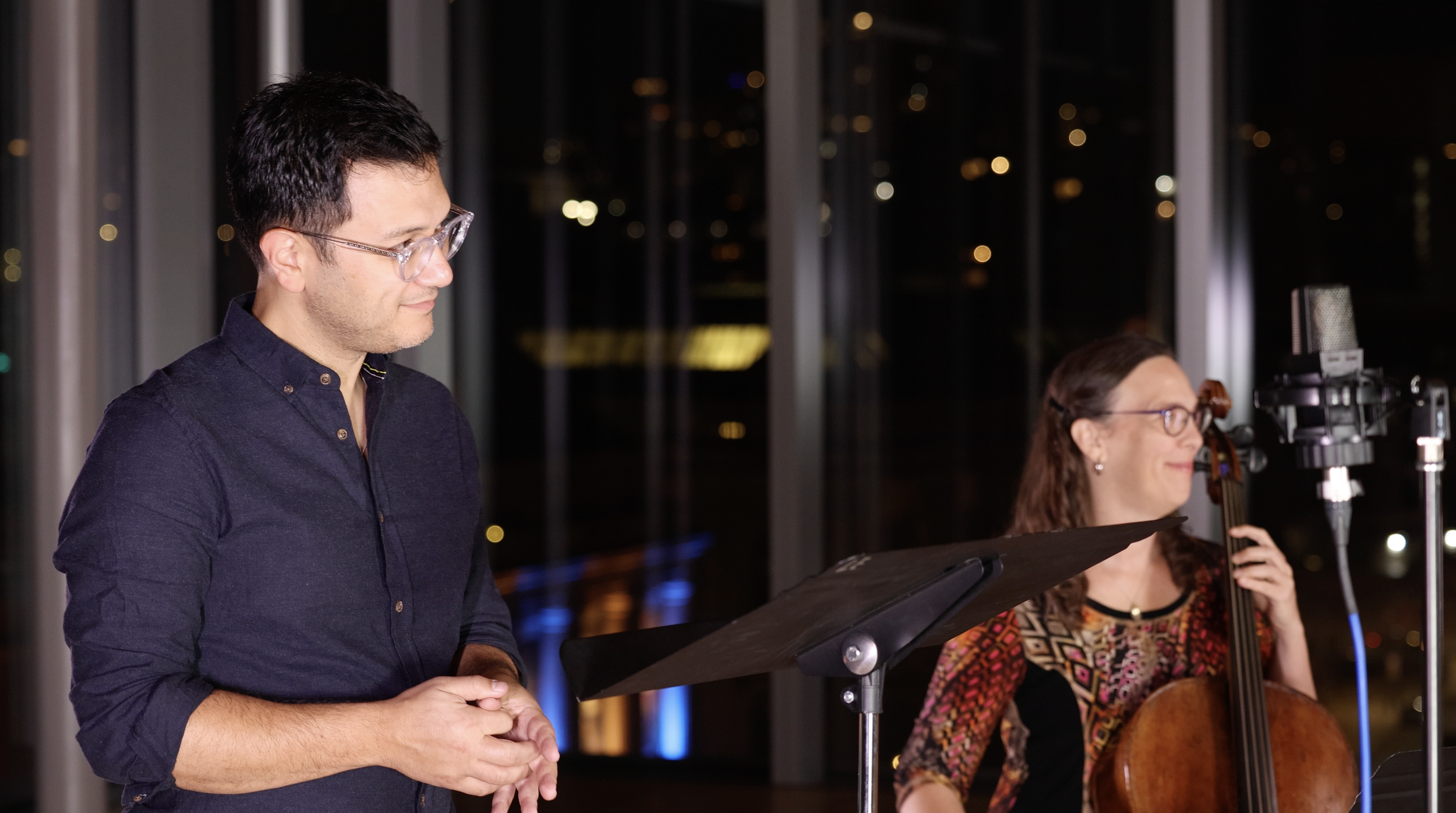
Matthew Swanson has spent the last several years working with one of the great American choral institutions: the Cincinnati May Festival, the oldest choral festival in the Western Hemisphere, founded in 1873 by a community that decided singing together was worth building an entire tradition around. After working with the May Festival in various capacities for many years, he took over as Director of Choruses in 2024, and now serves as Artistic Head of the organization, overseeing a number of choruses, for singers of all levels and ages, as well as conducting the organization’s flagship choir, the May Festival Chorus, the official chorus of the Cincinnati Symphony and Cincinnati Pops orchestras.
Nick sat down with him this past May, right in the middle of a week where they were on stage together performing Stravinsky and Orff — music that, on the surface, seems about as far from Bach as one can get, even though both composers clearly owe a great debt to Bach, like most Western classical composers.
The May Festival Chorus draws its singers from three different states and 92 different zip codes — a genuinely wide cross-section of a region that is deeply politically purple, not red or blue. Rather than treating that diversity of belief as something to work around, Matthew talked about it as part of the point: a room full of people who likely disagree with each other on a variety of political and religious touchpoints, choosing every Tuesday night to arrive at the same time, the same pitch, the same vowel, in pursuit of something beautiful that none of them could make alone.
It’s a small, weekly act of common purpose in an era where that kind of communal activity seems to be getting harder to find — and it illuminates another layer to our central question: is Bach’s music, or any music this demanding, actually for everyone?
ARIAS
Was willst du dich, mein Geist, entsetzen from BWV 26
PERFORMERS
Oboe: Debry Nagy
Cello: Elisabeth Reed
Organ: Corey Jamason
SOUND (BWV 8 only): Lolly Lewis | VIDEO (BWV 8 only): Clubsoda Productions
This project is a fiscally sponsored project of FRACTURED ATLAS.
To find our more information and to make a TAX-DEDUCTIBLE donation to support the continuation of this project please click the button below
TRANSCRIPT
[00:00:00] N PHAN: Do you think the music of Bach is for everyone?
[00:00:01] M HUANG: I think it could be for everyone. I don't think that it is for everyone in the sense, in, in the sense that they know it . You know what I mean? Like, I think that, you know, it's kind of the same question of whether music or classical music, is it for everyone?
[00:00:17] And I have friends who clearly, you know, the way that they respond to music is in a different way than how I respond. And it just takes a little bit of onboarding , you know?
[00:00:34] R WILLIAMS: I probably came across Bach first of all as a, as a student, as a pupil I said, not a student, as a pupil, as a boy playing the easiest piano music when I was learning in my grades.
[00:00:47] And then singing it as a treble in the Matthew Passion.
[00:00:52] S OKPEBHOLO: Bach taught me voice leading. He taught me counterpoint. He taught me to take a religious text and bring it to life in a very meaningful way.
[00:01:02] R WILLIAMS: When you, when I finished a Bach chorale harmonization as a, as a, you know, 16-year-old, and I think I got it, my teacher would then find all these mistakes I'd made, and then I would look at what Bach actually did and see something that was outside of the rubric.
[00:01:17] And I remember feeling both cheated because he, he had cheated, but then also awestruck because he had found a solution that was, that worked brilliantly with these extraordinary flashes of brilliance. That's, I suppose, the first time I became aware of what compositional music, musical genius actually means.
[00:01:40] S OKPEBHOLO: It's absolute genius, you know? And, and I feel like, you know, every piece he writes, it, it meant something. It wasn't an accident. He wasn't just writing notes just to write notes
[00:01:48] Hi, I'm Nick Phan, and this is Bach 52.
[00:01:53] N PHAN: Matthew Swanson has spent the last several years working with one of the great American choral institutions, the Cincinnati May Festival, the oldest choral festival in the Western Hemisphere. It was founded in 1873 by a community that decided singing together was worth building an entire tradition around.
[00:02:17] After working with the May Festival in various capacities for many years, he took over as director of choruses in 2024, and now serves as artistic head of the organization, overseeing a number of choruses for singers of all levels and ages, as well as conducting the organization's flagship choir, the May Festival Chorus, which is the official chorus of the Cincinnati Symphony and the Cincinnati Pops.
[00:02:42] I sat down with Matthew this past May, right in the middle of a week where he and I were on stage together performing music by Stravinsky and Orff, music that on the surface seems about as far from Bach as you can possibly get, even though both composers clearly owe a great debt to Bach, like most Western classical composers do.
[00:03:02] One of the things Matthew told me has stayed with me since we filmed this interview. The May Festival Chorus draws its singers from three different states and 92 different zip codes, a genuinely wide cross-section of a region that is deeply politically purple, not red or blue. Rather than treating that diversity of belief as something to work around, Matthew talked about it as part of the point, a room full of people who likely disagree with each other on a variety of political and religious touch points, choosing every Tuesday night to arrive at the same time, the same pitch, the same vowel, in pursuit of something beautiful that none of them could make alone.
[00:03:45] It's a small, weekly act of common purpose in an era where that kind of communal activity seems to be getting harder and harder to find, and it illuminates another layer of our central question: Is Bach's music, or any music this demanding, actually for everyone? My conversation with Matthew was not just timely because of our Stravinsky and Orff collaboration this past May.
[00:04:08] He and I are getting ready to work together again in March 2027, when we join the Cincinnati Symphony and their music director, Christian Macelaru, for performances of Bach's St. Matthew Passion, in which I am going to sing both roles of the evangelist and the tenor arias. That collaboration was also very much on my mind walking into this interview, so it was fascinating to discover how pivotal that piece was in Matthew's musical life as part of this discussion.
[00:04:38] Please enjoy this conversation with Matthew, and as always, stick around for the aria at the end of this episode, taken from Bach's Cantata Eight. Thank you for doing this.
[00:04:49] M SWANSON: I'm happy to do this.
[00:04:50] N PHAN: I always start out every interview kind of asking, like, just basically what is your journey with the music of Johann Sebastian Bach?
[00:04:57] How did he enter your life? Has he played a role in your life? You know, and if so, what is that role?
[00:05:03] M SWANSON: I'm happy to talk about this because it brings me great joy to think about Bach and work about Bach and listen to Bach, all those things. So I was trying to remember the, the beginning, and I remember distinctly starting the piano when I was about five years old.
[00:05:20] I think I started lessons officially when I was six. And in one of the early piano books, there was the Minuet in G from the Notebook for Anna Magdalena. And I guess I had heard it somewhere else because I remember it feeling familiar to me.
[00:05:35] MUSIC: Mm-hmm.
[00:05:35] M SWANSON: And I loved it immediately. And there was some other little Bach ditty in there as well, and I don't remember my teacher really talking to me about who Bach was or putting Bach on a pedestal or anything like that.
[00:05:48] I'm fairly confident that it was the music itself that appealed to me immediately. Its sense of charm, but also the order of it and the melodism of it. We might talk about this later, but I think Bach is underrated as a melodist.
[00:06:01] M HUANG: Hmm.
[00:06:01] M SWANSON: And I wanted to play that piece over and over and over again, even though there were other pieces in the book.
[00:06:06] I... That was my favorite. And then I remember being maybe in the fourth or fifth grade and going to a CD store, and my mom said that my brother and I could each get a CD that day. And I found a bin of half-off CDs So I negotiated a two-for-one deal, and I got a CD of 25 Handel hits and 25 Bach hits. It was just a compilation of excerpts from both of those composers.
[00:06:34] The Handel one was green, the Bach one was red, and I listened to those over and over and over again. And the delightful thing about them was they tried to sum up each of those composers' total output in 25 pieces, so it was a real smorgasbord of things. On the Bach CD was everything from the Toccata and D to several movements of the Brandenburg Concertos and certain excerpts from the B Minor Mass, pieces of cantatas, other keyboard works.
[00:07:01] And some of them I didn't quite understand. I, well, I liked some more than others, but I was amazed at how firmly those recordings implanted themselves into my brain even before I could organize them or categorize them because years later I was in college in Baroque music history class and the teacher started playing an excerpt from a Brandenburg Concerto and I thought, "I already, I already know this song."
[00:07:27] I could hum, I could hum along. And so somehow I found great appeal in the music of Bach on the purely aesthetic terms before I had an impression of him as one of the towering figures of Western classical music. And that's one of the reasons I think the music is so special to me. The first major piece of Bach that I learned was the St.
[00:07:51] Matthew Passion. I had not really performed any Bach beyond those rudimentary keyboard pieces, and I remember trying to look through the cantatas in college. I didn't know there was a catalog of them, so I went to the library and like, you know, pulled one of the collected works off the shelf and I'm looking through it and I was trying to find one to put on with my friends, but they all had these really difficult choruses at the beginning.
[00:08:16] And through, I guess, combing through them trying to find one that was easy, I learned that Bach cantatas have certain formal standards and one of them is often a really hard chorus at the beginning A- anyway, one of my teachers later helpfully said that, you know, there is a catalog of all of these that you can go and look at.
[00:08:32] But I didn't find one that we could do, and we did other music. But auditions for graduate school were coming up, and some, I think maybe two places, had excerpts of Bach on there. Komm, Jesu, komm from one institution, and a little "Schne" from the St. Matthew Passion from another. I didn't know this music at all, so I started trying to learn it, and I remember listening to the St.
[00:08:55] Matthew Passion on a long car ride and being completely confused by it because I didn't know any German and I didn't really understand the formal structure or any of that. I just put together my little scene and tried to do that. Then I came to the University of Cincinnati College Conservatory of Music to start graduate school, and we happened to be doing the St.
[00:09:15] Matthew Passion that fall- Wow ... in a staged production.
[00:09:19] R WILLIAMS: Oh, wow.
[00:09:19] M SWANSON: And on the first day of the choir rehearsals, we sang through the entirety of the St. Matthew Passion in one go. And that was my first real introduction to the music of Bach in a major practical sense. And that was very special. Uh, I remember being kind of gobsmacked by it.
[00:09:37] But the staging process required pianists, and I'm not a good pianist, but I wanted to be involved, and so my teacher and I would split it. Uh, I would play the left hand and he would play the right hand or, uh, vice versa, and play the recits as much as I could. And during the staging rehearsals then I was just trying to get as much of the score as I could under my belt and in my ear, and fell completely head over heels in love with the piece in all kinds of ways and for all different reasons.
[00:10:10] And then the works of Bach have lived, uh, with me, fortunately, I'm happy to say, in my professional life quite consistently ever since. And coming to them again, as I will do next season with the St. Matthew Passion, is... Such a gift is like seeing an old friend who comes back to town after you've been away for a long time.
[00:10:29] You start leafing through the score and remembering what's special about this moment and discovering something new about that one that you didn't previously capture, and that process is very fulfilling to me. So I find myself returning to the works of Bach, as I'm sure many people do, for the pleasure of playing it.
[00:10:46] I... The scores are always near my keyboard at home and I'm getting out a particular aria or something like that just to sing through because I like the way that it sounds.
[00:10:55] N PHAN: Amazing. Did you study singing in college or conducting or piano?
[00:10:59] M SWANSON: My undergraduate degree is in trumpet performance and American studies, and my graduate degrees are in choral conducting.
[00:11:07] So I've never studied singing in a degree program. I try to be a diligent student of singing as much as I can be, mostly by spending a lot of time around really good singers and really good teachers of singing. I don't consider myself a singer per se, but I am someone who sings.
[00:11:24] N PHAN: So when you were looking for like something for your friends to put on in college as a cantata, like was it a choral situation or were you trying to like...
[00:11:30] What was the goal there?
[00:11:31] M SWANSON: I guess I had some sense by that time that I wanted to try to become a conductor.
[00:11:37] N PHAN: Mm.
[00:11:37] M SWANSON: And I looked at how do you do that? And one way is you go to graduate school. How do you do that? You have to send them tapes of you conducting. Right, right. So I had to get some people together and figure out how to put this on.
[00:11:50] So I thought, you know, Bach cantatas are something that my teachers had talked about in music history class and that are important, so maybe I should go and do one of those. Turns out they were, uh, too complex for me at the time, too complex for my situation. But exploring them in a tactile way actually was really worthwhile.
[00:12:12] N PHAN: It's funny, he keeps these interviews people talk about. He's, like, so foundational in terms of music education. I mean, we all sort of encounter some version of the Anna Magdalena books early on. But then it's, it's funny, he always sticks with even though, like, people tend to, I don't know, especially as a trumpet player, like, it's so easy to get kind of absorbed in symphonic repertoire that is, like, Mahler, Beethoven, Brahms, Mo- Mozart maybe.
[00:12:36] But, like, Bach tends to be sort of left by the wayside unless you decide to pick up a piccolo trumpet and-
[00:12:41] M SWANSON: Yeah, and the thing about all the Bach trumpet excerpts is the ones that are fun to play are really hard. Right. So I would say, uh, my abilities as a trumpet player began to approach playing some of those excerpts, but certainly not in the manner that I wanted to.
[00:12:58] My taste exceeded my abilities i- in that regard. So the, uh, Bach trumpet parts are a tall task for anybody, but The other thing I guess I've, I'm remembering now as we talk about it, during, um, the COVID pandemic when everybody was at home- Mm ... all the time and kind of looking for ways to amuse themselves, I had a copy of the Riemann Schneider Chorales that I had played and worked through for all kinds of reasons.
[00:13:24] But I thought, "Well, I really have the time to sit down and actually build some keyboard skills and make sure that I'm really playing all four notes- Right ... at the s- at the right time and in the right place." And, uh, that was quite useful actually, I have to say. And, and my keyboard skills did improve. I went through two or three chorales a day until I finished the book, and really forced myself to develop some hand and finger independence.
[00:13:51] I'm not a great keyboardist, I'm a functional keyboardist. And that again was Bach, uh, even at this... I guess I'm years out of school now. Even after I've left school, Bach being my teacher again.
[00:14:03] N PHAN: Right. Right. It's funny, I had my choral conductor in high school said that she taught herself keyboard skills by sight-reading Bach chorales.
[00:14:11] M SWANSON: I had always, I've long ago bought a copy of The Well-Tempered Clavier in a music store, 'cause again, I guess I learned in music history class that it was a thing that musicians knew how to play. And very few of the fugues or preludes could I actually play, but I did try to challenge myself to learn more of them.
[00:14:34] And that also was a hugely broadening experience, and I'm sure there are many people who watch or listen to this that can play all 24 of them without thinking about it. But for me, you know, trying to work through, like, the C# major fugues was really a mus- a musical discipline, actually. And then trying to make music out of them as so many great keyboardists have done in, in artful and beautiful ways.
[00:14:57] I remember reading Aaron Copland, What to Listen For in Music, talking to people about how to identify and appreciate music, and encouraging people to sit down and take the subject of the fugues of all of these Bach- fugues and simply describe them with words because they all have different personalities and unique- Mm
[00:15:18] shapes and, uh, structures and colors. I wouldn't say uniquely necessarily in classical music, but, uh, often ubiquitously presents himself as a composer to you and through other composers to you.
[00:15:31] N PHAN: Yeah. Right. Everybody's... Part of the reason we're centering on his music for this project is because if you ask this question of him, you sort of more broadly ask it about classical music, right?
[00:15:42] I mean, everybody's in dialogue with him whether they wanna be or not. I mean, even Nina Simone is in dialogue with Bach. Like, he's so wide-reaching.
[00:15:48] M SWANSON: You and I are working on Stravinsky together, and most people's eyebrows go up when they realize that Stravinsky made arrangements of Bach's music.
[00:15:55] N PHAN: Yeah, but you can see it in everything he wrote.
[00:15:58] The counterpoint, point is complicated. Yes. And inspired by other complicated co- counterpoint. What... You said you were the Matthew Passion, like that first read-through in, at CCM kind of made you fall in love with the piece and had you gobsmacked. What about it?
[00:16:18] M SWANSON: Well, I think on day one, the, the size and the breadth of the piece, it was the longest piece of music I had ever encountered personally to that time.
[00:16:28] I think I had maybe seen a couple of Met operas in HD, and I'd played a Mahler symphony. Mm. But, you know, sitting down and you get the book, and we only read through the choruses and chorales, but depending on what numbering system you use, you know, how many discrete pieces of music are in the St. Matthew Passion, 68 plus or something, plus all the small recits that are 22B and all that kind of thing.
[00:16:54] N PHAN: Right, which are not small.
[00:16:55] M SWANSON: No. It's a huge amount of music, and then over the course of the, I don't know, two or three-month rehearsal process as we learned about the piece, and I put all the translations in and went to the coachings and heard the arias and went to the stagings and began to understand how multi-layered the piece is and how rich, I'll use the word complex I suppose, the piece is, and how it speaks to, uh, so many different aspects of music and religiosity and theater and drama all at once.
[00:17:32] It's extraordinary that it's came from one person. Mm. It's extraordinary that it's not, well, one person and his librettist, I suppose, from two people. But it's not the only work that he wrote of such magnitude. It's exceptionally long. It's longer than the B Minor Mass, but It's not an outlier in his output in that regard.
[00:17:53] And something about the, the profundity of it, I think speaks to me. Even the opening gesture, which Leonard Bernstein called, you know, the entrance of the children's choir in the first movement one of the great moments in Western music history. He has a way, even without being a composer of opera, of setting you up for this grand story by the magnitude of the first chorus.
[00:18:15] You have the sense that we're gonna be in here for a while because of the musical world that he's created. That really hit me, and I remember thinking also that he has invented his own sense of time, 'cause once you get into the second half of the piece, which is longer than the first half, the arias get longer, the recits, uh, some of them are quite long, and he's...
[00:18:39] doesn't seem to be in a hurry to conclude the proceedings. Some of the arias in the second part are quite lengthy.
[00:18:46] N PHAN: Hmm.
[00:18:46] M SWANSON: And eventually I stopped caring about that and became more interested in what was happening in the music on a very small scale, at a kind of micro level, and realized that he had altered my own expectations of dramatic pacing as a result of that.
[00:19:02] Some of that is tied up in the fact that it was a staged production, which allowed me to consider the work in a whole bunch of interesting and unexpected ways. But I think the, the weight and the profundity and the, the endeavor of the piece really s- spoke to me and, and felt like a significant piece of art, not just of music, but of-
[00:19:21] N PHAN: Yeah
[00:19:22] M SWANSON: of Western art.
[00:19:23] N PHAN: Had you prepared for that first rehearsal where you read through everything? Like, had you translated everything or- No. No.
[00:19:28] M SWANSON: It was, "Here's the book, and-" Let's read ... let's read." And my German skills were not strong. The people around me, many of them had undergraduate degrees in voice and, you know, great diction skills, so I was really playing catch-up.
[00:19:43] And I had to spend a lot of time in the practice room that semester learning the tenor part in Choir 1.
[00:19:49] M HUANG: Hmm.
[00:19:49] M SWANSON: Um, again, Bach was, was teaching me, and that was really quite- Exciting actually, because I felt like I was uncovering something very important. Like I was, I was getting to know something that was of great consequence.
[00:20:03] N PHAN: I'm struck that it had such a profound impact on you with all that German, like not really speaking the language and, I mean...
[00:20:10] M SWANSON: I've always liked chorale type music.
[00:20:13] N PHAN: Mm.
[00:20:13] M SWANSON: Church hymns and there was something about the order of that that really spoke to me. I've always liked the capo arias because the form is quite structured and- Right
[00:20:22] it's symmetrical, which I enjoy. So the formality of Baroque music has always been attractive to me since I discovered it, and this is a piece that's full of those forms in one way or another. I ha- can't say I had done anything that had the variety or the complexity of the recitative. That doesn't mean that it doesn't exist, it was just my first experience with that kind of thing.
[00:20:46] N PHAN: Right.
[00:20:46] M SWANSON: Particularly the alternation between the accompanied and unaccompanied recitatives and the meaning that, uh, is buried within those. But that part of it always struck me, even if it took me a while to figure out, get all the translations in and put the German in and understand where that was going and, you know, read the books that describe the theological backgrounds and all that kind of a thing.
[00:21:09] I think the orderliness of the music was apparent from the beginning, and I do find it fascinating to compare St. Matthew and St. John for that reason. Mm. St. John feels slightly less ordered to me. It is. Slightly less perfectly or elegantly designed. It's not quite as symmetrical. Some of the action moves ahead or doesn't move ahead at unexpected paces and places.
[00:21:33] Some of the arias feel too close together and all these sorts of things. So St. Matthew feels somehow a little more worked out- Right ... and more considered in a way, which is a horrible, uh... It's a horrible thing to say. Bach obviously revised both of them multiple times, and St. John in particular several times.
[00:21:49] So to say that he didn't consider it is unfair, but St. Matthew seems to be an order above in terms of its organization.
[00:21:55] N PHAN: Right. Well, I think he ju- wrote John first, right? Yeah. So it's, it's like, it's the first or it's the earlier attempt. Also the source material, like- The John Passion, he has to actually, he ends up fleshing out what's in the gospel-
[00:22:06] M SWANSON: Yes
[00:22:07] N PHAN: with some of the Matthew. The Matthew is just like a very complete story, so I think that helps too. But yeah, you're right, it's much more developed, so to speak.
[00:22:15] M SWANSON: I do find it shocking to imagine for the listeners at those performances in 1727 and 1729, if I remember correctly, that there was more music and more church after the piece.
[00:22:28] I, uh, could be wrong in remembering this, but I think I remember seeing it. There was at least a motet by Hassler following it- Wow ... uh, and some other things, which surely must have sounded paltry in comparison. Maybe that was the goal, I don't know. But considering or trying to consider at least what the experience would have been of his congregation, of his audience, his listeners, to sit down and hear that amongst other things.
[00:22:55] N PHAN: Right.
[00:22:55] M SWANSON: And I assume they were considering as a piece, a single piece in liturgical music, two and a half hours, amazing.
[00:23:03] N PHAN: Yeah. Well, at least. Were you raised in a religion?
[00:23:07] M SWANSON: I was raised in the Methodist Church.
[00:23:09] N PHAN: Hmm. Does that feel... I don't know much about Methodists. Tell me about that. Is it Is it a leap to kind of get into the theology of this Lutheran take on these stories?
[00:23:20] M SWANSON: I would say yes and no. I think Methodism is a, was originally created as a branch of Anglicanism.
[00:23:27] N PHAN: Mm-hmm.
[00:23:27] M SWANSON: So there are certain similarities there. I think in the United States, Methodism is often lumped with, uh, Lutheranism or the ELCA in America- Mm-hmm ... because they're sort of nearby mainline Protestant denominations.
[00:23:43] I think what's more or what's further afield probably from the religion that I was used to is the corporeal nature of Bach's Lutheranism, the amount of time that he spends talking about bodies.
[00:24:00] N PHAN: Hmm.
[00:24:00] M SWANSON: The, the body of Christ or what's happening to Christ's body, and then reflecting on that in very bodily terms in the arias.
[00:24:08] N PHAN: Mm-hmm.
[00:24:08] M SWANSON: I think about Ich will dir mein Zanker. Can't remember... The soprano aria. By Herr
[00:24:14] N PHAN: von Schinkel,
[00:24:14] M SWANSON: yeah. Yeah. Like, "Sink yourself into my heart," and those kinds of things. Or how many, you know, instances of, they talk about the blood and the head, and that beautiful moment at the end of St. John when he's, uh, in that bass aria, he's talking about, you know, the head of Christ falling, but in doing so saying yes, which is a magical rhetorical device.
[00:24:33] It's very corporeal. Mm-hmm. And I understand that's a particular feature of the pietistic Lutheranism that Bach was raised in. That was not something that was part of my religious tradition, so I found that kind of interesting. And fascinatingly, the production that, that we created at CCM in the fall of 2011 drew on that or attached to that quite powerfully, so perhaps my attention was drawn to it as a result.
[00:25:01] But I found that quite interesting, and a lot of these passions are something to do with bodies.
[00:25:10] N PHAN: Interesting. I kind of want to talk about your role here-
[00:25:13] M SWANSON: Oh ...
[00:25:14] N PHAN: in Ci- I mean, you've obviously been in this community for a very long time. You studied here, and then-
[00:25:18] M SWANSON: I did, yeah
[00:25:18] N PHAN: Have you been elsewhere since?
[00:25:19] You've kind of ensconced yourself.
[00:25:21] M SWANSON: I spent one year shortly after moving to Cincinnati. I was here for two years in a graduate program at CCM, and then I spent a year living in England studying at the University of Cambridge. Mm-hmm. And I moved back to Cincinnati, and I've been here ever since. So most of the last 15 years I've been here.
[00:25:35] N PHAN: Wow. And you are the director of choruses here at the May Festival- I am ... which is an august 153-year-old institution? We
[00:25:43] M SWANSON: were-
[00:25:44] N PHAN: Something like
[00:25:44] M SWANSON: that ... yes, the May Festival was founded in 1873, and this, the 2026 May Festival, our 153rd anniversary.
[00:25:51] N PHAN: Wow, congratulations.
[00:25:52] M SWANSON: Thank you.
[00:25:53] N PHAN: You know, some... How do you see this-- I mean, it's an institution that's been in this community for, obviously, a century and a half.
[00:25:58] Like, what's its role here, and, like, how do you... How does it serve the community? And...
[00:26:03] M SWANSON: The May Festival owes its roots or its heritage to a few different threads that were gathered together. Cincinnati had a heavily German population in the 19th century and was the site of many large Sängerfests, both kind of statewide, regional, and in some cases national, the gathering of thousands of people, mostly of German origin, to come together and sing.
[00:26:30] And the May Festival also is indebted to European choral festivals that arose in the 19th century, like the Three Choirs Festival in England, in the west of England, or the Birmingham Festival where Mendelssohn's Elijah was premiered, and other such festivals. And particularly interested patron of the arts, Maria Longworth from Cincinnati, wanted to establish one of those here.
[00:26:56] And it was on a tour of the Theodore Thomas Orchestra, then the most famous classical music traveling band in the country, during a visit to Cincinnati that she said to Theodore Thomas, "I want you to found a great music festival here in Cincinnati because this community should experience the finest classical music that can be on offer."
[00:27:18] And he was convinced to do that. He said, "I will do it only if sufficient funds can be raised, and if a chorus of strong quality can be assembled from the community to bring these pieces to the public." And in fact, at the first May Festival in 1873, chorus numbering probably 700 people, if the newspaper reports are to be believed, from 19 different communities and as far away as six states came together to perform great works, mostly of the German European tradition, almost exclusively, uh, in the beginning with the Theodore Thomas Orchestra and prominent soloists that he had brought over from Europe to tour through the United States with him.
[00:27:59] And within a few years, it had become a permanent institution in Cincinnati, and it has always been, I think, meant to be a gift to the community and always been intended to celebrate the gifts of the community, because the chorus itself is drawn from community members. So those are things we still attach ourselves to today.
[00:28:21] There's been a particular interest in teaching young people to sing. The first May Festival also included a chorus of 600 children from public schools-
[00:28:29] N PHAN: Wow ...
[00:28:29] M SWANSON: which is quite a feat to imagine in 1873. And in a variety of ways and in new ways, we are doing those things today. So one of the things that we see ourselves as doing is presenting high quality music to the public and celebrating the spirit of volunteerism among our chorus members.
[00:28:47] We think it's important to present new and important works to the public that they might not otherwise have the chance to experience, or that might not have yet been heard in Cincinnati if they've been heard other places. And because we've been around for a long time- We think it's important to promote the health and wellbeing of the entire singing community in Cincinnati, which is robust.
[00:29:11] We have many different choirs of many different kinds serving different age groups, uh, international, uh, traditions, styles, ways of singing, different kinds of schedules to accommodate other needs, church choirs, choirs in temples and other religious institutions, choirs in schools, community choruses, all kinds of things.
[00:29:30] And the May Festival is very interested in promoting the health of our choral ecosystem so that we can be sure that this art form, this wonderfully accessible art form, is accessible to everyone. And a particular interest of ours is in making sure that young people in schools in our community have the opportunity to experience high-level singing, high-level choral training all the way through their journey so that when they leave school, whenever that might be, they're prepared to take their singing skills with them wherever they go.
[00:30:01] N PHAN: It's amazing. I mean, part of the reason I wanted to talk to you is because these parts of your mission in terms of, like, the community impact and the wide spectrum of levels you're working with in terms of the people who are involved as singers from, you know, young ages through older ages is very much like the community that Bach was writing for himself.
[00:30:24] Mm. You know? I mean, he was writing for obviously amazing boys who could sight-read that stuff on a Sunday, but-
[00:30:29] M SWANSON: Yes ...
[00:30:30] N PHAN: everything from children all the way up through, you know, adult singers, and it was all... I mean, he was working for the city. He was a city employee. So there's something about what you all are doing here.
[00:30:42] You know, it's not just about being a great choir, it's about preserving this art form and also, like, building community around it and through it- Right ... that I find really interesting.
[00:30:50] M SWANSON: Yeah. People... I spend a lot of my time around singers, and singers love to, to gather. They love to be together, and they love to sing with other people.
[00:30:59] Certainly, the members of the May Festival Chorus are in this because this particular opportunity appeals to them, the opportunity to sing extraordinary works of art and to appear on stage at Music Hall, this wonderful building that was built for the May Festival, to collaborate with an orchestra of extraordinary caliber, the Cincinnati Symphony Orchestra, and soloists and conductors from across the country and around the world, uh, who, uh, among us, I, I certainly wouldn't turn that opportunity down.
[00:31:29] I didn't when I had the opportunity to join the chorus, which I very happily sang with for many years. I think that is compelling to them. That doesn't mean that it's the only way to sing, but it is a way of singing, and the idea that someone could join our youth chorus as maybe a 14-year-old, and they too can be involved in that, singing the St.
[00:31:50] Matthew Passion at Music Hall, or Mahler Eight, or name another major work of choral repertoire that we're routinely engaged in. As a young person, I'm so envious of them. Mm. I didn't get to encounter those pieces until slightly later in my life, and the idea that we could put that in someone's pocket. I remember when we did the St.
[00:32:11] Matthew Passion in 2019, some of the students in the youth chorus were in the eighth grade. I thought, "Oh, how lucky are you?"
[00:32:19] N PHAN: Wow.
[00:32:19] M SWANSON: You- you've been given this extraordinary a- artistic object that you can take with you for the rest of your life to begin to be curious about and enjoy. And hopefully, at some point, maybe they'll come back and sing in our chorus or sing in any other chorus wherever they go, and they'll see, "Wow, they're doing the St.
[00:32:37] Matthew Passion. I wanna sing in that. I know how that one goes." Or maybe they'll say, "I just wanna be on stage with those people because I've had that opportunity before." But I guess I hadn't considered that Bach was, Bach was rather like that as well, and that's a fascinating thing to think about. I, I like the idea that he was responsible for training his own people.
[00:32:56] It's easy to say, "Oh, maybe he hired people or he wanted better people." We know the let- from the letters that he was petitioning the town council for more money, presumably to hire more and better musicians. But I think he also knew that his fortunes were somewhat in his own hands, in the sense that if he could get the boys to sing at the level that he desired, then he would have the choir that he would have wanted.
[00:33:21] N PHAN: Right.
[00:33:21] M SWANSON: And there is something about in- investing in the community that you're in and trying to f- growing your own- future audience members and ensemble members that feels important to me in this role.
[00:33:34] N PHAN: So does Bach show up regularly in the May Festival programming?
[00:33:37] M SWANSON: I'm so glad you asked. Short answer, yes.
[00:33:41] N PHAN: Mm.
[00:33:41] M SWANSON: The May Festival actually gave the US premiere of the Bach Magnificat- ... in 1875.
[00:33:46] N PHAN: What?
[00:33:46] M SWANSON: Yes. With a chorus presumably of hundreds of people.
[00:33:50] N PHAN: I'm sure.
[00:33:51] M SWANSON: So it's fun from, um, a reception history standpoint to think about, uh, what aesthetically that performance must have been like.
[00:33:58] N PHAN: Right.
[00:33:59] M SWANSON: And I believe our first performance of the St.
[00:34:01] Matthew Passion was in 1880. I should fact check that date. It was with a, a cast of significance. A woman who had created roles for Wagner- Mm ... at the Bayreuth Festival was here, and the paper published dissenting opinions on the success of her Aus Liebe.
[00:34:20] N PHAN: Oh.
[00:34:21] M SWANSON: Well,
[00:34:21] N PHAN: imagine.
[00:34:22] M SWANSON: But it has been a consistent presence ever since an early performance of the complete Christmas Oratorio in the 1890s, and the B Minor Mass has shown up, uh, from time to time.
[00:34:34] So yes, the music of Bach has been there. Cantatas, of course, have also appeared. I think given the German origins of the festival and the classical music origins of the festival, that's no surprise.
[00:34:45] N PHAN: Right. And I imagine it shows up also in, like, the youth chorus stuff occasionally too.
[00:34:48] M SWANSON: It does. The youth chorus, you know, will sing the children's choir part in the St.
[00:34:54] Matthew Passion coming up next season. We sang a cantata or excerpts of a cantata of Bach, Cantata 191, on this year's May Festival, and it will continue to place itself in our repertoire and our lives, and that of the Cincinnati Symphony Orchestra with whom we collaborate throughout the season.
[00:35:10] N PHAN: Right.
[00:35:12] I'm excited about Matthew Passion.
[00:35:14] M SWANSON: Ah, me too.
[00:35:14] N PHAN: We're gonna have a good time.
[00:35:15] M SWANSON: Can't wait.
[00:35:16] N PHAN: So this series is centered around... I mean, here you are making music for everybody, I mean, at least you're trying to, in the city, or anybody who wants to sing, I should say. Mm. Which I think is always a funny thing because, you know, people will say like, "Oh, I can't sing."
[00:35:27] And I'm always like, "Everybody sounds good in the shower. What are you talking about? Everybody can sing."
[00:35:30] M SWANSON: I work very hard to try to change people's mind about that, and I find, uh, that, uh, athletics plays a big role in our culture, sports.
[00:35:42] MUSIC: Right.
[00:35:42] M SWANSON: People are exposed to sports in the media and in school and clubs all the time.
[00:35:48] MUSIC: Mm-hmm.
[00:35:48] M SWANSON: And of course, I played sports in s- in school, and my mom was a PE teacher and, and I learned a lot playing sports, and I still engage in sports. But of course, I wish people had the access to the arts that we often give to sports, or the attention to the arts that we often give to sports. So I feel guilty about making analogies to the arts that deal with athletics, but sometimes it's useful, and I remind people that singing is a physical act.
[00:36:19] Just like shooting free throws or swinging a golf club.
[00:36:21] S OKPEBHOLO: Mm-hmm.
[00:36:21] M SWANSON: And there would be people, you could take them to the driving range and put a golf club in their hand, and the first time they've ever done it, and they will have some natural affinity for this slightly unnatural skill that requires very specific aspects of muscular control and timing and coordination and a whole bunch of other things.
[00:36:40] And there'll be other people who, with a little bit of training, can get really good at it. And there's other people, even with a lot of training, don't get a lot better, but they enjoy it. And there's other people who might struggle all the time. But I feel like everyone with some training can improve at swinging a golf club, and I think everyone with training can improve at singing.
[00:37:00] We'll all have a different starting place perhaps Mm ... but everyone with good training can improve. And I think more people should sing and be less bashful and, and less fearful of singing or their perceived lack of ability because as far as I'm aware, recorded civilization has never known a society without song.
[00:37:21] It is a fundamental human expression. I believe it was the composer Harry Partch who said that singing was not natural because it took effort. Okay. I'd love to continue that conversation with him. But beyond that, I do find it quite a natural human expression actually. And I tell people, "When you are talking and laughing with your friends, you're exploring your head voice."
[00:37:45] Mm. "And when you are doing impressions of someone's you saw in the movies or a voice that you heard on the radio, or you're telling a joke or a particularly animated story, you are using the exact same physical and emotional tools that singers use." It's so near to singing in that way, and I really try to encourage everybody to take a small leap, but a, a very large leap for some, yeah, into singing, even if it just means singing in the car or singing with your kids.
[00:38:14] Because first of all, it's good for children to sing and good for children to hear singing. It's good for people to express themselves. It's good for people to enjoy it. Singing feels good. It's, it's good to do. So I try to jump on the idea of I don't sing because I don't sound good im- immediately
[00:38:33] N PHAN: I just read the other day this study that said choral singers, their immune system, like, is stronger after singing.
[00:38:40] M SWANSON: You know?
[00:38:40] N PHAN: They, they, they ran a test on them singing some Be- like Beethoven Nine or something. Yeah. And, you know, they tested their saliva, and it was like so many... Like 50% higher, you know?
[00:38:48] M SWANSON: Chorus America has amazing research, uh, about the benefits of choral singing, specifically the benefits of choral singing-
[00:38:55] N PHAN: Mm-hmm
[00:38:55] M SWANSON: as distinct from the benefits of singing as a soloist as well. Not that there aren't benefits to that, but the idea, the civic singing of people who sing in choirs tend to vote at higher rates, for example- Hmm ... than people who do not sing in choirs. And, and singing in choirs, I should note, is an exceptionally popular thing.
[00:39:14] Like, something like one in five to one in six Americans, more than 50 million Americans sing in a choir on a regular basis. It's an extraordinary number. Wow. The openness of that and the, the, the idea that you might be able to go and find a group of people that you wouldn't meet otherwise-
[00:39:31] N PHAN: Mm ...
[00:39:31] M SWANSON: but who gather on a routine basis for something that they're choosing to do, and something that can only be done together.
[00:39:39] Composer David Lang was at the May Festival two seasons ago and remarked on the fact that choirs are, are wonderful because they are, they're a gathering of people specifically with the intent of creating something beautiful.
[00:39:52] N PHAN: Hmm.
[00:39:52] M SWANSON: And every Tuesday night I'm privileged to see the May Festival Chorus, this group of people who've, yes, been selected through competitive audition, but who otherwise would not know each other.
[00:40:01] They come from three states and 92 ZIP codes. And we have people who were, you know, in their first or second year of college, all the way up to people who've been singing in the May Festival Chorus for more than 50 years-
[00:40:13] M HUANG: Wow ...
[00:40:14] M SWANSON: sitting side by side and engaging in this beautiful art form that can only be done with people.
[00:40:20] We sang the Vaughan Williams "Sea Symphony" last, uh, Saturday. That's not a piece that you can do with four soloists. It's not a piece that you can do with a chamber choir. It requires a large mass of humanity, and I think it is for that reason that many of these composers use choral orchestral works as a vehicle for major statements about the nature of humanity.
[00:40:45] Mahler Two, Mahler Eight, the "Sea Symphony," um, the St. Matthew Passion, even though we could get into a spirited argument about how many people are required for that Uh, any number of other major choral orchestras, Beethoven Nine, go on. Uh, all of these works that put down some foundational truth on the part of the composer about humanity and about the condition of human life seem to, particularly in the 20th century, require a large mass of humanity, uh, singing, playing, et cetera.
[00:41:17] And I think there's something about that composers are aware of in terms of the, the artistic tool. And I would like to think that as they're doing that, there might be some conscious or subconscious awareness that the gathering of people to prepare that was in itself part of the art and part of the, the work, literally the work of that art.
[00:41:39] N PHAN: It's amazing to me when you point out that the May Festival Chorus is comprised of people from three different states and- Which- ... 92 different zip codes. And then I think about this particular region of the country in the times in which we live. I mean, we live in some truly, um, bifurcated... What is the word I'm looking for?
[00:41:56] Divided times. And you're gathering people in a place that... I mean, I think people tend to wanna, you know, it's red or it's blue, and, like, no place is that. Most places are purple, and this place is particularly purple, this region of the country where all these people are coming from. I mean, how does that, how does that play out in your...
[00:42:13] Does it play out in your rehearsal room?
[00:42:16] M SWANSON: In my mind, I remind myself that this part of the country has always been politically diverse.
[00:42:24] N PHAN: Mm-hmm.
[00:42:24] M SWANSON: And that every May Festival will have gathered together singers and audience members Of diverse beliefs. And shouldn't we want more places in public life that gather together people of diverse belief?
[00:42:40] And I'm certain that on Tuesday nights when we gather in this precious space, that we have, have brought into the room people who disagree with one another politically. But that's not why they have been brought there. That's not why they brought themselves there. They've chosen to be here, which is one of the things that makes the chorus special, makes many choruses special and important.
[00:43:03] They've chosen to be there, again, with the goal of bringing beauty into the world that is dependent upon the person next to them-
[00:43:10] R WILLIAMS: Mm-hmm ...
[00:43:10] M SWANSON: in some sense. Dependent on the people surrounding them. And it is a good reminder that it is hard to organize people. It's hard to organize people to arrive. It's hard to organize people to arrive, uh, to come to participate in any civic project.
[00:43:27] And this, in some ways, is a civic project. Even harder to organize them to begin the note and end the note precisely the same time. And, and be precisely on the same pitch with the same vowel and the same color and the same intention about what is trying to be accomplished. And isn't that the work, uh, of living in a society?
[00:43:45] N PHAN: Yeah.
[00:43:46] M SWANSON: Isn't this a metaphor? Isn't this the group project that people often laugh about having to work so hard on a group project in college? Life is a group project.
[00:43:56] M HUANG: Right.
[00:43:56] M SWANSON: And choral singing is a group project. And I've learned a lot about myself singing in choirs.
[00:44:03] M HUANG: Hmm.
[00:44:03] M SWANSON: So yes, are we full of- People of different political beliefs, absolutely.
[00:44:09] I, in some way, I hope that we are because the bringing together of people for the common good, for a good, is getting rarer it would seem.
[00:44:20] N PHAN: Hmm.
[00:44:20] M SWANSON: Or at least the, the media and the internet tell me that it is getting rarer.
[00:44:25] N PHAN: Right.
[00:44:25] M SWANSON: But then every Tuesday night I come and in my own way, in my own life, disprove that a little bit.
[00:44:32] And then I get to sit in the auditorium and hear this group of people from three states and 92 zip codes sing music of extraordinary unity and in a unified way. Sing the immortal words of Walt Whitman, for example, when he talks about one flag, uh, above all the rest in the Sea Symphony, and the uniting factors of humanity, uh, across all distances of time and space, however wide.
[00:45:03] That's very moving to me, and I hope it's moving to others and to the members themselves who give so much of their time, the most expensive thing they have, their time, so much of their time and energy to bring this to life.
[00:45:15] N PHAN: So this leads me to this question, which is this, this series is centered around, which is, do you think the music of Bach is for everyone?
[00:45:23] Which people take this all sorts of different directions, and I'm curious to see where you're gonna take it.
[00:45:27] M SWANSON: I've been thinking about that question a lot in the past few days. The, the pedant in me, the grammar pedant wants to- ... to consider the word for.
[00:45:35] N PHAN: Right.
[00:45:36] M SWANSON: What does, what does for mean? And replace it with other prepositions for the sake of argument.
[00:45:43] I don't know that that's entirely productive, and it might just be a rhetorical game that I was playing with myself. Oh,
[00:45:49] N PHAN: no. Th- there's a reason the question is phrased the way it is. It is to provoke that.
[00:45:54] M SWANSON: But I think-
[00:45:55] N PHAN: Otherwise, what are we gonna talk about?
[00:45:56] M SWANSON: Right. Uh, I think the way I'd like to choose to answer it is I'm not in a position to speak for everyone, so I can only say that the music of Bach is for me, and it's for me in a surprising way.
[00:46:09] I, I grew up on a farm in southeast Iowa And I would say my parents and some of my family members had an interest in music, but they were not musicians per se. I didn't grow up with professional musicians in my family, and I didn't grow up in, uh, in a community where a professional musician was a, a thing, you know.
[00:46:29] The people who were playing the piano at church were a school music teacher or someone who had piano skills but was not a, was not a professional musician in that capacity. So I did not grow up surrounded by the business, as it were, or surrounded by models. I didn't have someone exposing me to classical music in that way.
[00:46:52] But as I mentioned earlier in the conversation, it was the music of Bach itself that appealed to me immediately. Mm-hmm. And that leads me to think that there are probably people out there in the world who simply haven't had the opportunity to be exposed to this music that could play an important part in their life in some way.
[00:47:19] And on one hand, I can rejoice that we live in a time when the music of Bach is more accessible than ever. There are more recordings at this very moment in human history of Bach than have ever existed. There are more online resources like what we are filming right now to talk about the music of Bach.
[00:47:36] The Bach Cantatas website can give you exhaustive, uh, information that even a couple of generations ago required delving through multiple sources to try to put together. You can find quality editions online for free now, whether or not th- they're legal. Uh, and there are people performing Bach all over the place.
[00:47:57] Right. Um, there's probably in the world right now someone rehearsing a piece of Bach at this very moment, I would venture to say, and you might be able to say that that would be true for just about every day in a calendar year because of the ubiquity of his presence in the training of classical musicians.
[00:48:13] So yes, I can be happy that it's there, but also how do you find your way to that unless someone might be guiding you? And maybe you will. Maybe you will, but odds are gonna go up if someone is there to say to a young person, "I'd like you to listen to this piece of music and tell me what you think of it."
[00:48:30] So is the music of Bach for everyone? I don't know, but I'd like-- I would like to live in a world where everyone has a chance to decide for themselves, where everyone is offered the music of Bach, a musical offering, if you will.
[00:48:42] N PHAN: Mm-hmm.
[00:48:42] M SWANSON: Offered the music of Bach, uh, and given a chance to consider it. I also think given the, the breadth of Bach's music and the extraordinary variety contained within it, that- At least in my life, there are all of these moments that seem perfectly suited to certain moments of Bach, where the music itself seems to be just the right soundtrack for that thing.
[00:49:11] And I think about, you know, getting asked to play music at my grandmother's funeral. But I knew there were things that she and I had talked about that she might like, but then there was space for, you know, special music. What was that gonna be? And I'm not a great keyboardist, but I'm okay, and I thought, "I'm gonna play the beginning of Cantata 106."
[00:49:32] N PHAN: Mm.
[00:49:32] M SWANSON: Because that felt to me like the right music for that moment. Or when I was in my friend's wedding, and The, the music, uh, to, to bring the bride down the aisle was the aria from the Goldberg Variations
[00:49:46] N PHAN: Hmm
[00:49:46] M SWANSON: And it just felt like exactly the right thing at exactly the right time. And it's, it's pleasant to have, I think, a musical companion in your life in that way.
[00:49:58] And I don't know all of Bach's music. I haven't listened to every single piece, so I look forward to spending time in the years ahead discovering the rest of Bach that I don't already know and going back to the Bach that I do.
[00:50:12] N PHAN: Yeah. It's interesting. He's... I mean, I think that's... It speaks to, you know, his genius and all of those things, but also it speaks to, again, this idea that he was writing music as a church musician.
[00:50:22] When you're in a church, you are... You're there for people's births, you're there for their wedding, you're there for their, you know, adolescence, you're there for their funeral. It's... You're there for every chapter of life, and so it makes sense that his music can function as a soundtrack to every moment.
[00:50:39] M SWANSON: I sometimes find it hard to believe that he was a person, that he was a real person because the amount of genius that flowed and the level of the genius that flowed seems somehow superhuman-
[00:50:54] N PHAN: Hmm
[00:50:54] M SWANSON: beyond human. But then the music is somehow also of great humanity and in some cases great intimacy, and so deeply felt. And we know from the, from the writings, limited as they are, how deeply he cared about the music, that, uh, I just find it hard to imagine that he was a, he was a real human being. Yeah.
[00:51:19] It's extraordinary to think that all of that came from this one person. And I had a professor in college who was a great scholar and a great aficionado of Schubert, Susan Youens, and I remember she spoke beautifully and very movingly about Schubert in our music history classes. And she said one day, "You know, th- when I'm having a bad day and the world seems to be going wrong, I remember that this was a world in which Schubert once lived, and that makes me happier."
[00:51:53] Hmm. Uh, and I never forgot that, and I thought, "This is a world in which Bach once lived." A very different world, of course, yes, but a world in which Bach once lived. And That somehow is extraordinary to me, producing this amazing, incredible art that still continues to move us and inspire us today, at... Or at least me,
[00:52:11] N PHAN: I
[00:52:11] M SWANSON: will say, today.
[00:52:14] N PHAN: Something else I really like about your answer, or am compelled by by your answer is you're talking about people having the opportunity to be invited to his music and to have their own experience with it. I think it's one of the things that I find fascinating about him is that because of this sort of superhuman quality that so many of us feel that he has, we tend to put him on this pedestal, and then it's like he serves to us like he's fiber.
[00:52:40] You know? It's like, "This is good for you, and so therefore you should like it, and you should. You have to somehow," or, like, you're shamed if you don't. And I don't know, I li- like that you're inviting people in to discover it and kind of come to their own conclusions.
[00:52:53] M SWANSON: I remember being in maybe middle school or high school and going to piano contests where you learn a solo and play it- Right
[00:53:01] for the judge. And one of the common pieces for students at a certain level was the F Major Invention Number Eight, which I was never good enough to play, but I remember being in the hallway and hearing someone else play it, and thinking like, "Oh, that's, like, a technical exercise. That's really hard." It's like you're hand in exercise to do something- Mm
[00:53:24] but even more difficult- Right ... and it's a piece. So imagine my surprise when there I am at, at CCM and I go to an aria coaching for the baritone to come and work on "Mache Dich."
[00:53:36] And I thought, "Oh, this is a different, this is a different kind of music." I mentioned earlier, I think he's kind of underrated as a melodist, and I think Machady is a great example of that. I mean, it's so beautifully simple and tuneful and exquisite and Has this quality of, uh, of longing. I sort of never want it to end, is it keeps going around these kind of s- small melodic sequences of extraordinary eloquence and elegance and eloquence.
[00:54:06] And I thought, wow, this person, who- the person who wrote this had so many tools at his disposal to challenge people in F minor inventions, but also to move their spirits and express deep emotions of all kinds of stripes and colors. Extreme joy. Extreme is a good word for it. Or the kind of, like, amazing, uplifting...
[00:54:34] Uh, I, I'm not even sure. The way my breath stacks when I hear the end of the, um, Et Expecto in the B minor Mass.
[00:54:41] M HUANG: Mm.
[00:54:41] M SWANSON: Maybe my breath is stacking because I can't quite sing the coloratura. But the, the, just, like, extraordinary... The, the craft of that and, and his ability to use musical tools to explore human emotions in a way that very few people, other people, uh, artists of any discipline have been able to accomplish is extraordinary.
[00:55:00] So yes, I hope people do get invited to that. I, I would love to think that, yeah, maybe there is a piece out there of... There's... May- Is there one piece of Bach that, uh, is, is perfect for everybody or would be the perfect entry point for everybody? Boy, I hope so. That would, that would be nice. Maybe it's- And I'd- Yeah
[00:55:16] I'd love to help them find it.
[00:55:17] N PHAN: Maybe it's the Matthew Passion.
[00:55:19] M SWANSON: Maybe it's the Matthew Passion. Maybe it's The Notebook for Anna Magdalena. I... It could be.
[00:55:24] N PHAN: Sounds like it was both of those for
[00:55:27] M SWANSON: you. Yes, and, and the, the searching goes on. Like, I, I need to spend more time with the keyboard works and more time with the instrumental works and more time with the trio sonatas and the organ.
[00:55:34] Yeah. I mean, those are unbelievable works of music, uh, in their own right, and if he had only written those, he would be an extraordinary composer. I, I don't know the cantatas as, as well as I did, and there's a lifetime of searching just in that repertoire alone. I do love, I have to say, the fact that he wasn't always the choice candidate, you know, that he lost jobs.
[00:55:57] Right. He was campaigning for jobs that he didn't quite get or employment opportunities that he didn't want. I remember learning that, you know, Telemann wrote 1,500 cantatas, and vastly more productive and more reliable than Bach. So it's not always the most productive
[00:56:13] N PHAN: Yeah ...
[00:56:13] M SWANSON: person. Um, or you, you sh- you can be happy with your own level of productivity, I guess, as an artist.
[00:56:18] N PHAN: Sure. '
[00:56:18] M SWANSON: Cause you might be trying to say different things or have other things to say, but...
[00:56:22] N PHAN: What do they say? Quantity does not equal quality.
[00:56:24] M SWANSON: There you go. And he also... I wonder, I would love to ask him what he thought his place in music would be after he was gone. This local or regional church musician and organ consultant.
[00:56:39] Something about the, the assembling and the, and the finishing of the B Minor Mass in the last decade of his life, even though he never heard it, and probably by that time knew that he wasn't going to hear it, feels like he might have had this idea that he wanted to leave something for later. And that's interesting, too.
[00:56:58] His music was, by some counts, outmoded by the end of his life or no longer in fashion. And, uh, thanks to Mendelssohn, we reversed that trend.
[00:57:09] N PHAN: Yeah. Thank you, Felix.
[00:57:10] M SWANSON: Yes, but that too is fun to think about. His, his humanity or his, his personhood as, as a human being and how that is present in his music. The music s- is so aspirational for me.
[00:57:23] M HUANG: Mm.
[00:57:23] M SWANSON: The, the music of Bach is so aspirational because as a... I was never skilled enough as a performer to do any one of its things in the way that it fully demanded. I was never skilled enough as a keyboardist to play the keyboard works in the way that I would want. My, my taste has always outstripped my abilities.
[00:57:42] Was never skilled enough as a singer to sing the Benedictus of the B Minor Mass in the way that I wanted, or to evangelize or sing, uh, Erwäge in the way that I wanted. And I think there's something about that that's actually quite good in a way, that the music continues to demand more of me.
[00:58:03] N PHAN: I don't think you're alone in those feelings.
[00:58:05] M SWANSON: I don't think I am.
[00:58:06] N PHAN: Like, most of us feel that way.
[00:58:08] M SWANSON: Yes. Well, I saw in your conversation with, uh, Ruben, he, we were talking about that, how demanding the music- Yeah ... and I think he even used the word defeating.
[00:58:15] N PHAN: Yeah. Yes, he did.
[00:58:15] M SWANSON: The music can be.
[00:58:16] N PHAN: That was his word.
[00:58:17] M SWANSON: And- I have
[00:58:18] N PHAN: other words.
[00:58:19] M SWANSON: So I guess I'm not, I'm not alone in that.
[00:58:21] The music is so demanding, and that is inspiring to me, and I just hope that I will have enough time and opportunity on this earth to get to work on it a lot, to try to get closer.
[00:58:33] N PHAN: Hmm.
[00:58:33] M SWANSON: And closer to what? Who knows. Closer to fluent maybe- Right ... um, i- in whatever that means. But the fact that trying with the music of Bach or that working on the music of Bach means communing with it in a very deep way is a h- is a tremendous joy and a tremendous honor because, yeah, the Benedictus of the B Minor Mass is really hard.
[00:58:58] I find it really hard. It's very hard. So naked. But wow, is it beautiful. I... Something about the turn from major to minor just in the middle section there is so unbelievably elegant. And if I'm gonna struggle to do something, isn't it a gift to struggle in the pursuit of that kind of beauty?
[00:59:18] R WILLIAMS: Right.
[00:59:18] M SWANSON: So, you know, thank you to Bach for that extraordinarily motivational frustration-
[00:59:24] that he has left for us. And yes, I hope I have enough time to keep working on it.
[00:59:31] N PHAN: Beautiful. Well, thank you very much for doing this.
[00:59:34] M SWANSON: My pleasure.
[00:59:35] N PHAN: I
[00:59:35] M SWANSON: really- It was a great joy.
[00:59:36] N PHAN: Well, I appreciate it
[00:59:36] Throughout our conversation, Matthew spoke a lot about time. And toward the end of our chat, I was struck by Matthew's comments about his hope that he has enough time to continue to find deeper fluency or mastery with some of Bach's most challenging works, and what it means to spend our time, the most expensive thing we have, as Matthew so insightfully points out, in pursuit of music this demanding.
[01:00:02] The finite nature of our most precious resource, the time we have on this earth, is confronted directly in the aria we chose to close this episode. It comes from Cantata eight, Liebster Gott, wenn wird ich sterben, Dearest God, When Will I Die? And the tenor aria from that cantata asks something even more pointed: Why should my spirit recoil when its final hour strikes?
[01:00:28] Bach set it over a steady tolling accompaniment, like a clock or a bell that never quite stops. It's not a morbid piece. It's the opposite. It's an act of acceptance and a reassurance that we can face the end of this life without terror. Why resist the unchangeable fact that our own clocks will run out?
[01:00:47] What's more important is what we do with that time that we have. And Matthew's work with the Cincinnati May Festival posits that perhaps the most valuable use of that time is to invest it in our community, creating communal works of beauty with our friends and our neighbors
[01:01:03] MUSIC: Was willst du dich ein Geist entzwe