EPISODE 15
Music, Medicine, and the Healing Power of Bach
with Dr. Lisa Wong, MD | co-director, Arts & Humanities Initiative at Harvard Medical School
Our conversation explores how Bach's music has served Lisa throughout her life—from helping her solve calculus problems in college to providing comfort in clinical settings. She shares insights on how Bach's structure ("rules broken just enough to keep you interested") creates both order and surprise, and how his deeply human emotional expression transcends the religious texts he set to music.
We also discuss her inspiration, Albert Schweitzer—the organist, Bach scholar, and physician who called his hospital in Gabon an "improvisation," carrying Bach's spirit of curiosity and harmony into his medical practice.
No matter what paths our lives take, they inevitably intersect with the likes of Lisa and her medical professional colleagues at some point, for better or for worse. Oftentimes, we are encountering the field of medicine on the worst days of our lives, and much of a medical professional's work is to usher us through those moments, whether they are helping us heal or gently holding our hands as we pass through that final transition from this life into whatever lies beyond. With this in mind, our conversation was centered around an aria from Cantata BWV 21, which confronts suffering and its associated terror head-on ("Why have you turned away in my hour of distress?"), then paints torrents of tears in the most achingly beautiful music.
The episode features two performances of this aria from Bach's Cantata BWV 21. We close with a bonus performance of Buxtehude's "Quemadmodum desiderat cervus"—music by one of Bach's greatest inspirations.
Through Lisa's story, I'm reminded that Bach's music doesn't just belong in concert halls or churches—it lives in hospitals, in practice rooms where students struggle with calculus, in the hands of medical professionals who find renewal through art, and in the everyday moments when we need something to help us feel both grounded and transcendent.
Special thanks to the Tanglewood Learning Institute, Bach Collegium San Diego, Noe Music, and the American Bach Society for their support of this episode.
ARIAS
Bäche von gesalznen Zähren from Ich hatte viel Bekümmernis, BWV 21
PERFORMERS
Bach Collegium San Diego | Ruben Valenzuela, director
Violins: Elizabeth Blumenstock, Janet Strauss
Viola: Aaron Westman
Cello: Alex Greenbaum
Violone: Malachi Bandy
Therbo: Kevin Payne
Oboes: Kathryn Montoya, Stephen Bard
Bassoon: Anna Marsh
Organ: Ruben Valenzuela
SOUND (BWV 21 only): Daniel Rumley | VIDEO (BWV 21 only): Clubsoda Productions
Dietrich BUXTEHUDE: Quemadmodum desiderat cervus, BuxWV 92
PERFORMERS
Ruckus Early Music
Violins: Katie Hyun, Owen Dalby
Viola da gamba: Doug Balliett
Bassoon: Clay Zeller-Townson
Theorbo: Joshua Stauffer
Harpsichord: Elliot Figg
SOUND (BWV 92 only): Lolly Lewis | VIDEO (BWV 92 only): Clubsoda Productions
This episode was filmed in partnership with Noe Music, Bach Collegium San Diego, and the Tanglewood Learning Institute.
This project is a fiscally sponsored project of FRACTURED ATLAS.
To find our more information and to make a TAX-DEDUCTIBLE donation to support the continuation of this project please click the button below
TRANSCRIPT
[00:00:00] S MCGINNIS: Do I think the music of Bach is for everyone? That's a complex question.
[00:00:13] Z REAMS: Yeah. I, I, I do believe that.
[00:00:17] K HYUN: Yes, absolutely. You know? Should I come up with why? I'm like- Suddenly I'm think- I wish I had, I wish I had- No, no ... had like two days
[00:00:26] D NAGY: to think about this. No, no. I mean- It is potentially relatable for everyone on some level.
[00:00:34] E EXNER: I think Bach is for everybody who wants
[00:00:35] STUDENT 1: it. I am strongly in the camp of yes, I do think it's for everybody no matter how young you are, no matter how old you are.
[00:00:45] M BEATTIE: I think if it, if it isn't for everyone, it's a pity that it isn't.
[00:00:49] E EXNER: I don't think anyone should ever feel badly or forced to think that they should love something that, that maybe they don't.
[00:00:56] S MCGINNIS: I mean, that just, it brings up a lot of other questions.
[00:01:00] J BLUMBERG: I love a coffee cantata as much, as a Passion, but I think, um, I like that it raises questions.
[00:01:08] I like that it, it, it spurs dialogue.
[00:01:11] N PHAN: I think there's something about Bach's music that creates a space for truly understanding not just the human element, but our, our, our frailty as well as, as our, our virtue.
[00:01:31] Hi, I'm Nick Phan, and this is Bach 52.
[00:01:39] In this episode, I sit down with Dr. Lisa Wong, a pediatrician, a violinist, a co-director of the Arts and Humanities Initiative at Harvard Medical School, and also a past president of the Longwood Symphony Orchestra. The Longwood Symphony Orchestra is an amazing institution that is comprised of medical professionals who are also excellent amateur musicians in the Boston area.
[00:02:03] And it has the philanthropic mission of supporting other not-for-profit organizations in the area through its musical work. Lisa and I talked about how she discovered Bach's music as a child growing up in Hawaii, where she learned this idea that music is a playground. And she also had these experiences of taking music into hospitals in order to entertain children who were convalescing there while she was a teenager in Hawaii.
[00:02:29] Those experiences inspired her to become a doctor, and she talks about how her musical education and musical experiences and training all continue to play out on a day-to-day basis in her life as a medical professional. We also talk about one of the Longwood Symphony's great inspirations, Albert Schweitzer, who was an organist, a Bach scholar, and a physician.
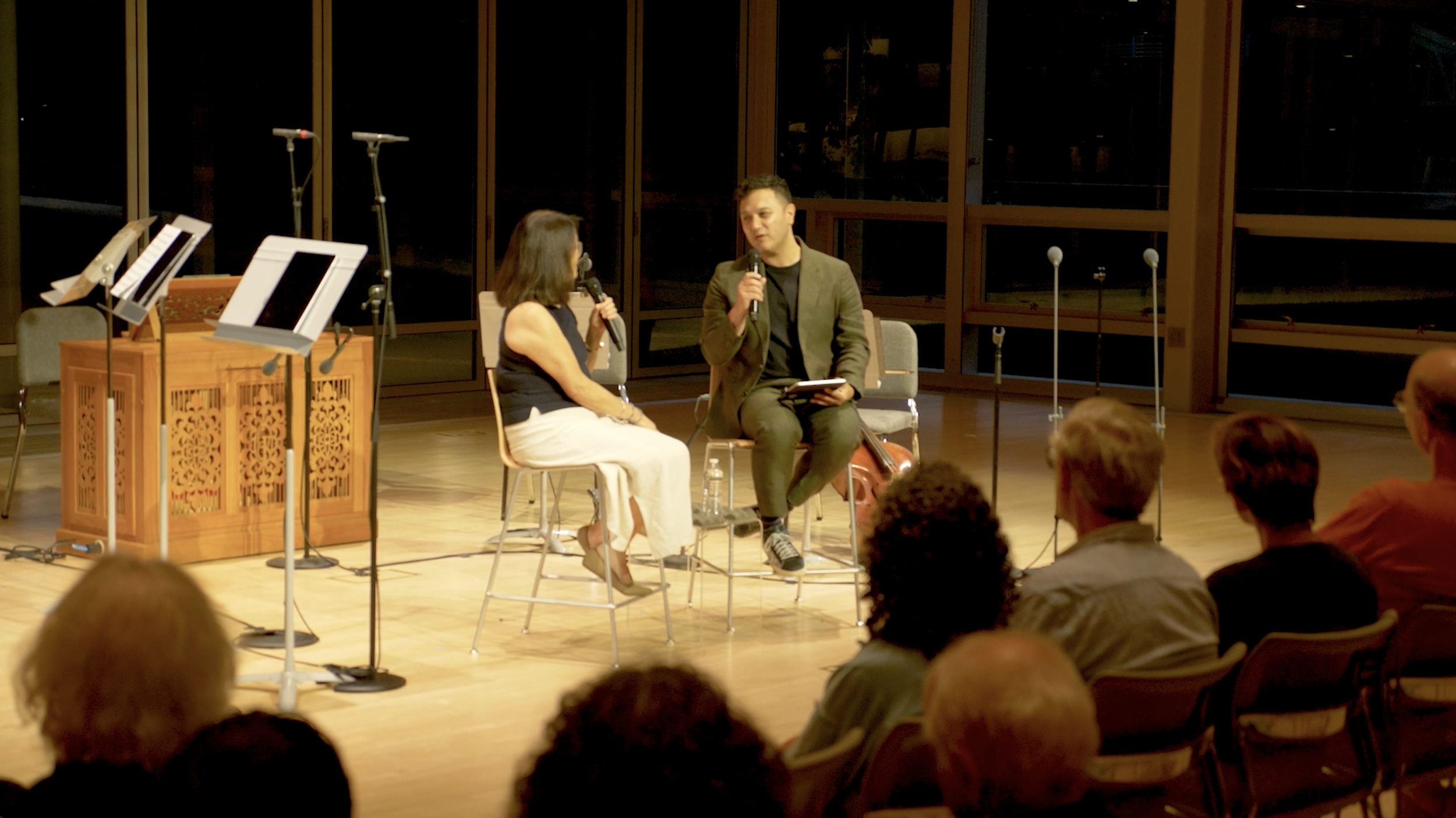
[00:02:54] This episode, like the last episode with Chad Smith of the Boston Symphony, was filmed live at Tanglewood as part of the Tanglewood Learning Institute's programming last summer. These events at Tanglewood last summer were concerts with conversation, basically. And so I had the chance again to collaborate with the wonderful members of the Berkshire Bach Society.
[00:03:15] Unfortunately, for a bunch of very boring logistical reasons, we weren't able to capture those performances that day. So as a substitute, I'm dropping in some films from previous performances, one from a performance with Bach Collegium San Diego, and also one from a performance at Know E Music in San Francisco with the early music group Ruckus.
[00:03:37] At the end in Tanglewood, we finished the concert with a bonus aria by Dietrich Buxtehude, who was one of Bach's contemporaries. So we've added that as a little extra treat at the end of this episode as well. I'm so grateful to the Tanglewood Learning Institute for their partnership on this episode, as well as all of my other episode partners, Bach Collegium San Diego and Know E Music.
[00:03:57] I hope you enjoy this conversation about music and healing and music and medicine and the ways in which Bach's music works with our brains and our hearts. I am very excited to introduce today's guest. It's Dr. Lisa Wong. Lisa Wong, MD, is Associate Co-Director of the Arts and Humanities Initiative at the Harvard Medical School.
[00:04:18] She is a pediatrician, a musician, an arts advocate, and an author. Dr. Wong is a pediatrician at Milton Pediatric Associates and an Assistant Clinical Professor of Pediatrics at Harvard Medical School, where she also co-founded and serves as Associate Co-Director of the Arts and Humanities Initiative. She is the past president and a current violinist in the Longwood Symphony Orchestra, the ensemble of Boston's medical community.
[00:04:46] In 2012, she published a wonderful book, Scales to Scalpels: Doctors Who Practice the Healing Arts of Music and Medicine, in collaboration with writer Robert Viagas. Please welcome Dr. Wong.
[00:05:13] Thank you so much for being here and making the trip out.
[00:05:16] L WONG: Thank you for that music. That was very centering and very calming and beautiful. I'm glad. Very beautiful. Thank you.
[00:05:22] N PHAN: I'm glad it was calming for you.
[00:05:26] L WONG: I was there. It was.
[00:05:26] N PHAN: Yeah. So, um, you know, I always start these interviews with this question: How did Johann Sebastian Bach enter your life?
[00:05:36] And along with that, how has he impacted your life as your life has progressed?
[00:05:42] L WONG: And thank you for that question because I've been pondering it for the last couple of weeks since I knew about this. And, um, I think it's in four parts, so I'm just gonna start with my childhood. Um, I am from Honolulu, Hawaii.
[00:05:54] I'm the middle child of five kids. And I had parents who were, um... My father was a music lover. He came from a family of 11, um, quite impoverished, but then had the, um, good fortune to have the, the, um, G.I. Bill, so he went to law school. And so when he came back to Hawaii, he said, "You know, my children will have the chance to play music," because he had loved classical music.
[00:06:20] So when we were born, he basically allowed us to all, uh, play music. So that was, that was the gift. I was a four-year-old when my sister, who was seven, started the piano, and as soon as the itinerant, uh, teacher left the house, I would climb up on the piano bench and play everything that I had just heard. So it dawned on my mother that perhaps I should have lessons too.
[00:06:46] What they didn't figure out was I actually couldn't read music until I was eight, and if, if something was played by my sister, I loved it and I could play it. Um, and I'd pretend that I was staring at the k- at, at the notes. Until I got a new teacher who said, "Here's a new piece." And I said, "I hate it." And then they said, "Well, you haven't tried it."
[00:07:07] And I said, "Well, if you play it for me once, I'll probably love it." And he's like, "Oh, no, no, no, no." And so that was... I grew up with this family of... So, oh, when I was eight, then when each of us turned eight, we had the gift from my father of choosing a second instrument. So there was none of this psychological, "You have to play the piano, and you have to play these things."
[00:07:25] It was like, "Your, um, privilege is to choose another instrument." So the three older kids were violinists. The fourth was a cellist, and the, the baby of the family said, "Trumpet." So, um, he was, he was really quite out in left field for that. But they didn't know that they were supposed to tell us to practice either, which was great because we all sort of goaded each other to practicing.
[00:07:54] And it was, it was actually very hard 'cause if you're practicing something on the piano, somebody from the other room is yelling, "That was an F sharp. You missed the F sharp." And so we had our own internal pressures. But we were also playing, you know, games where my sister would just put her elbow on the piano, and I'd have to write down all the notes that she, that she, she, uh, played.
[00:08:13] And so like, "Nope, you missed, you missed the B flat under my elbow." And so we learned ear training, um, and when she was playing, you know, a children's version of, um, Liszt Hungarian Dances, we would dance and pretend to be the wolf and pretend to be the... And chase each other around the, the, the living room according to the music.
[00:08:33] So we learned that music is play, and that was a huge gift for me. And then when I, when I got to school... Well, when I got to school, I started learning about Bach. We had Anna Magdalena Bach was also, you know, something we learned on the piano. And we started learning about the inventions and fugues. And so we would all take turns playing the different voices, um, because we had three violinists and a cellist.
[00:09:00] And that was also fun. And so we started really learning about voicing. And when I started in orchestra, I was 10 years old. So I would say that pretty much my whole life from 10 to now, so over five decades, orchestra has been like the social c- center for me. But we played the, the, the Bach, you know, the, the s- the little and the big G minor fugues, and those were my favorites.
[00:09:26] And later on when I grew up to think about how music is helping to heal, and we'll get to those questions later, I realized part of it is because there are rules, but there are rules that are broken just enough to keep you interested and challenged, um, and that's translatable to the future.
[00:09:48] N PHAN: Amazing. I love that you, you, you ki- it sounds like you were like playing, pretending to be Leopold Stokowski as like children making your arrangement of Ba- uh, instrumental arrangements of Bach fugues, orchestrating.
[00:09:59] It's, it's really advanced and all through a sense of play that's very beautiful. So what happened between, say, graduating high school and becoming a doctor?
[00:10:10] L WONG: So when I was an, an older child at, in, in, um, high school, I went to a school called Punahou School, which was a, um, missionary, uh, founded school. And the missionaries actually came from Park S- Park Street Church in Boston, which I did not know at the time until I got to Harvard.
[00:10:32] But we, um, were given... We were told, "You have a gift." Just, just like actually what you're talking about today. You know, "You have the gift of the arts. You have the gift of intelligence. Your job is to serve and give that gift back." So that w- that was the three-legged stool of the school. So by the time I was in high school, I was bringing music to the Shriners Hospital for, um, children with orthopedic, um, congenital anomalies.
[00:11:04] So, uh, kids in Samoa, because of the, um- It's a very small island. There's a, a lot of, you know, consanguinity. So many would be born with club feet, and they couldn't get around the beaches. And so they were flown to Hawaii from Samoa, had their surgeries, kept there for at least a month so that the wound wouldn't get sand in it when they went back, and then sent back.
[00:11:26] But they couldn't bring their families 'cause they were also from families of 10 children, and so the parents had to stay. So we had a lot of lonely, homesick children in this hospital. And this is, this is in the '70s, so this is before video games and before internet and all of that. So we would bring our instruments once a week and play with the kids and for the kids.
[00:11:47] And so by the time I got to college, I said, "I'm going to do something in music education in a hospital setting or heal- health somehow with kids." And so I didn't know which one of those things I was gonna choose, but when I got to school, that's... those were the, the things that I had on the table.
[00:12:06] N PHAN: How beautiful.
[00:12:07] Before we leave Hawaii, uh, I, I'm curious to know, um, uh, Bach in Hawaii, I cannot imagine he himself would've imagined his music being played in Hawaii. So I'm, I'm... I mean, of course not, 'cause, I mean, he was living in a very different time than we live. Um, but, you know, how... Did it seem just like a thing to be taken for granted?
[00:12:29] Was it seem that natural? I mean, um, you're obviously young people, so you're probably just encountering it as if you'd encounter anything new. But-
[00:12:35] L WONG: You know, I've been thinking about that. Because the music of the congregational churches was brought to Hawaii, and that was when it started. So when I got to college, it h- was the 150th anniversary of when the missionaries had come to Bos- uh, to Hawaii from Boston.
[00:12:53] The music that I grew up in in my church were the congregational hymns, which were basically Bach hymns. And also the music of Hawaii, the more modern, not the chants, but beyond that, were one, four, five. You know, they were, they were... the harm- harmonies were the same. And so we got used to that tonality. So I took music theory at, in high school but didn't absorb much.
[00:13:23] But when I got to college, the placement exam at Harvard was they give you a tune, and you're supposed to harmonize it. So I, I did. I harmonized it by ear since that's mainly I- how I do things. And Louise Voskercian, who was, uh, my professor, who was here at Tanglewood for a long time, um, she said, "You know-" There's something about this chorale that I'm wondering a little bit about.
[00:13:50] It's very nice, but- And then so she put a figured bass on the, on the piano. And so she said, "Play this." And so I said, "Da, da, da, da, da, da, da, da, da. What are those little numbers underneath it?" She said, "That's what I thought. You don't know figured bass," which is the, the, the directions of how to harmonize, um, Bach.
[00:14:12] And so I was put back into first year theory instead of moved up to second year theory. Oh dear. Thank goodness.
[00:14:18] N PHAN: Bach humbled you. He humbles us all, I have to say. Um, so he-- Okay, now we're here at Harvard, and l- just fast-forward a little bit. I mean, th- these, these three pillars that you're talking about in terms of, like, having gifts and giving them back to serve, you know, there's something very embedded in Bach's music that is very much in line with that.
[00:14:37] You know, he was serving his community as he was writing these pieces for a purpose, you know, for a church congregation, and they were all meant to kind of serve a communal purpose. I, I wonder... And it's pretty clear that you, you carried that, like, as a directive all the way through from your youth into your adulthood.
[00:14:55] And so can we just fast-forward? I'm so curious to chat about the Longwood Symphony Orchestra and your work there. It is reading-- Everybody has to buy her book. It is amazing. Mm-hmm. It's extraordinarily moving to read the stories that are in there. But I, I'm, I would love to hear about the beginnings and the ethos and how that ethos that you had from your youth, you brought that into this organization.
[00:15:17] L WONG: Yes. So, um, at Harvard I didn't, um, end up being a musician, and I didn't end up being a music teacher, and I didn't end up being a music therapist. I did become a pediatrician who played music. So, um, and then when I got to NYU Medical School, I was down the street from an Episcopal church that played Bach cantatas every week.
[00:15:39] And so, um, whenever we had time, my friends who were instrumentalists would go and play with them. So that's, that was my, um... Which I didn't remember till I was thinking about all of this. But, but, you know, so, so Bach was part of that. Fast-forward to 1991, um, I had joined the Longwood Symphony about three or four years before that.
[00:16:01] Um, had just finished my residency at Mass General. I was looking for another orchestra to be playing with, and somebody said, "Well, there's a new orchestra in town that's medical professionals. Um, you should join that." So w- we became part of that. The Albert Schweitzer Fellowship, which was the fellowship that, uh, Harvard Medical School started to send medical students to Gabon, to Africa, where the Albert Schweitzer Hospital was, to help, um, to, to provide medical, um, assistance there.
[00:16:34] It was at a, at a point where they were realizing that Schweitzer and all the work that he did did not have to stay in, in, uh, Gabon, in the, you know, western s- part of Africa. But if Schweitzer lived in the United States, what would he do? And what would... Specifically, what would he focus on in Boston? So, uh, my colleagues, Dr.
[00:16:58] Lachlan Forrow, who's a palliative care doctor, uh, Judge Mark Wolf, um, who was the chair at the time of the Albert Schweitzer Fellowship, con- contacted our mutual friend Yo-Yo, Yo-Yo Ma, and said, "Let's have a symposium to think about Schweitzer and Bach, and Schweitzer and, um, healing, and Schweitzer in Boston."
[00:17:17] So he said, "Well, you should have the Longwood Symphony playing with us then." And so that's how I got brought in. I was the new president of the Longwood Symphony. So this was this beautiful idea. Two days symposium taking over every single public space in all of Boston. The public library, the YMCA, Old South Meeting House, all of those places and involving what we thought Schweitzer would do if he were in Boston.
[00:17:46] Homelessness, domestic violence, HIV AIDS, children's healthcare disparities. And then Yo-Yo was going to play Bach and we're going to reflect on the reverence for life philosophy of Schweitzer. So we did that and Yo-Yo said, "Therefore, at the end of this we should have a concert. And if it's a concert for all of these people involved including staff, patients, and, um, caregivers, then it should be free."
[00:18:14] So we raised money to pay for Jordan Hall, 1,000 seats. We gave it away to those groups and we had a concert of Bach double. And, um, my husband is a violinist, Lin Chang, and he, he played the, uh, Sinfonia concertante with Yo-Yo. And so we had this beautiful concert all set up and we had given away all the seats.
[00:18:36] It was completely sold out. And we sat down on stage and looked out at the audience and the homeless population could not come because the concert was going to go past 10:00 o'clock and they would have lost their beds. Um, the women who were victims of violence could not come to a public space that it was announced that they would be there.
[00:18:54] And we looked out at this audience with these empty spaces and we all realized that we hadn't met our patient where they're at and it changed all of us. We were a pretty young orchestra but we played our best both because we're playing with Yo-Yo but also just because we're inspired to find that piece of us that was doctors, music, and service.
[00:19:18] So ever since then, every concert the, the Longwood Symphony plays is in partnership with a nonprofit healthcare organization in Boston.
[00:19:27] N PHAN: That's amazing. It sounds... I mean, reading your book it sounds like these-- the experience of, you know, dedicating so much of your free time to music really does change all of you as, I mean, doctors, as humans, and as artists.
[00:19:41] And This-- I mean, the way you describe this one experience, it sounds like it's just one of many- Mm-hmm ... from your book. And, uh, I find that really extraordinary. Um, you know, I, I'm curious to know how you see that play out in your medical practice. I mean, again, it so-- it seems so clear to me that it's like this line of Bach and service, and like these, these sort of principles in the same thing.
[00:20:10] But I'm just-- I'm curious to see how that-- how does it change out in, in the day-to-day life as a doctor?
[00:20:17] L WONG: Well, one of the questions that was raised was why are there so many of us? Why are there so many doctors who play music? It's not an anomaly, actually. And I started asking, "You know, how many of you play music?"
[00:20:32] And-- or, "How many of you are musicians?" When I talk to my doctor colleagues, they'd be like, "I'm not a musician. I'm a radiologist." But then if I said, "How many of you had musical training as children?" Almost all of them raised their hands. And then I thought, "Why? Why is that?" And there are many reasons, but the neuroscientists are helping us understand that that was something that changed our brains long ago when we were just starting out.
[00:20:57] Even two years of musical training, even if you're not the best, just learning how to use your hands in ways that are asking you to use both sides of your body, but also thinking ahead, thinking in small amounts. I was thinking about that when I was listening to that last, that last aria. Um, there was a, a large beat, there was a smaller beat, and the cellos were saying so- and then there's a teety- those teeny-tiny notes.
[00:21:27] Everything is so important for us as mus- as doctors as well as musicians to do that. I mean, I can diagnose a baby at 18 months with, with type 1 diabetes, which I have. I cannot tell that mother that day, you know, "When they're 60 years old, we're going to have to be thinking about their retinas." You know?
[00:21:48] You want to be talking about today's sugars, tomorrow's sugars, next week's, how he's gonna manage in school, those kinds of things. But everything is played out at the time that it's played out, so there are larger rhythms and smaller rhythms going at the same time.
[00:22:04] N PHAN: What a beautiful analogy. You know, a lot of-- I'm, I'm, I'm hoping that as a pediatrician, you're, you're, you're s- you're there for people's growth most of the time.
[00:22:13] But I would imagine that a lot of your other colleagues in the orchestra are constantly seeing people on their, the worst days of their lives, or they're delivering them, you know, some of the worst imaginable news. And that has to take a toll. And, um- You know, I'm curious to know how the, the musical part of their lives helps with them.
[00:22:37] There's one beautiful anecdote that I just have to, like, rip from your book, I'm sorry, about one of your colleagues that I actually find really fascinating because it's a, it's a doctor who's clearly also a patient in this moment. He's recovering from an injury. And if m- if my memory serves, and I read closely enough.
[00:22:51] But his quote is, "Music helps me when I'm disturbed, when I'm upset, when I feel inadequate in my work, when I feel cut off from my feelings. Music takes me to an almost guaranteed place of openness and nurturance. After I fractured my elbow and worried if I would ever play the oboe again, I used Bach to repair, Schutz to pray with, and Schubert to cry with.
[00:23:14] That was the sequence. Friday mornings at the end of my week, that's when I play Bach obligatos. They make me feel renewed and taken care of and in contact with something beyond myself, something beyond my limited world. This music, like the music of Jewish prayer, is a place where I feel I can have some contact with the divine."
[00:23:33] You know, it's-- that's an extraordinary anecdote, and it, I mean, ag- again, it speaks to the power of, of Bach's music. But I wonder if you could just speak a little bit more about that and share some more stories if you have any.
[00:23:45] L WONG: Yeah. That was, that was our, our dear oboist, uh, Bill, who, um, for years, he was sort of the, the orchestra's psychiatrist as well as, as, as well as his, you know, his, his using Bach for his own.
[00:23:59] And when he couldn't play as much anymore when he got older, um, I would go over and other friends would go over and play Bach with him in his, in his home because he really was so centered on the, the oboe, um, pieces th- th- that are so beautiful in Bach. Well, now, again, a little bit of the neuroscience.
[00:24:19] You know, we know that there is no single center of the brain that is a musical center because there is so much of the brain that is involved when you're playing music. The cerebellum, which is your rhythm section, you know, your, your limbic system, and your, your deep down emotions, your memories, as well as the, the executive function, planning every note or thinking about every note.
[00:24:44] And, and, you know, and, and all of those pieces come together when you're playing music, and Bach is one of those, those composers that really, really invites you in at whatever level. Um, this is, this is going towards your, your major question. But I mean, we can approach Bach from a sort of universal, it's a nice piece kind of thing.
[00:25:10] But we can hone down all the way to, you know, every single nuance of every single ph- phrase as well. And you can belong to any part of that, um, any, any part of that spectrum. And I think that's what built it as he, as he aged at the end. You know, he, he really still remembered all the nuances. And th- you know, the...
[00:25:33] And I think, um, those of you who may have experienced people with dementia, music is the thing that they hold onto the longest. They may have forgotten how to dress themselves or how to speak, but when you play music for them, very often that will center them, and they will, they'll even remember all the words or, uh, remember the melodies.
[00:25:56] N PHAN: That's so powerful. Thank you. We're gonna take a little break from interview and have some music on that note. I just wanna tell you about this next aria, which is taken from Cantat- Yes
[00:26:14] This next aria is taken from Cantata 21. Uh, there's a note. You know, most of these, as I said, were composed for a specific Sunday. Apparently Bach reused this cantata a few times, and he, he put a note in there saying it's for, quote-unquote, "general use." Yeah. I, I love that idea. Um, but kind of along this line of, you know, the worst days of our lives and the struggle of life, this-- the reading for the initial Sunday that this was written for is taken from the first Epistle of Peter.
[00:26:44] And the-- it's, it-- the quote is, "Cast all your care upon the Lord, for he careth for you." And this aria, it really grapples with the reality of that concept, uh, and the doubt that it can provoke. And it, it starts with a recitative that asks, "Why have you turned away in my hour of distress, in my hour of torment?"
[00:27:09] And then it goes on in the aria to describe how this person cannot stop crying because of the pain that they feel. And you'll hear the upper strings just paint these torrents and floods of tears in the most beautiful and elegant way. And I don't know, Bach makes suffering sound really good, unfortunately.
[00:27:35] MUSIC: RECIT. & ARIA FROM BWV 21
[00:34:20] N PHAN: Such a gorgeous aria I mean, suffering should not sound so beautiful.
[00:34:26] L WONG: I've been saying since yesterday when I came for the first part of this, how do you go back and forth between talking with your mouth and brain to singing those beautiful arias and back and forth? It's... You're really code switching a lot.
[00:34:41] N PHAN: Yeah. I would say that the music, you know, as you said, like, music requires so many parts of our brain, and I'm just h- I'm praying that that is working right now, so it seems to be. It
[00:34:50] L WONG: certainly is.
[00:34:50] N PHAN: Thank you. Um, so we're almost to the question. There's just one thing I wanna ask you. I love that in, at the end of your book, there's an appendix that includes, uh, listening recommendations.
[00:35:02] And, you know, they're under these different headings, and I noticed that Bach appears in, like, a number of these. You know, Suggested Favorites for Listening, and Music for Healing, Music for Problem Solving, Music for Community. Notably, he is not under the Music for Stress Relief column, which I kind of understand.
[00:35:21] But, um, why do you think he, why do you think he shows up so frequently?
[00:35:23] L WONG: I think this leads us to that question, but you know, there are certain parameters in Bach that make it accessible. Um, the, the pulse is very often heartbeat pulse. Uh, the harmonies lead us to logical, sometimes surprising, but logical endings or resolutions.
[00:35:49] Um, but there's enough... It's not Pachelbel. You know, I mean, it's not... Even though that may, might be on the list. I didn't see, but, uh,
[00:35:56] N PHAN: I don't- He's there, I'm sure ...
[00:35:57] L WONG: sorry about that.
[00:35:57] N PHAN: Um. That's okay. We love him.
[00:35:59] L WONG: But, but it's, it's not that everything is so predictable that we get bored. I have a grandson who's seven, and he's in camp this week.
[00:36:08] And so he came to me and he said, "Guess what, Grammy? I climbed to the very top of rock climbing at rock climbing camp three times." But at the same time, he said that they were different. And so I wrote down Bach climbing and rock climbing because every time we come to any piece of Bach, we see it and hear it in a completely, or in a slightly different way each time.
[00:36:35] And just the images that you had with this music when I was just listening and watching it, if I ever see that image again-
[00:36:44] N PHAN: Mm ...
[00:36:44] L WONG: I will hear some of that Bach because it attached, and that may be part of it. I mean, neuroscientifically, a lot of music will attach when you, you see an image also. And Schweitzer talked about the painterly Bach, that he's, his, his music paints images all the time.
[00:37:03] But there's something that, there's something for everyone. You can, you can always find something. You know, the, the Bach air, we play it at weddings, we play it at funerals, we, we play it, you know, for each other, and it has something to say. There's a pathos and a joy in it. that are attached. And that's life.
[00:37:24] Um, so maybe that's why Bach is in all categories.
[00:37:28] N PHAN: Yeah, he does sort of touch on that sort of ineffable ex- thing of existence, right? It's like it's not a clean answer all the time.
[00:37:36] L WONG: Even the, the pieces of music that are in minor end in major. And he's not the only one to have done that, but it feels so good when that chord comes.
[00:37:45] Yeah,
[00:37:45] N PHAN: it does. And it's funny, sometimes the most joyful pieces he writes are in minor modes, which is kind of a strange thing. You don't normally expect that. But he, he plays with our expectations. That's interesting. So I mean, this does bring us to this question, you know. Do you think his music is for everyone?
[00:38:00] L WONG: Yes. Absolutely. It is for everyone on different levels. It may not be that a Bach chorale in a church is for everyone. But it may be that if you brought that piece of music and sang it at a hospital for someone who's going through a hard time and sang it as a gift of music to that person, that would be for them.
[00:38:24] Music, I think, in general is, it's a personal thing. And the music therapists know this. They will, you know, listen to the story of the person that they're talking to and then either create a piece of music or choose a piece of music to go with that. And I certainly will do that when I'm playing my viola and finding a piece of Bach to play.
[00:38:46] You know, it depends on what the mood is and it depends on what you're sensing that the audience is feeling or thinking about at that moment. And something will ping for me of like, "This is, this is the piece to, to, to play now."
[00:38:59] N PHAN: Uh, something that I've really... I'm, I'm s- I've been so excited to speak to you is because, you know, we all encounter your profession at some point- Mm-hmm
[00:39:07] whether we like it or not. And there is something about thinking about this music in that context that really opens it up. Because he's grappling with these ideas too. I mean, even with, like you say, like, maybe a chorale is not for everybody at any moment. But there will be a moment in life in which the things that he is grappling with, even in these, these texts that seem so dogmatic on the surface, you know, they-- There's gotta be something you can relate to at the end of the day.
[00:39:37] And I don't-- I mean, I think about the words a lot because I have to, as I said, because I'm a singer. I mean, I, I miss the days of just being like, "The Bach double's amazing." Yeah. And I just wanna play that until the cows come home. But, um, I don't know. I mean, do you, do you think about that at all or?
[00:39:51] L WONG: Well, the, the choral music is what I know the least.
[00:39:56] So maybe that's a, a good thing in some ways because I don't... I mean, I love it, but I don't understand it in those ways. And so I'm not grappling with the granularity of those words and those intentions. But even if someone does understand the words and thinks about how Bach took that music and turned it, turned it into tears and turned it into flow, there's something that's so human about that, that I think there is something that you can attach to.
[00:40:28] Even if it's not your own religion, just knowing that that came from deep in his spirit and his heart, and he's, he's trying to express that to somebody else.
[00:40:37] N PHAN: I, I wanna say too, uh, something I find very moving about your story with his music is that you did... I mean, the way you're describing it, you know, it sort of kind of bled into your consciousness through the church in a way and through these ki- Mm-hmm
[00:40:48] uh, through the church music. But- No matter how that entered your life, you've taken it into this very universal impa- it- this, this way that impacts the universe and the humanity in a very universal way, I think is what I'm trying to say. And I think that's really, that's very powerful.
[00:41:03] L WONG: I think the way that, um, Bach is...
[00:41:08] It, it just gets your brain thinking about something else and following those threads, where if you're really troubled, part of your brain can follow that thread and get away from that circling around and around of anxiety or whatever it is. And when I was, you know, in high school and college when I was trying to figure out calculus and all those sciences that I don't remember anymore, if I couldn't figure out the problem, I would go and play a, a, you know, I would go and sight-read a whole bunch of inventions and preludes because while my fingers were doing that and part of my brain was trying to figure that out, it quieted the other side of my brain to figure out the math problem, and I could come back to it, and it was mainly there.
[00:41:56] You know, I was never the best in calculus, but, but it, it got me out of that, you know, stuck place and brought me to somewhere else. And it always was Bach.
[00:42:06] N PHAN: Well, look at that. Bach for problem-solving. No wonder it's on the list. Is there anything else you'd like to share with us this evening?
[00:42:11] L WONG: Just a little bit about Albert Schweitzer-
[00:42:13] N PHAN: Yes, please
[00:42:14] L WONG: because I, after I started learning about him in 1991, he has sort of been the, the North Star for me and also for the Longwood Symphony because Schweitzer started with Bach. He was an organ- organist and a pianist and really reveled when he was a kid in improvisation of Bach. And actually, he, he studied with the father of Charles Munch, who is the conductor here at the Boston Symphony.
[00:42:43] But he took that, and when he decided at the age of 30 to go to medical school because he, he had been a lecturer, a philosopher, a theologian, he said, "I don't want to use words now. I want to live my life as the example of service." So he moved... He started this hospital, and he called it his improvisation.
[00:43:04] He called the hospital in Gabon his improvisation, uh, because he was learning all the time. And I think that curiosity and that learning and trying to find how things harmonize was always in him from his early time of writing about Bach and thinking about Bach. So I take that as another u- another resonance that I have with Schweitzer and his work.
[00:43:30] N PHAN: That's beautiful. That's beautiful. I cannot thank you enough for sitting down and chatting with me today.
[00:43:35] L WONG: It's been a, it's been a pleasure. Yeah, yeah, yeah. It's been really fun.
[00:43:37] N PHAN: Yeah. Thank you. Thank you. Thank you.
[00:43:48] We're gonna send you off with some more music by a composer named Dietrich Buxtehude, which if you were here yesterday, you're familiar with him. And if you were not here yesterday, again, we have to press the skip intro button. Buxtehude was one of the composers that Bach admired the most. He-- There's this, a legendary story about him walking 250 miles from Lübeck to Arnstadt just to watch him at work and hear him play.
[00:44:09] I can't imagine walking 250 miles anywhere, and I'm impressed. I really wish he'd had an Apple Watch on him to count those steps. Um, so we'll end with some Buxtehude just to show you some of what inspired Johann Sebastian.
[00:45:48]MUSIC: BuxWV 92 Quemadmodum desiderat cervus
END CREDITS