EPISODE 2
Why Bach's Music Touches Everyone — Even If You're Not Religious
with Debra Nagy | oboist & artistic director, Les Délices
Is the music of Bach for everyone?
In Episode 2 of BACH 52, tenor Nicholas Phan sits down with oboist and artistic director Debra Nagy to explore this question through the lens of historical performance, personal belief, and the universal human emotions that Bach's music somehow captures across centuries and cultures.
Debra is the artistic director of Les Délices and one of the most thoughtful advocates for baroque music today. Raised in the conservative Jewish tradition and now identifying as culturally Jewish and agnostic, she shares something deeply personal: how Bach's profoundly Christian music still resonates with her experience of humanity, grief, loss, and connection. The conversation explores why the St. Matthew Passion moves non-believers to tears, how baroque instruments create colors and emotions that modern instruments simply can't access, and what it means to find your life's calling through the intimate dialogue between voice and period instruments.
The episode also explores the fascinating world of the baroque oboe and oboe d'amore, instruments that Debra describes as having "more color, more humanity, more emotion" than their modern counterparts. The featured performance of BWV 166 "Ich will an den Himmel denken," a rarely-heard aria, showcases exactly why these historical instruments matter so much.
This conversation is about more than just music. It's about how Bach builds community across time, how his cantatas speak to our deepest experiences of mortality and love, and why engaging with this music on its own terms opens up something profound and universal.
ARIA
Ich will an den Himmel denken from Wo gehest du hin? BWV 166
PERFORMERS
Nicholas Phan, tenor
Debra Nagy, oboe
Carla Moore, violin
Elisabeth Reed, cello
Corey Jamason, organ
SOUND (BWV 166 only): Lolly Lewis | VIDEO: Clubsoda Productions
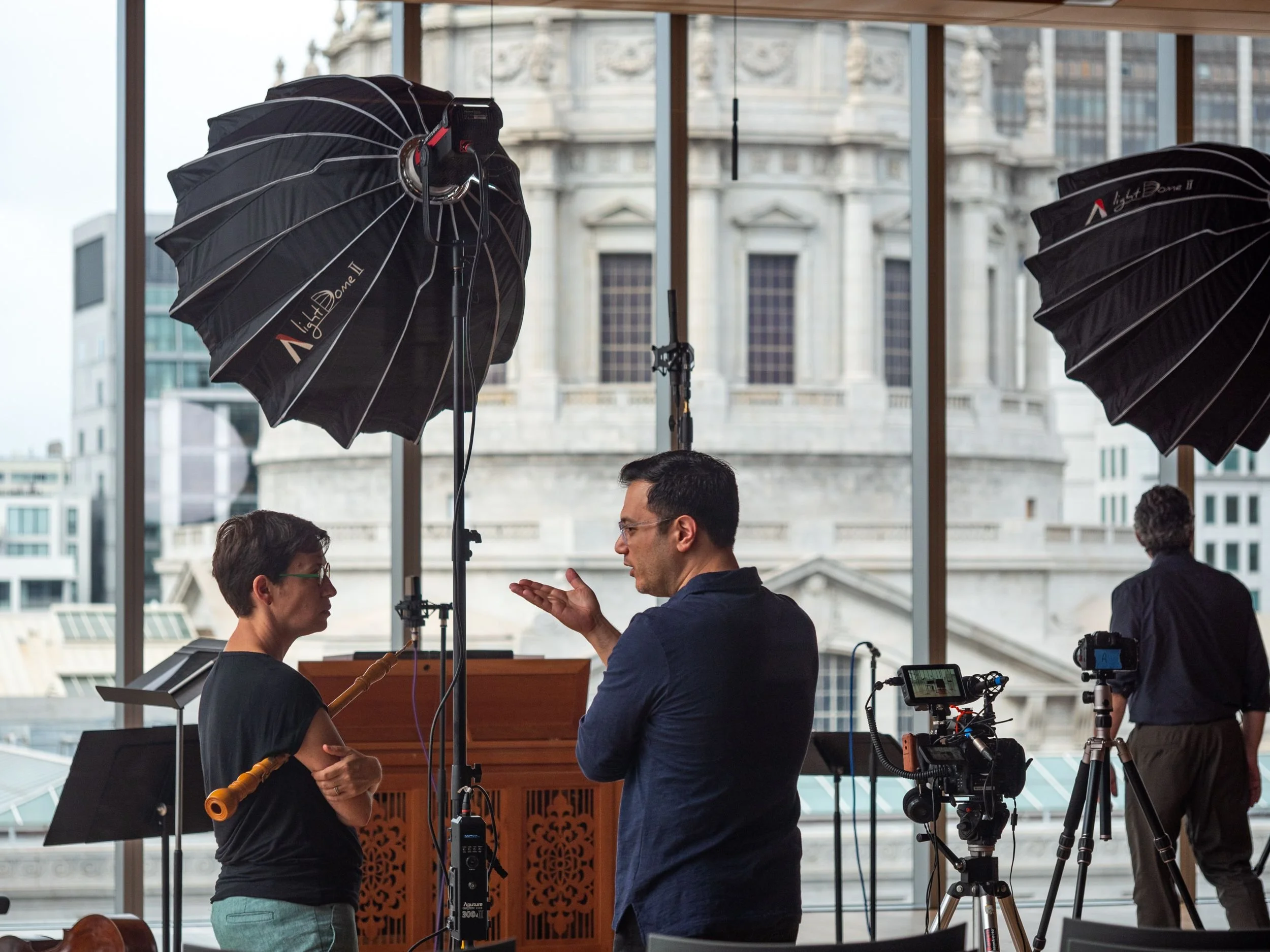
This episode was filmed in partnership with Les Délices and the San Francisco Conservatory of Music.
This project is a fiscally sponsored project of FRACTURED ATLAS.
To find our more information and to make a TAX-DEDUCTIBLE donation to support the continuation of this project please click the button below
TRANSCRIPT
[00:00:00] C MOORE: The music of Bach taps into an emotional depth
[00:00:06] C JAMASON: Look, it's the most human music that I know. You could look at it and see all the counterpoint and the harmony, and, and it looks very technical and kind of mathematical, and I suppose it is that. But that's all in service of basic expression, basic human expression, in the most profound and direct way.
[00:00:22] C MOORE: It is human. It is very human. Like, it, it resonates with human nature.
[00:00:28] K HYUN: He's a very special composer because he has a real range of abilities that make it so he can depict almost any, any aspect of the human experience.
[00:00:40] AUDIENCE MEMBER: You don't have to, uh, I don't think, relate to it on a personally spiritual level to understand the spirituality that's behind it, and just be taken by the, the, the humanity that, that, uh, is behind all of his compositions and, and the glory of it.
[00:00:54] It, I don't know how you can miss that.
[00:01:01] N PHAN: Hi, my name is Nicholas Phan and this is the Bach 52 Project.
[00:01:10] This week's guest is oboist and artistic director of Les Delices, Deborah Nagy. Deborah is a longtime colleague and friend. We've performed many times all over the United States together, performing all sorts of Baroque repertoire, including the music of Johann Sebastian Bach. Based in Cleveland, Les Delices is an ensemble that has a wonderful web series called Salon Era that mixes music and conversation not unlike the Bach 52 Project.
[00:01:38] If I'm being completely honest, part of the inspiration for this project and the format of this project came from Deborah's vision for Salon Era. So I'm really grateful to her and her colleagues at Les Delices for partnering with me on these first three episodes of Bach 52. Deborah flew out to San Francisco in September of 2022 to film six arias with me, and you'll hear the first of these on this episode this evening.
[00:02:04] The first aria of these six is from Cantata 166, Ich will an den Himmel denken. My chat with Deborah was fascinating. We talked not only about what drew her to early music and Baroque music and learning how to play these historical instruments, but we also talked about why she thinks there's something in Bach that is potentially relatable for everyone.
[00:02:30] You know, the question we're examining with Bach 52 is basically, do you think the music of Bach is for everyone? So- Let's start there and see- Mm-hmm ... where this conversation goes.
[00:02:43] D NAGY: I feel like it is potentially relatable for everyone on some level. I mean, for myself, I obviously am not a native German speaker, for instance.
[00:03:00] I am not from Christian tradition, let alone German Lutheran uh, tradition. So, um, that may or may not be a point of remove. But I feel like the emotion and, and some of the larger kind of meta ideas and sentiment are, uh, universally relatable. It was interesting. I found myself reflecting and, and thinking about, you know, some major, I wouldn't say aha moments, but some moments where Bach's music, whether I'm listening to it or in the midst of performing it, has, you know, really touched me or when there have been some additional resonances.
[00:03:51] And I think that one of the things that's amazing about Bach, and I don't mean to get macabre here, but there are the most fascinating and deep and beautiful and centering messages about mortality. And, you know, whether that, you know, is, you know, the one moment in the St. John Passion where I always cry or, um, or doing Seufzer-Tränen and thinking about, uh, recent losses in, in my life or the lives of loved ones.
[00:04:27] It's, uh, very, very deep and very impactful. And I don't have to be a believer, and I don't have to speak German and, um, or any of those things in, in order to feel those feelings.
[00:04:40] N PHAN: So tell us a little bit about your relationship with Bach. I mean, how did it begin? How has it evolved over the course of your career?
[00:04:49] D NAGY: Being that I play the oboe, my relationship with Bach is, it's a pretty intimate and important one You know, the real golden age of the oboe, and I- when I say the oboe, I speak generally of the instrument, not necessarily the baroque oboe or the modern oboe, but, you know, for oboists in general, the music of Bach and really the 18th century is the golden age.
[00:05:17] Since I became remotely serious about the oboe, which is to say, like, in high school, um, you know, I was aware and I was already taking advantage of this very rich repository of repertoire in the baroque period. My teacher, who was kind of my surrogate mother from, you know, when I started with her in fourth grade until I graduated from high school, actually considered herself a b- a baroque specialist.
[00:05:45] And rather than playing etudes and God knows what all the way through high school, she was developing my t- technique playing sonatas by Telemann and Handel and Bach. So I was absorbing so much of this language and rhetoric without even totally knowing it. And when the opportunity, um, came up when I was in my undergraduate, a student at the Oberlin Conservatory, to experiment with baroque oboe, what was an experiment became a absolute, um, passion and obsession, if you will.
[00:06:29] I mean, in a way, recognizing that there was an extraordinary amount of repertoire that I could, um- Kind of not just discover, but rediscover in a whole different way with an instrument that would bear different and arguably richer fruit, uh, expressively, specifically in that repertoire. So, you know, by the time I returned to Telemann and Handel and Bach on, on a baroque oboe, I felt like I was, in a way, being enabled to reach a whole another level.
[00:07:06] I remember hearing that very first week that I was playing the baroque oboe, hearing the Christmas Oratorio for the first time, which is also an absolute tour de force for the oboe. You know, I had played obbligato cantatas on, on-- obbligato arias, uh, by Bach on modern oboe and things like that, but, you know, the relationship between the voice and, and this very, very vocal instrument, um, in quality, the, the baroque oboe, um, or the oboe d'amore, was just so arresting, and I just, I needed to do more of it.
[00:07:41] And here we are twenty years later.
[00:07:45] N PHAN: Yeah, here we are. So tell us a little bit about the difference between, A, a modern oboe and a baroque oboe, and then, you know, the difference between the oboe and the oboe d'amore, 'cause we recorded arias with both of those instruments this week.
[00:07:59] D NAGY: So the difference between a modern oboe and a baroque oboe, first of all, um, a modern oboe has about twenty-six keys on it, and the baroque oboe has a grand total of two.
[00:08:12] The way that keys functioned originally on a period instrument of any kind is that you only have keys generally to act as an extension of the hand, which is to say, to open or close holes that you could not reach otherwise. Mm-hmm. Whereas those twenty-six keys on a modern oboe, you know, I could press a key down here, and it can open holes up here.
[00:08:35] And the whole idea behind all of those keys is to make the notes sound as much the same as possible. Now, if I were to play, say, a chromatic scale on the baroque oboe, which is not something that I'm almost ever called upon to do because it's extremely unnatural- ... you would hear how different the quality of each note is, and particularly the notes that roughly correspond to the black notes- Mm-hmm
[00:09:05] on the keyboard. Notes like that are what we call cross-fingered notes, which is to say I'm cutting the bore of the instrument in a funny place, and the modern oboe cuts the bore at the exact right place and has a r- you know, has a key open or close. What happens then with the baroque oboe is that the sound quality is covered-
[00:09:30] N PHAN: Mm-hmm
[00:09:30] D NAGY: and soft. And then in order to deal with these kind of inequalities between the notes, you en- end up needing to have a reed which is very flexible. Also, you can't, um, there's no octave key, so you also have to have this very refined control over how you use your air, not unlike a singer or even a trumpet player, in order to basically voice- Mm-hmm
[00:09:56] all these notes differently. So the result is that you have s- an instrument that is, in a way, more flexible, where you use your wind very differently, not just to voice notes, but, uh, that becomes a potentially different sort of, uh, expressive device. And playing in different tonalities or keys, one sounds very different from another.
[00:10:22] So, and this is a good way to segue from baroque oboe to oboe d'amore. The baroque oboe is essentially a flat key instrument, which is to say it sounds great and feels best, best playing in flat keys, which is why, uh, the arias that we recorded together, one of them is in G minor with two flats. The other one is in C minor with three flats, and those are, like, the two best solo keys or most common solo keys for the baroque oboe.
[00:10:56] But what you'd never see for the oboe is, is a solo in D major- Mm-hmm ... with two sharps, and you never see a solo in A major in two sharps for the oboe. In fact, in the, for Bach, we have a whole nother instrument to do that, and that is the oboe d'amore. The oboe d'amore is, you know, if the oboe is in C, the home key of the oboe d'amore is A, A major.
[00:11:29] So if that is my home key, I can, you know, travel away from that home key and m- further and further sharpward. So, you know, there's no, um, mistake that the pieces that we recorded with the oboe d'amore were in F sharp minor and B minor and C sharp minor Mm-hmm ... um, which are sort of like keys with unthinkable numbers of sharps, at least to per- people who specialize in period instruments.
[00:12:01] Um, I, I can't even think about double sharps and, and, uh, kind of comprehend that. But that is the kind of lingua franca and the kind of home for an oboe d'amore. And the oboe d'amore was, is very special and very particular to the music of Bach. It is an instrument that was very geographically limited. It only existed from, it was invented around 1718 or so.
[00:12:29] And so when Bach gets to do his audition in Leipzig, that's his first opportunity really to write for oboe d'amore, and he takes advantage of these instruments that are only available locally. And it's, so you'd see really important, uh, parts for oboe d'amore in the works of Bach from 1720 to 1723 onwards.
[00:12:52] The only other composers that write for oboe d'amore are specific to that northern Germany, and it's, like, just me- Telemann, Graupner, Graun, and that's about it.
[00:13:05] N PHAN: Hmm.
[00:13:06] D NAGY: And it's an instrument that doesn't really exist after 1750. What does the music of Bach mean to me and, and what is it like for my instrument?
[00:13:14] Well, it's a super rich repertoire, and it's also very specialized in that way.
[00:13:20] N PHAN: Interesting.
[00:13:21] D NAGY: Mm-hmm.
[00:13:22] N PHAN: It's interesting doing, singing these pieces with modern oboe versus the baroque oboe.
[00:13:30] D NAGY: It- What's that- I mean- ... experience like for you?
[00:13:33] N PHAN: It's interest-- I mean, like, orchestras tune to a modern oboe because the, the reasons you were describing, like, the pitch is evened out, and it's very pure.
[00:13:41] D NAGY: Mm-hmm.
[00:13:41] N PHAN: And so you can always tune to this very pure tone.
[00:13:46] D NAGY: It cuts through. I mean, the modern oboe is, is built to penetrate.
[00:13:51] N PHAN: Yeah. And, like, having evened out the instrument in terms of just making all the pitches s- sound the same, it's, it's just always super in tune. And so it's, it feels, in a way, I mean, there's, A, the challenge of being at, you know, at the higher pitch which modern instruments are playing at A equals 440.
[00:14:11] Baroque instruments have A equals 415, so we're down a half step. There's a kind of warmer, richer sound that makes things easier. But also- The baroque oboe, because it has that sort of uneven quality of tone between the pitches, it feels like there's more color for the voice to respond to. Mm. And it gives you just a little bit more room to breathe and be a little flexible.
[00:14:34] And I, I feel like it opens up a kind of human sound to his music, whereas with modern instruments it does start to, particularly the oboe, it starts to s- it can sound, um, it's still beautiful and it's still gorgeous- Mm-hmm ... and it should be played on these instruments too, but it's ... It just sounds a little bit more precise in a way.
[00:14:57] It, like
[00:14:58] D NAGY: I think that's partly aesthetic of modern performance practice. But I think it is also partly how, uh, how the modern oboe functions, which is to say it's a highly, highly pressurized - Mm-hmm ... situation, and you need to maintain a very, yeah, very fast air speed all the time- ... on the modern oboe. And, you know, one of the great joys and also frustrations for beginners of the baroque oboe is that there are all these variable air speeds that you use because the notes are all different.
[00:15:33] Have different resistances because of the fingerings or because you have to be able to manipulate which octave you're playing in, and so many other things. But being able to use variable wind speeds, um, to me also, uh, equates to m- more varied expression.
[00:15:52] N PHAN: Yeah. So. It's like a bigger color palette somehow.
[00:15:56] Mm-hmm. And it makes it feel a little less sterile in some ways to me- Yeah ... as a singer.
[00:16:03] D NAGY: Well, I enjoy it, obviously.
[00:16:07] N PHAN: Me too. It's interesting. You found this life passion for, and your sort of life's calling in a way-
[00:16:13] D NAGY: Mm-hmm ...
[00:16:14] N PHAN: through, A, this, these particular instruments and also this music it sounds like. I mean, you know, Christmas Oratorio is like a transformative experience for you it sounds like.
[00:16:23] D NAGY: Yeah.
[00:16:24] N PHAN: And has that continued to evolve over time since that moment?
[00:16:29] D NAGY: I think that, I mean, one of the things that we're hearing from so many artists as they approach Bach is how infinitely challenging- ... that music is, that you feel like your work is never done. But also how enriching the things that you notice for the first time, no matter how many times you have the opportunity to perform a given work.
[00:16:58] And the fact of the matter is there are so many works by Bach that we don't hear- Mm ... um, often enough or on a regular basis.
[00:17:06] N PHAN: It's a, I mean, there's so many even just for our individual instruments. And it's like- Mm ... this treasure trove that you can kind of keep diving into. And they are demanding. Yes. And so there are constantly new layers to discover.
[00:17:20] So part of the thing that's really- Well, the thing that is really inspiring me to kind of ask this question of his music is the religiosity of these texts. Mm-hmm. And as a s- I was introduced to Bach's music as a player. You know, I was a violin player when I was a kid, and, you know, I was Suzuki Book 4, you start to play the Bach double.
[00:17:41] I played, you know-
[00:17:42] D NAGY: Mm ...
[00:17:43] N PHAN: uh, E Major Concerto and the A Minor Concerto. And you know, like, you study these things as a student, and I remember the, specifically the Double Concerto in D Minor. I was, you know, got to Book 4 in Suzuki, played that second violin part, and I was hooked. And then when I made this transition to being a singer, I eventually encountered his music again.
[00:18:00] And I didn't really think much about it until I think I did my first St. Matthew Passion. And you know, we're doing this piece that is so real. I mean, it's really the centerpiece of Christianity.
[00:18:13] D NAGY: Mm-hmm.
[00:18:13] N PHAN: The story. Yeah. Crucifixion and Passion of Jesus. And you know, I was seeing how much space we create in the secular space.
[00:18:22] I mean, it was in a concert hall. People are coming there for, you know, nearly four hours of their evening to listen to this music. And it started making me think, you know, this is... All of his music is really deeply religious. You know, he signs every piece Soli Deo Gloria.
[00:18:39] D NAGY: Mm-hmm.
[00:18:40] N PHAN: Only for the glory of God.
[00:18:42] Which, uh, you know, as an artist, that's certainly something I can appreciate and admire, this idea that you're doing something in service of something larger than yourself. But the Christianity aspect of it, it, it's, it seems like such a limiting factor. And yet this music is so revered and loved by so many different people.
[00:19:04] And so I just wonder, you know, you said you're not, you weren't obviously raised a German Lutheran. So I mean
[00:19:10] D NAGY: Indeed.
[00:19:11] N PHAN: I mean, what were you raised? Yeah.
[00:19:13] D NAGY: Um, I was raised conservative Jewish.
[00:19:16] N PHAN: Oh, wow.
[00:19:17] D NAGY: And I, at this point, identify as culturally Jewish. I am not practicing. My own personal beliefs, you know, are somewhere on a continuum between agnostic and atheist, probably closer to atheist, which doesn't mean that I don't believe in humanity and, um, and empathy and feeling, which is what, for me, the Passions become about.
[00:19:52] I can sing along with all the arias. And at least in the John, I can mouth most of the words and understand most of the words in the, um, Evangelist recit. And I almost inevitably cry at Es ist wohlbracht, in part because I, I realized the loss of a, of a best friend in the middle of Es ist wohlbracht one time.
[00:20:24] And, and so I can't go through that experience without thinking of that person and that moment. So, you know, I feel like there are any number of resonances that we may have that are independent of being believers. I don't have significant opinions, quite honestly, about, for instance, discussion of antisemitism, uh, in the St.
[00:20:53] John Passion in particular, though I hear the anger, and I hear the emotion, and I... You know, Bach didn't write any operas. Right. This- these turbacoruses are as, as, uh, close as we come, and the range of human emotion from, from joy to grief to anger to jubilation is complete, and that Bach brings all of that to us in turn.
[00:21:25] I'd love to ask you if you If you have a, a formative moment or memory or piece with Bach.
[00:21:38] N PHAN: I have a co- a few. That first time I did the St. Matthew Passion, I remember sitting in a, a sort of dress rehearsal before the first performance. It was with Jane Glover, Music of the Baroque, so it was modern instruments.
[00:21:48] D NAGY: Mm-hmm.
[00:21:49] N PHAN: And I stepped... I was singing the tenor arias, so I was able to kind of step out into the house and, you know, just observe the piece from afar- Mm-hmm ... as we ran it that night. And I remember the soprano getting to Aus Liebe and it just hitting me and dawning on me that two things. A, that beautiful message of, like, Jesus is doing all of this out of his love for humanity.
[00:22:19] He is sacrificing himself- Mm-hmm ... and undergoing all of this passion and, I mean, pathos, suffering for mankind, to save us from ourselves. That was kind of, you know... I was raised in the Greek Orthodox Church. Again, I don't know where I fall on belief.
[00:22:38] D NAGY: Mm-hmm.
[00:22:39] N PHAN: A- and, and these days I would say I'm pretty agnostic in the sense that I believe in something larger than us.
[00:22:49] What is that? I have no idea. I think it's kind of presumptuous to assume that we could ever possibly understand that as human beings, and, uh, if we could understand it, I... That would... I don't know if that would be a good thing.
[00:23:01] D NAGY: Mm-hmm.
[00:23:03] N PHAN: But that, that notion of love and compassion and sacrifice for the community and the greater good, and even when people are being at their worst That was a really moving moment for me.
[00:23:21] And then the other thing in that moment was I was listening to her sing, and it dawned on me for the first time, even though I had studied the piece and whatnot, that the story ends before you get to the resurrection. It ends with his burial. And there was something about that for me that made me realize this story is a very human story.
[00:23:44] It's an extremely human story up until we get to, you know, a bunch of Marys coming to- Mm-hmm ... this tomb, and there's nobody there except for a couple of angels. That's where it starts to veer off into the supernatural and the sort of mythological and, you know- Right ... belief situation. But up until there, we're just dealing with the story of a martyr.
[00:24:05] D NAGY: And what I, as someone who's playing Aus Liebe in the Matthew Passion, am thinking about in, and relating to in that moment is, and it's what I find generally fascinating in the music of Bach, is various elements of dichotomy and psychology. So Aus Liebe, as anyone who's listening will recall, is for soprano, flute, and two oboes d'amore, and no one else and nothing else.
[00:24:37] There is no other harmony. And so it's actually this extraordinarily, uh, fragile and vulnerable and naked state in, in addition to being, you know, an, an expression of love and sacrifice.
[00:24:57] N PHAN: Right. So- And you have this beautiful flute line that's- Mm-hmm ... playing this gorgeous melody, but then the oboes are punctuating it with these- Mm-hmm
[00:25:05] very short things that are like nails-
[00:25:09] D NAGY: Mm-hmm ...
[00:25:09] N PHAN: and a cross. I mean, like, you can... It's almost as if they're being pounded in. And so you have this... There's something horrifying to me about- Yeah ... the starkness and the sort of- dichotomy between those two- Yeah ... those, those parts and the instrumental writing. And it was one of the-- that was part of what contributed to that moment.
[00:25:28] Mm-hmm. The other moment that was more recent for me that was sort of like, oh, wow, like epiphanic moment about Bach's music was, uh, recently, actually. I was in Columbus, uh, earlier this spring. So by the time this airs, last year. Mm-hmm. And we were doing the St. John Passion, and it was those tourer choruses, the crowd scenes.
[00:25:49] And I was thinking a little bit about, you know, they had done the pre-concert panel discussion with the rabbi and the priest and the whoever, you know, talking about, is this anti-Semitic? And sort of examining that question. And I was mulling on that in that performance. I had this moment where I, you know, it just made me-- I realized because of the way Bach structures things, he-- I mean, he takes other parts from the Matthew Passion and inserts them into the narrative, into the John Passion narrative in order to flesh out the John Passion.
[00:26:21] But there's also something very intentional about that to me that is really trying to drive home this point that it's these people who are so angry, even though John, St. John, is calling-- identifying them as Jews the entire time. Bach is also saying, "Those people are us."
[00:26:40] D NAGY: Mm-hmm.
[00:26:41] N PHAN: And in this current climate of cancel culture and- Mm-hmm
[00:26:45] and sort of, you know, public, uh, tarring and feathering of people on social media for whatever misstep someone has made for political reasons or whatnot, and this sort of kind of being pushed everything into a sort of black and white binary in terms of our political discourse.
[00:27:05] D NAGY: Mm-hmm.
[00:27:05] N PHAN: Mm-hmm. There was something about those scenes that feels very of the moment and sort of the timelessness of it all, this idea that people who are daring to speak their truth, whatever that is, oftentimes, you know, get consumed and sacrificed as scapegoats.
[00:27:23] It's kind of the thing that sort of perpetuates the cycle of it all. I mean, we're willing to take the most precious things to us and, and cancel them, or, you know. Right. I mean, I don't like that term really, but- Yeah.
[00:27:34] D NAGY: No, but it's y- y- you make an interesting point. And actually, you know, these days when I listen to The Passions actually, the character and the characterization that I often find myself most compelled by is Pilate.
[00:27:51] You know, who goes through this whole psychological, uh, transformation and, and trying to understand his, his role, um, in, in the course of the, um, of the trial and, and really whether, whether he's doing the right thing by, uh, by listening to the crowd. For me, it's mostly mythology, but we are storytellers.
[00:28:14] Bach is a great storyteller in, in multiple modes in this way. And, you know, we learn not only what he may have been thinking or what his interpretation might be, but also we learn about our- ourselves and, and humanity and history along the way. And one last story, since you told this story of, uh, playing the Bach double.
[00:28:36] N PHAN: Mm.
[00:28:37] D NAGY: And for Suzuki, you know, I've-- made me realize actually that, you know, one of my very most important and formative experiences with the music of Bach was learning the oboe violin double-
[00:28:50] N PHAN: Oh ...
[00:28:50] D NAGY: when I was- That concerto ... still in high school, um, with, um, you know, a good friend. And I went over to her house every single week and for months we were preparing it, you know, for the concerto competition and the, in the youth orchestra.
[00:29:06] And, you know, I mean, there's no professional situation where you would have the opportunity to like rehearse a concerto with a fellow soloist for months on end. But, you know, in thinking about that experience, we had the opportunity to come to know that piece so deeply, to discuss every phrase and every inflection, you know, to be able to explore musical dialogue in the slow movement, you know, in a way that is sort of unheard of.
[00:29:45] And, you know, I could say something goofy like Bach builds community, but it absolutely did for me in that instance, and I think it does for us more generally, where, you know, we can sit and talk about our experiences playing this or that Passion or cantata or concerto or suite or, um, solo and connect with some kind of For lack of a better word, universal experience
[00:30:17] N PHAN: Yeah.
[00:30:18] I mean, he was composing all of this in service of the community ultimately.
[00:30:22] D NAGY: Mm-hmm.
[00:30:23] N PHAN: And so, I mean, it kind of makes sense.
[00:30:25] D NAGY: Yeah.
[00:30:26] N PHAN: Well, thanks.
[00:30:27] D NAGY: Thank you so much, Nick.
[00:30:28] N PHAN: Thank you so much for doing this. This has been such a joy.
[00:30:32] D NAGY: Fab.
[00:30:39] D NAGY: One of the arias that Nick and I recorded in September 2022 was the aria Ich will an den Himmel denken from Cantata 166, Wo gehest du hin? The aria is a pledge that during my time on earth, I will focus my thoughts towards heaven. The aria actually survives in an incomplete form with just the oboe, tenor, and continual part surviving.
[00:31:05] The violin part has been reconstructed, but as you can hear, the imitation in the violin is extremely natural. For me, the aria's A section, full of suspensions, musical sighs, and a meandering bassline, signals tension, inner conflict, and indecision. But I love the contrast in the B section. While the text basically asks, "Should I go or stay?"
[00:31:31] Bach composes resolute traveling music full of ascending scales for both bass and voice.
BWV 166 PERFORMANCE