EPISODE 10
Death, Doubt & the Bach Institute
with Pamela Dellal | Bach Institute director & intellectual resources curator, Emmanuel Music
This week on BACH 52, Nicholas Phan sits down with Pamela Dellal — alto, master translator, and director of the Bach Institute at Emmanuel Music — for a conversation about death, doubt, and why Bach's cantatas still speak to us today.
Pam has translated Bach's cantata texts for Emmanuel Music for decades. She talks about the history of the ensemble under founder Craig Smith, how she became the church's "intellectual resources curator," and her vision for making Bach's music accessible to musicians and non-musicians alike.
The conversation turns to two themes that run through nearly all of Bach's music: his fearless meditation on mortality (including the story behind Lorraine Hunt Lieberson's unforgettable final performances of "Ich habe genug") and his surprisingly modern portrayal of doubt.
This episode's featured aria is "Komm, du süße Todesstunde" from Cantata 161, composed in Weimar in 1716.
ARIA
Mein Verlangen ist, den Heiland zu umfangen from Komm, du süße Todesstunde, BWV 161
PERFORMERS
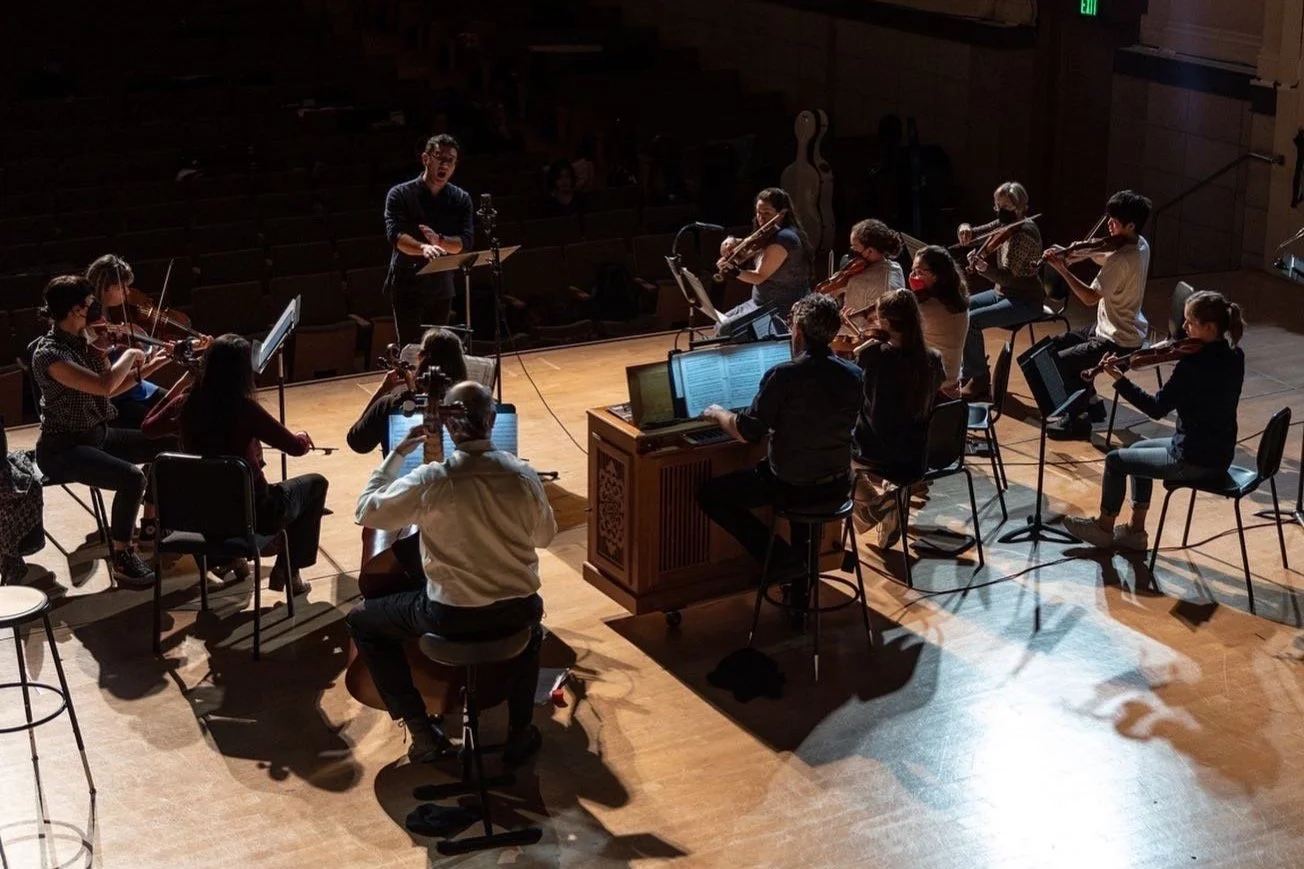
SFCM Baroque Ensemble | Elisabeth Reed & Corey Jamason, directors
Violin 1: Cynthia Black (leader), Annemarie Schubert, Pauline Kempf, Alexandra Santon
Violin 2: Luke Chiang, Eliana Estrada, Carla Moore
Viola: Jennifer Redondas, Caitlin Keen
Cello: Elisabeth Reed, Ruiwen Liu
Bass: Farley Pearce
Organ: Yunyi Ji
Thanks to Julian Bullitt for his photography of the Emmanuel Music Bach Institute events.
SOUND (BWV 161 only): Chanho Han & Jason O'Connell | VIDEO (BWV 161 only): Clubsoda Productions with Edgar Garcia assisting | VIDEO (Interview): Nicholas Phan
This episode was filmed in partnership with Emmanuel Music and the San Francisco Conservatory of Music.
This project is a fiscally sponsored project of FRACTURED ATLAS.
To find our more information and to make a TAX-DEDUCTIBLE donation to support the continuation of this project please click the button below
TRANSCRIPT
[00:00:00] STUDENT 1: What brought you to the Bach Institute?
[00:00:09] STUDENT 2: What made you seek this out? I just, I love
[00:00:09] STUDENT 3: playing Baroque repertoire. I love interpreting
[00:00:09] STUDENT 1: Bach. Bach is my favorite, or if not favorite, one of my favorite composers.
[00:00:14] STUDENT 3: I, I was really curious to see how this whole concept of Emmanuel of doing all the cantatas in the liturgical, like church year, um, what that was like.
[00:00:26] And there's not many places that really do that anymore.
[00:00:29] STUDENT 4: I've been looking at different opportunities to, you know, play with Bach's music and see what else I can get out of it, and I think the beautiful thing about Emmanuel Church is that as, you know, visiting musicians, we're incorporated into the weekly Sunday service, which is something that was really important for me.
[00:00:47] STUDENT 6: You're doing it kind of in context at church services, really diving in depth to not just Bach's works at large, but just the cantatas, and getting really textual analysis and diving into that kind of scholarship behind it.
[00:01:09] STUDENT 7: It's revealing to me that I would like to know the text on a deeper level.
[00:01:16] M BEATTIE: Anytime you teach, you are thinking ahead, right? I mean, if you can, if you can teach a young singer and a, a young player just some of the things that we've been talking about, about w- what Bach can do in your life and, and, and how it can make you a better musician and maybe even a better person, that's pretty ex- that's pretty exciting.
[00:01:33] STUDENT 8: It, it feels important that I also get this experience, and to be able to play alongside professional Baroque players and work with people who just, like, know this music so deeply and love it so much has been, like, super inspiring.
[00:01:54] STUDENT 7: In this workshop, we're talking a lot about the text and the meaning behind it and how the music is reflective and driving the meaning that Bach is trying to convey, and it's, it's just showing to me that, like, I need to do a little bit more homework to really be able to get on that level.
[00:02:10] STUDENT 10: Performing the cantata in a church service where it was meant to be done, there are no egos, I feel, and no applause and no relishing. I sort of feel like that's shifted my perspective because I'm finally experiencing Bach in the way it was supposed to be experienced.
[00:02:27] M BEATTIE: It can be a lot about, you know, the, the placement and how am I sounding and, and, and will I get hired and, and all this stuff, and it's like it's...
[00:02:35] kind of Bach just sort of teaches you that that's just not very important, you know?
[00:02:40] EMMANUEL VOLUNTEER 1: I think people need to come to Bach, not have Bach come to them. Our culture today is such that there's so many distractions and so many different paths. Um, and Bach is there, and as long as groups like Emmanuel keep the tradition, and through Bach Institute, the young people coming up, we will have Bach.
[00:03:08] M BEATTIE: I'm at the, I'm at the sort of other end of my career than all these students, and it's It's refreshing. It's, it's, it's, it gives you hope.
[00:03:23] N PHAN: Hi, I'm Nicholas Phan and this is Bach 52.
[00:03:32] On this week's episode, I have a conversation with Pamela Dalal, the director of the Bach Institute and Emmanuel Music, an alto in the ensemble, and the intellectual resources curator. Pam is an amazing resource when it comes to the music of Bach. She has done countless translations of the cantata texts and also the Passion texts.
[00:03:53] If you go to Emmanuel Music's website and look for t- her translations, they are some of the best out there, in my opinion. She has a knack for capturing so much of the meaning while also having it make sense so that it's not just a word for word word salad, but it's actually something that conveys deeper meaning from the texts.
[00:04:17] Pam has been a member of Emmanuel Music's ensemble as an alto for decades. Talking with her was fascinating. I got to learn so much about the history of Emmanuel Music that she's had a front row seat to as a member of the ensemble for so many years. She talked a lot about the vision of its founder, Craig Smith, about many of her inspiring colleagues who've been there with her over the years, and also talked about where it's going under its new leadership.
[00:04:47] She also talked a lot about where she sees the Bach Institute going now that she's the director of the institute. Pam's vision for the Bach Institute is really compelling. She talks a lot about how she wants to make Bach's music accessible to everyone of all levels. And while the Bach Institute is geared specifically towards pre-professional young musicians interested in the music of Bach, she clearly has a vision for the institute being a resource for not just those pre-professional young musicians, but also for musicians, non-musicians of all levels, all ages, all backgrounds.
[00:05:23] In my weekend at the Bach Institute in January, it was amazing to watch Pam work with these young musicians, in particular the instrumentalists. She really opened their eyes to the meanings of these texts that comprise these cantatas, and also really opened a lot of instrumentalists' eyes as to how their parts interact with those words It was amazing to watch so many light bulbs go off over the weekend for these young people.
[00:05:51] Pam and I also talked about some of the themes that Bach's music grapples with that really apply to everyone, in particular, this theme of death. At one point in the interview, Pam talks about how she has been obsessed with death her whole life, not in a morbid sense, but just fascinated by, by the fact that it happens, and that it happens to all of us at some point.
[00:06:13] And she describes how that aspect of Bach's music, which grapples with that very theme so often, is part of what makes it for everyone in her eyes. We also talked about Bach's musical depiction of doubt, which I thought was really fascinating because we are dealing with music that is describing intense faith.
[00:06:33] And so how does doubt interact with that faith, and how does Bach make it manifest musically? It was a really fascinating conversation. I hope you enjoy it. And stick around to the end of the episode for this episode's aria, taken from Cantata 161. L- I'm starting all of these interviews with this sort of basic question of, like, how, how did your journey with Bach begin, and how has it progressed?
[00:07:01] P DELLAL: So as a child, I remember playing the, some of the two-part inventions, and I, I was a flute player, so I had done probably some really simple things. And I was telling Sam that i- in seventh grade, in, you know, treble choir, we sang Wir Osten. So, you know, that was probably the first Bach piece that I had sung.
[00:07:26] But for me, I, I have one of those sort of, um, you know, epiphany moments with Bach because I'm not, I was really not brought up in any religious tradition, and anything that might have been offered me, I rejected. So I was really very, you know, non-religious. I remember coming home from school, uh, turned on the television, and there was the St.
[00:07:50] Matthew Passion. And I literally didn't know anything. I didn't even know the story It was this, um, c- Funkhauen thing that had been filmed with Peter Schreier, and, uh, Fischer-Dieskau, and I think possibly Gundula Janowitz, and, you know, all these great singers. And they had, like, a different set for each.
[00:08:12] Like, there was a set for when the choir was singing chorales, and a different one for tuba choruses. And, and I was riveted. I- everything about it was new to me. Like, the idea of a singer just narrating what's gonna happen, and then these, you know, incredibly passionate, beautiful, v- personal arias. You know, it's, it's always nice when y- when s- you can encounter a- an incredible masterpiece with no preconceptions.
[00:08:44] N PHAN: Mm.
[00:08:44] P DELLAL: And even though I, I obviously had had some contact with Bach, I think my feeling about Bach was, yeah, it's sort of nicely, you know, put together music. I wasn't prepared for the emotional impact of watching that St. Matthew Passion. And it was literally like, "Okay, this is it. Now I have to do this now."
[00:09:05] You know, went out and bought the Funkhauen recording. Became an instant fan for life of Peter Schreier, who is one of my very favorite singers. Of, of everything, I bought all of his lieder recordings and things like that. And then when I, I came to Boston, I was a sophomore at Boston University, and the conductor, Thomas Dunn, do you remember him?
[00:09:27] He was the conductor of the Handel and Haydn Society back then, and they were doing a Matthew Passion. And I was like, "Please let me sing in the Matthew Passion." The group was still amateur at that point. And I got to sing the Matthew Passion on the stage of Symphony Hall.
[00:09:42] N PHAN: Wow.
[00:09:42] P DELLAL: And I, I stood for the whole performance.
[00:09:45] I was holding my score like this. I had memorized every single note. And just watching the soloists, and watching Tom, and watching the violinist. And Peggy was playing in the orchestra, and watching her play. And oh my God, like Wow ... oh, I was, what, 19 or something like that. It was, like, peak experience. So yeah, that, that, that did it for me for Bach
[00:10:12] N PHAN: So you were converted
[00:10:13] P DELLAL: I was, yeah, I was
[00:10:14] N PHAN: converted. The Matthew Passion converted you- Yeah ... between Carillon and H+H and Symphony Hall. Right. I mean, wow. That is... And so, you know, once that happened, I mean, were you certain you wanted to devote your life to his music? As, I mean- Uh,
[00:10:29] P DELLAL: yeah ...
[00:10:29] N PHAN: it seems that you have.
[00:10:30] P DELLAL: I, I already was like, you know, "How can I, how can I do more of this?"
[00:10:34] And I remember before I graduated, I, I got myself into a, a nice church job, and we got to do a couple of Bach things there. And then I had, you know, the other, like, probably transformative thing in my life, which was b- getting to sing at this church. I was a couple years out of school, and I, I had taken a job in a record store.
[00:11:04] You know, when we still had record stores.
[00:11:05] N PHAN: I, I did the same actually- Ooh ... so I remember.
[00:11:08] P DELLAL: Yeah. Yeah. So I, um, it was actually pretty fantastic job because I was standing on the sales floor, and I could just have conversations about music all day, and listen to music and take music home, and it was pretty nice.
[00:11:23] And somebody pointed out to me, "Oh, that's Craig Smith over there."
[00:11:28] N PHAN: Hmm.
[00:11:29] P DELLAL: So I introduced myself to him, and I asked for an audition. And, you know, I knew about Emmanuel, but I was... I never actually heard the ensemble because I had been busy singing in my own church job. And, uh, I didn't know, I had no idea, that he actually needed altos at that point.
[00:11:46] I think he, he might have even had two openings. So he gave me an audition, and I came in, a very green and unfinished singer, but he hired me. So there I was. I was 24, and I remember coming in and, and thinking, "Actually, I'm not really sure if I've been hired just to sing choruses or whether I'll be a soloist."
[00:12:11] The first weekend, the person who- we, we were doing, um, uh, Cantata 17. First, the, the major solo alto was sick, so he said, "Oh, sing, sing the recit." And I was like, "Okay." So I was like, "Now I, I guess I'm, I guess I'm a soloist too." 'Cause it was like we were f- you know, four on a part- Right ... and everyone was sharing solos.
[00:12:36] And then I was like, "Okay, this can be my life. I, I can do this."
[00:12:42] N PHAN: I'm marveling at the space this institution holds for this music, and also the care with which you are all m- making sure that it, it, it continues to thrive. Not just survive, 'cause I mean, survival is basic. It's much more than that. Yeah. It's thriving.
[00:13:03] I mean, and it- your title intellectual-
[00:13:06] P DELLAL: Resources curator.
[00:13:09] N PHAN: I mean, tell me more about that. I, it's... You obviously have a vision for it. I have to say, you're a master translator. I said this the other night. Thank you. But, like, your translations... Translation is so hard, and it's so, you know, it's so easy to, like, lose layers.
[00:13:26] But you manage to maintain s- all, so many layers, if not all at times- Mm ... as well as, you know, make it English. I mean- I love when you're teaching someone and, like, you, you, you say, "What does this mean?" And they give you a word for word translation. It's- It's like you have not internalized what that means in your brain.
[00:13:41] P DELLAL: It's nonsense,
[00:13:41] N PHAN: yeah. You do such a masterful job of that. But I mean, I'm so curious to know- more about what's inspired you to kind of s- to fill that, this space here in this institution.
[00:13:53] P DELLAL: Well, in terms of the translation specifically, I was telling someone that I'm sort of a, a lopsided linguist because it was always very important to me to learn the grammar, be able to read, and I m- didn't prioritize so much the other side to, to sort of, you know, be fluent in speech or to, or to write in, in a language, but more to, to understand.
[00:14:17] And as a singer, I think most good singers do, you, y- you understand, you know, work out your own translations of your pieces because that's how you know deeply what you're singing about. It also helps you memorize things more quickly when you, when you work through the meaning of the language on your own.
[00:14:36] And I also learned as a young performer that you then can communicate on that dimension to your audience, this is what I think the, the piece is saying. So I'd already gotten very comfortable kind of translating whatever it was I was singing in almost whatever language. The Bach translations happened way back in the day.
[00:14:56] We had these funny Xerox sheets, there was a closet full of them, of translations that were sort of stuck into the bulletins, and they were so It, uh, to me they were so imperfect, you know? They were, they were, they were too literal. Sometimes they would have all those like, oh, the pronoun is not in the German so we're gonna put it in parentheses.
[00:15:16] And you know, those kinds of annoying-
[00:15:18] N PHAN: Right ...
[00:15:18] P DELLAL: things. We don't need to know that when we're reading. We don't need to know that this particular English word was not literally present. That, that doesn't help me understand what's going on, you know? And around the time when w- we were starting to digitize more things, we were looking at options and we got a set of translations and they were just awful.
[00:15:40] You know, 'cause they were, they were meant to be exactly word order.
[00:15:45] N PHAN: Right.
[00:15:46] P DELLAL: And Craig said, "Can you clean this up?" And I was like, I can do better than that. I can just do it. And I just started reworking them, and then he said to me, "I'm planning to write a book on all the cantatas. But I would really love to have a really nice set of translations.
[00:16:04] Would you collaborate with me and create translations?" I'm like, hell yeah. So I got really serious about working through all of the texts and, you know, it, it, it became kind of like a, I don't know, 18-month, two-year project where I just kept plowing through, getting them all done so that they would be available for the bulletin, they'd be available for his book, and, um, eventually on the website.
[00:16:31] I, I probably would've done it, but maybe not quite so quickly or systematically, but, but I was doing it to have them ready when he was ready to incorporate presumably my versions of the English into his essays. So the book itself never quite happened because he died too young, and he hadn't really ... He had some incredible essays, but others cantatas that he did, hadn't done yet and this and that.
[00:16:59] And they just, it just languished. And then about eight years ago, a small committee, including myself and John Harbison, decided to just see what we could salvage. And we ended up Choosing 24 essays, and we put... We fi- found a publisher, and we put it together. So there... And my translations are in there, but obviously 24 is not nearly-
[00:17:22] N PHAN: Well.
[00:17:23] P DELLAL: Yeah. But-
[00:17:24] N PHAN: 24 out of hundreds.
[00:17:26] P DELLAL: It, it was a way of, you know, for those of us who still miss Craig, to just pay tribute to him and say, you know, "Here's, here's one portion of his life's work that he had really hoped to bring to fruition," and we've brought a piece of it to fruition. So that w- that was nice, you know?
[00:17:45] That's
[00:17:45] N PHAN: very special.
[00:17:46] P DELLAL: Yeah.
[00:17:46] N PHAN: The rector was telling me about how th- this all began here.
[00:17:50] P DELLAL: Yeah.
[00:17:51] N PHAN: And, you know, her, sort of her knowledge of that story, and how it sort of seemed like Craig had this idea to try it out here in the, to do this radical thing of putting a cantata in the context of a church service, and, you know, that it just sort of seemed to keep working.
[00:18:05] So then, you know, here we are now, 50-some years later. Y-
[00:18:09] P DELLAL: yeah, we've, we had a couple bumps along the way.
[00:18:12] N PHAN: Including the loss of this original visionary.
[00:18:15] P DELLAL: Right.
[00:18:15] N PHAN: I'd love to hear your perspective on that journey.
[00:18:18] P DELLAL: So when I started singing here, the choir was filled with, like, spectacular luminaries. Sandy Sylvan-
[00:18:26] N PHAN: Right
[00:18:27] P DELLAL: James Maddalena. Lorraine Hunt Lieberson post-dated me. She joined after. I, I had been there for quite a while. Yeah. But Susan Larson, Frank Kelly. Actually, Frank came after me, too. I, I just remember watching this parade of singers who were not only, you know, amazing artists, but this sort of risk-taking.
[00:18:51] N PHAN: Mm-hmm.
[00:18:51] P DELLAL: Th- this sense of The most important thing I'm ever going to do is going to happen in the next five minutes, and it's going to... Like, everybody's life is going to depend on how I convey the message. And, and of course, as a young singer, you know, a young musician who, who was already so in love with the art form and in love with this composer, that idea of this sort of mission of, of how to perform this music, and the fact that it was in a church service where message is being preached, and the sense that, as we were saying the other night, it's not, you know, how, how beautifully do I...
[00:19:35] You know, how beautiful do I sound and how am I coming across? You know. But, you know, did I make myself transparent enough? Did I, did I open myself up? And, and these guys were incredible at it.
[00:19:49] N PHAN: Mm.
[00:19:49] P DELLAL: Like, to the point that you would be back there just weeping, hearing them sing. And I was like, "I can't wait till it's my turn to, you know, get up there and do that."
[00:19:58] And, and there was this synergy. I, I, I, I still now think that there's something about Boston. I know we're very parochial. But, um, th- at its best, the music community in Boston kind of can have that, that sense of we just want to really penetrate and get to the heart of what, what is happening. And, and a couple of periods when that seemed to be most true, and I think my coming in in the sort of mid-'80s, which was just around the time when they started doing those Peter Sellars operas, the, you know, the big, the Mozart-
[00:20:39] N PHAN: Mm-hmm
[00:20:39] P DELLAL: cycle and, and Julius Caesar and things like that. And the, that sense of what it means to be a really great artist is this radical devotion to Putting yourself out there, letting the music talk through you and things like that. We had to fight for it. We, we almost lost it in the '90s. There was a, a new rector who came in who I, I think for a number of reasons, but one of it is sort of, like, jealousy.
[00:21:09] Like, you know, the music program seems more important than what I'm doing. And it almost became one of those, you know, vote them out in the board kind of thing. And we, the diocese had to step in, and we went under... I can't even remember the term for it, but it was, like, this official thing where they had to adjudicate- Mm
[00:21:31] who would stay and who would go. We won. He got kicked out.
[00:21:36] N PHAN: Wow.
[00:21:36] P DELLAL: And then they demoted our stature, and they had, they appointed a rector before Pam, and he was another amazing person like she was, and he understood the power that our, our presence, how it wasn't only about music, but it, it sort of pulled all of the aspects of this church together, its progressiveness, its, its social outreach.
[00:22:03] You know, it's not that we're wasting all this money on music and not thinking of the world. In fact, the opposite, because the church doesn't pay for the music program.
[00:22:11] N PHAN: Mm-hmm.
[00:22:12] P DELLAL: That was probably the most existential crisis we, we went through. And then there was a fire. That was fun. But yeah, of course, Craig's passing was Was painful and difficult, and that was right around the time when Pam came too.
[00:22:30] So the transition was very dicey, but we had a very deliberate and long search with John Harbison stepping in as, as interim. And of course John and Craig were, you know, the oldest of friends, and John understood and knew how to preserve Craig's legacy-
[00:22:51] N PHAN 6: Mm-hmm ...
[00:22:51] P DELLAL: in, you know, probably the best possible way. So we were very fortunate to have that stability as we were trying to make our next choice.
[00:23:00] And then we're calling up Ryan from within, you know, was really the right, absolutely the right move. I, I think one great thing that Craig always wanted was the, this sort of multi-generational thing, the thing of having the ensemble have y- young musicians who are just finding their way, and then the mature artists, and then, you know, some of the more seasoned.
[00:23:24] And I, I think you can certainly see that now. I, I love that we still have that same energy, and the Bach Institute is part of that too. Because integrating these musicians in training to get to sing and play in the ensemble and figure it out, and then take the lead themselves. Next week they're all going to do the solos.
[00:23:46] N PHAN: Oh, wow.
[00:23:47] P DELLAL: So with John conducting,
[00:23:50] N PHAN: so . Okay.
[00:23:50] P DELLAL: And of course the, the Bach Institute was not even something Craig... That happened after he passed. So I think it was very explicitly meant to be a way of capturing that special thing, that thing that he taught us. I, I mean it was a... I, I think he really believed that if you sang the music the right way, you were changing the world.
[00:24:21] You were sending out an energy into the world that was a force for good. It's a f- almost like a, like a, a Buddhist concept or a Zen concept. And he also was not a, a, a traditional sort of Christian believer, but, but his sense of the spiritual force of this music was profound, and I, I was like, "I'm signing up for that."
[00:24:45] I, I remember feeling that I- I'm just gonna s- I'm just gonna commit myself so strongly when I'm singing that I'm just gonna send this energy out. And it's not my job to know what the energy means or how it's affecting the person. It's just I'm gonna s- I'm gonna just be a conduit for it.
[00:25:07] N PHAN: Having received that from afar and as an audience person via recordings and whatnot, you know, and thinking about- The, the films I've seen of those Peter Sellars productions, and also those recordings that Craig made with Lorraine.
[00:25:22] Oh. Which are so spectacular and very special. I mean, that is the thing, that's the thing that you, you perceive immediately from all of those performers. I mean, I, I had the privilege to work with some of the people you just talked about, too, and it's just like there's, there, there's this instant connection that they have, well, that all of you have here, too, that it's...
[00:25:43] You can tap into the core and, of what the message is, and that is the priority. There's not a lot of vanity about the way things are performed. You can sense that the ethos is that the performer is the conduit through which the vision becomes reality. And I don't know that you can find that without, m- I, without that being in this spiritual center.
[00:26:07] I mean- ... I think that's the thing that's so compelling and so interesting to me about the story of Emmanuel Music, is that there's so many of... There's this long history of all of you amazing artists being associated with the organization. But also, it's so clear that part of what makes that possible is because it's in this spiritual space.
[00:26:26] P DELLAL: Yeah.
[00:26:26] N PHAN: It's not in a concert hall. And as much as we would, you know, we aim for that, I mean, many of us do. I can't say that everybody does, but you know, that, that was certainly my hope going into this profession, is that that would be in the secular space. And- It's, it's... I don't know. You need, you need to be able to hold space for this, no matter what your belief system is.
[00:26:48] P DELLAL: Right.
[00:26:48] N PHAN: Part of what I've been learning on this journey with this is r- I mean, 'cause this whole project is a bit of a journey for me, too. And you come into a situation, and you think with- you've got your preconceived notions. And one of the things that I've been kind of assuming and sort of, was that there's going to be discomfort with the spirituality of it.
[00:27:04] Mm. But I'm noticing that with so many of the people who are most successful in this repertoire, there's not, and actually there's worlds to be gained from being willing to sit with any discomfort you may have-
[00:27:16] P DELLAL: Mm-hmm ...
[00:27:17] N PHAN: with it. And I think that's something that, I mean, just hearing about the story of Emmanuel Music and knowing the people who have been associated with it over the decades It's so apparent to me that part of what it informs that artistry and that humanity on such deep levels.
[00:27:39] And it's... I keep trying to have an open mind of like, is it for everybody? But like, it just kind of keeps pushing me further and further into this camp of, you know, it is for everybody. So-
[00:27:50] P DELLAL: Yeah ...
[00:27:51] N PHAN: I mean, let's go to the question. Yeah. Do you think the music of Bach is for everyone?
[00:27:55] P DELLAL: So, the way I'm gonna tr- try to answer it this particular time, there was a gentleman who was at the talk on Friday, I don't know if you spotted him, who really wanted to ask a question, and I kind of pushed him down.
[00:28:09] He's well known to us. He wrote to me after the thing, and he told me what it was he wanted to say. And he, he basically said, you know, just like Dostoevsky and Milton and some of these other artists, you know, it- the, the amount that you need to know and learn and absorb to approach the artist properly, th- th- you just can't casually walk into the world and, and he said, "For me, Bach is this world, and, and other, other composers are just sort of, you know, scenes."
[00:28:45] You know, or so I can't remember what he said. And I said, "Yes, I know what you mean." And, and that's, of course, the, the, the counterargument, that, that it's just so much that one needs to kind of see in order to feel like you are open to what Bach is saying. But I, but I, I said to him, "I think that the, the answer is that anyone can make that choice to walk on that journey."
[00:29:15] So it's not like just introduce the music of Bach to anyone, and they'll instantly be captured by it, but no matter what walk of life you're coming from, I, I imagine the, the possibility of becoming fascinated, and therefore wanting to choose to come into... There, there's no barrier to that. There's no like, if you're, if you were not brought up as a Christian, you will never understand this music, or if you were not introduced to Western music at a young age, you cannot possibly see what, what the greatness of this art is.
[00:29:54] I- that's what I'd like to say in terms of saying it's for everyone, is that- The, the com- the compelling nature of this music means that, that you could be enticed enough to then choose to walk into the world and become conversant. In which case, you join a minority. But there's, but there's no saying, "No, it's not for you.
[00:30:19] Don't even, don't even try." You know, "Don't... Let's not even introduce it to you because we know you cannot understand." You know? And I think that's a facet of the question.
[00:30:30] N PHAN: Then that is a really, uh, important facet, I think. I mean, what I appreciate about it is the great reverence and respect for the art, and the great love for it.
[00:30:41] I mean, that obviously comes from a place of care, right? Mm-hmm. But... And. And I agree with you. I think that there's alway- I mean, this music was written for people of ages, what? F- five or six all the way up through adults. I mean, you know, the, the cantatas would've been sung by- The performers, yeah ... yeah, the performers themselves- Yeah
[00:31:00] would've been children.
[00:31:01] P DELLAL: Right.
[00:31:02] N PHAN: And, you know, Bach's music is part of our li- I mean, even the rector here was telling me that she started learning Bach with Anne Mag- Anne Magdalena Buch. Like-
[00:31:10] P DELLAL: Yeah.
[00:31:12] N PHAN: You know, it's, it's, it's part of our... It's a such a useful educational tool, and he intended it to be that way.
[00:31:19] P DELLAL: Mm-hmm.
[00:31:19] N PHAN: So if that's the case, then the door should always be open, as you say.
[00:31:23] P DELLAL: Right.
[00:31:24] N PHAN: And- I mean, I think it's a testament to this whole sort of multi-generational ethos that you hold here that really hearkens back to that orig- the, the way the music was originally intended as service music, you know? For the children of the congregation as well as the adults- Right
[00:31:40] and professional musicians.
[00:31:41] P DELLAL: Yeah, I, I think what you were alluding to earlier, the, the, I, I, I didn't think I was taking it for granted, but maybe there is a way in which I do take it for granted that, uh, my experience of Bach is in a church service. Like, that's what I know. I mean, I've of course performed Bach in concert in, in many places, and I know what that feels like too, although I guess it, to me, I'm always sort of in here, you know?
[00:32:08] But that's an unusual experience for even great Bach performers- Yeah ... to, to have this be the sort of default.
[00:32:15] N PHAN: Today was my first time singing a Bach cantata with a, any m- m- piece of music by Bach in the c- in the context of a religious service, and I have had a lot of church jobs over my time. Mm-hmm. I've sung Bach in a lot of places, in a lot of churches, but never as part of the service.
[00:32:30] Yeah. And it's, it's different.
[00:32:32] P DELLAL: It really is different. You know, the, we experimented a lot over the years with where to place the cantata. You know, in Bach's time, of course, it was right after the sermon or before and after the sermon, and we tried that. And not only was it really logistically awkward, but it made no sense because it actually was just this gigantic interruption in the middle of the flow of the service that, that was much, much worse.
[00:33:00] N PHAN: Mm-hmm.
[00:33:00] P DELLAL: You know, and what, what, what we have discovered is that you've, you've had your, your religious culmination by, by sharing communion, and then there's just this time before everything's over where you just have this chance to sort of sit with... You know, the m- delivery of the message here at Emmanuel, it feels very different than what it felt like in Leipzig wh- where it was like we've really gotta hit you with all of this, you know, the sermon and the, and the Biblical and, and the cantata's reinforcing all of that, and then we move off of that.
[00:33:31] It doesn't work that way here. The music has a resonance because you know, even if you haven't been sitting in the service, which you didn't because you were up here rehearsing, you, you know when you're standing there that it's gonna be surrounded by a prayer and, you know, sort of a, this sort of humble sense of th- thanksgiving.
[00:33:53] No applause. It, it does inform How I imagine this music. You know, one of the things that I love about Bach, and that is the most spiritually profound to me about Bach, is the meditation on death.
[00:34:09] N PHAN: Mm.
[00:34:09] P DELLAL: The meditation on mortality. I'm a, I'm a pretty serious girl. No one, no one would be surprised to hear me say that.
[00:34:18] And even as a young woman, or young child, I was always, you know, kind of thinking about how, you know, what does it mean to face death and things like that. I am so grateful to have that question posed to me frequently, and to really think about what it means to have a good death. You know, Bach tells us you're longing for death because you want to be with Jesus, or you want to be...
[00:34:51] I don't believe in an afterlife. I'm, I don't, I don't believe in, in any kind of a deity. I think Jesus was an amazing teacher and a, a great leader, and I think the words that he said are important words for people to live by. But I think it's incredibly important that we think about death, that we think about how we can prepare ourselves to not have horrific fear, and anxiety and, and regret and pain and, I mean, pain is a physical thing, but emotional pain.
[00:35:25] The idea, now I'm gonna cry, the idea of Lorraine singing Ich Habe Genug when she herself was, you know, weeks away from death in a hospital gown with, you know, IV cords
[00:35:49] And that was sort of an embodiment, and thank you, Peter, you know, for being so brave as to create that staging. But that's that discipline that, you know, I, I keep wondering what, what, what her mind was saying to her as she was facing literally the things that she was singing about. And knowing as Craig was dying, thinking about never really had the conversation with him, but, you know, how was he mulling over all of the things that Bach teaches us about how to walk serene towards that?
[00:36:30] I mean, there is really no more human experience than to die, right?
[00:36:35] N PHAN: Right.
[00:36:36] P DELLAL: And-
[00:36:37] N PHAN: Common denominator ...
[00:36:38] P DELLAL: and Bach never lets you forget it. You know, he's constantly talking to us about death, and people who don't work with his music, they're like, "How can you deal with it? It's so much death." You know? And our culture doesn't, you know, doesn't wanna think about it, and I'm like, I'm so grateful that it's, it's always present with me because there's always some amazing piece of music that's gonna remind me, and I'm gonna go, "Right, I need to do that.
[00:37:06] I need, I need to be ready. I need to be okay with this, whatever comes." I don't know how I'm gonna deal with it, right? It's that, that big question. I mean, you're not gonna learn that from a Handel opera.
[00:37:19] N PHAN: Well, no.
[00:37:21] P DELLAL: Right?
[00:37:22] N PHAN: You'll learn a whole lot of other things, but not that.
[00:37:23] P DELLAL: Yeah, yeah. So I think that's, that's, again, going back to is Bach for everyone, I mean- If there was a way that everyone could say, "Oh, okay, maybe I should have a little thought to..."
[00:37:37] I think it was Montaigne who said, you know, "How do I have a good death?"
[00:37:41] N PHAN: Mm-hmm.
[00:37:41] P DELLAL: Which I read when I was, like, 15.
[00:37:44] N PHAN: Oh, gosh.
[00:37:45] P DELLAL: I know. Just really, I'm so nerdy. It's terrifying.
[00:37:49] N PHAN: That's great.
[00:37:49] P DELLAL: But, you know, so it... Well, look, my point is that, that I was already being kind of drawn into questions like that before I even really became- Sure
[00:37:57] a Bach person. But yeah, like, he's right, absolutely. We should, we should know. We should, we should be... This should be the goal of our life, is to be ready to, to do this thing well.
[00:38:09] N PHAN: Well, I mean, that's the mark of a life well lived, is it not?
[00:38:11] P DELLAL: Yeah, absolutely.
[00:38:13] N PHAN: I mean, that's... That is the only thing we can do our best to control.
[00:38:19] And his music, as you... I mean, if you're being confronted with that, he obviously was confronted with that on a daily basis-
[00:38:24] P DELLAL: Right ...
[00:38:25] N PHAN: in very different ways than we are now, but also not so much.
[00:38:30] P DELLAL: Right. And so- Right. And then with the pandemic, you know- Yeah ... and the fear of death, and it's like, oh, we're right there.
[00:38:36] N PHAN: Yeah.
[00:38:37] P DELLAL: Yeah.
[00:38:37] N PHAN: I th- it's interesting hearing you talk about him and his music and your experiences with it, and the subject matter that it brings up for you. I mean, these are things that... You know, I know you're just making a flip comment about Handel operas- ... but, like, Handel operas, you know, we're dealing with mythology, we're dealing with royalty, we're dealing with, you know...
[00:39:00] And it's not quite the Shakespearean sort of, like, human drama, even though it's King Henry the whatever. It's very different. It's much more... Those plots are so complicated and overwrought, and really- Yeah ... they, they've, they're so fantastical. Which is great, 'cause they're fun entertainment.
[00:39:16] P DELLAL: And of course he was a great dramatist, and the music is glorious.
[00:39:18] N PHAN: The music is glorious, and... But I, it's interesting. I mean, these things that Bach is asking us to contend with, those are things that are real, and they're things that apply to everybody, whether you're the King of England or, you know, a farmer in the hinterlands of Germany. I mean, he also is, asks us to sit with the, the complexity of those things.
[00:39:38] P DELLAL: Yeah. And, and, you know, moving off of death for a moment, the, the... I love that question that we got on Friday about doubt.
[00:39:46] STUDENT 3: Mm.
[00:39:47] P DELLAL: Because that just fascinates me, how Bach deals with doubt. You know, as, as a clearly very devout believer who felt strongly motivated to help the people he was communicating with, you know, writing for, to not doubt, the way that he portrays the experience of, of doubt in the music is- Is so recognizable and so profound.
[00:40:19] You know, it really brings you up short. I mean, g- cantata, like Cantata 60, you know, the other O Ewigkeit du Donnerwort- Mm-hmm ... which I'm sure you've sung.
[00:40:26] N PHAN: I haven't sung it, but I love it- Oh, God ... 'cause I mean, that alto-tenor situation at the beginning is extraordinary.
[00:40:30] P DELLAL: Right, and, and this, this, you know, struggle, again, it's about death and, and, you know, I just can't, I can't face it.
[00:40:39] I can't, I can't look down into the open pit of the grave, you know? And then you hear hope saying these conventional things and, and h- and fear is going, "No, no, no. Not good enough." It's like it goes on for 20 minutes. It- Bach knows that you can't just sort of wipe these things away. Ich glaube, lieber Herr, hilf meinem Unglauben.
[00:41:03] Have you ever sung that?
[00:41:04] N PHAN: No, I haven't. Oh
[00:41:05] P DELLAL: my God. The tenor aria. There's, there's a modulation at the end of the B section that will literally turn your stomach.
[00:41:15] N PHAN: Wow.
[00:41:15] P DELLAL: In the space of less than half a bar he, he pushes the harmony so that it drops a whole pitch lower than where it's destined to go, and it, it, it just feels like a, y- you've been in a traffic jam.
[00:41:29] I mean, a, a traffic accident. It's sickening. It's literally sickening. And, you know, that entire aria is this sort of struggling with doubt that the, the, the candle of faith is nearly guttered out, is one of the lines in that text. Wow. And, and the way that he manipulates us with this harmonic turn, I, I, I, I st- can hardly think of anything in any piece of music more extraordinary than that modulation at the end of that B section Is doubt a spiritual concept?
[00:42:02] Maybe. It's definitely a, a, a psychological experience. And the, the psychological perception of Bach in moments like that when he lets us live in the, in the ugly places and, and says, "I know. I know what you're going through. I know exactly how hard it is to get out of that, and it's not e- none of this is easy.
[00:42:28] And believing is really hard," is what he keeps saying. And how, so how do I, how do I, you know, this absolutely confirmed atheist deal with all of the positive stuff? And I, I don't need a higher being to explain the world to myself, but I absolutely as a human being feel that way that your heart opens up when you imagine something that could be more beautiful and more loving and something that's, that, th- that's not all focused on you So to me, I'm, I, I have no problem recognizing that.
[00:43:11] You know, it's like that, that particular bliss that Bach is... He's just as good at doing that, right? I, I have never struggled with that. I, it doesn't bother me because I s- there's something inside of me, I kn- I recognize it. And that's, again, why I think Bach is for everyone. Because I think that the, the emotional points that he is able to illuminate are everybody's human experience, just not, just not a Chri- not only a Christian believers.
[00:43:46] But, but they are really experiences that we can all recognize, and I would just love for everyone to be able to hear that. I think he, he, he has his finger on the truth there.
[00:44:00] N PHAN: I would agree. He, I mean, it's so e- evident he does know what it is to doubt, and what it is, and how difficult it is. And it's also evident that his way of sharing that and dealing with it was through his commitment to his work.
[00:44:14] P DELLAL: Yeah.
[00:44:15] N PHAN: Because that's what he requires of all of us who dare to sing his and perform his music.
[00:44:22] P DELLAL: Right.
[00:44:24] N PHAN: You know, I, I think I said the other day in, uh, our panel discussion about how there's something inside me when it comes to Bach, like, I find I hold my colleagues to a higher standard.
[00:44:32] STUDENT 10: Yeah.
[00:44:33] N PHAN: And I have less patience for ill preparedness.
[00:44:35] And in a way that I, I just don't in other music, and I don't know what that is. And I don't know, these, these last few days and this conversation just now kind of maybe make me realize why, you know, that it's because he, that's what he demands of us. And also, it's not because he's, he's just a stern jerk.
[00:44:54] P DELLAL: Yeah, right.
[00:44:54] N PHAN: But, like, that's, that was his coping mechanism- Yeah ... of dealing with the uncertainty of life. I mean, you know, I think we all Everybody grapples with anxiety and depression on some level, and mental challenges. Or, you know, emotional, like emotional challenges and mental illness on some way. And, you know, there's no better way than to, at least for me, to deal with that is by, by like just rooting myself in the moment through work.
[00:45:24] And so I don't know, that's something I can relate to.
[00:45:27] P DELLAL: Yeah. Well, of course we're lucky 'cause when we say work, it's this amazing, you know, artistic- Yes ... glorious thing. So, but, but to find that, you know, we are enterprising, we are working to make this happen, and it also happens to be great art.
[00:45:48] N PHAN: Right. Yeah. I mean, and you're right, we are fortunate, right?
[00:45:51] Like, it could be a whole slew of other things. Yeah,
[00:45:53] P DELLAL: making coffee for people.
[00:45:55] N PHAN: Yeah, exactly. Or like, you know, doing manual labor somewhere. Right. But the thing is, the, there is something though about what we, what is required of us to do what we do, that it is, it requires discipline and it is work.
[00:46:07] P DELLAL: Mm-hmm.
[00:46:08] N PHAN: It is a craft and it's, it's an art, but it's also a trade.
[00:46:11] P DELLAL: Yes. Yes.
[00:46:12] N PHAN: And I mean, I think you get a really keen sense of that with Bach too. So anyway, is there anything you wanna add?
[00:46:22] P DELLAL: I, you know, I could talk all day. Uh, that's obvious.
[00:46:27] N PHAN: That's great. But- You have great passion for it, uh, which I share. So it's-
[00:46:31] P DELLAL: Yeah, which is fun I'm excited. I just, you know, kind of wrapping up on a sort of a lighter note, you know, with the, with the... For me, this is only my third iteration of the Bach Institute, and as I was telling you, I, we made a fair number of changes from its original conception, even though I think the heart of it is the same.
[00:46:53] You know, we're, we're, we're thinking hard, and we're already beginning to think of the institute as being year-long in terms of programs that we're giving. And I'm thinking, you know, is there, are there more levels of, of young musicians that we can introduce, you know, high school level or, you know, undergraduate level, maybe not as long a program, maybe not as challenging a program.
[00:47:18] I'd love to see that this mission to, to say it's for everyone, you know, we can, we can make that feel more real. I mean, we, we... I had a master class for amateurs. It's like y- y- you're playing some Bach on the piano or, you know, you, you h- you know, have the flute partita or something, you know, come in and play for us, or, or you're singing, you know, Ich folge dir in your voice lesson, whatever.
[00:47:42] And I want to do more of that. We had a second annual chorale sing, just, you know, come in and sing some chorales with us, 'cause they're so amazing.
[00:47:51] N PHAN: They are.
[00:47:52] P DELLAL: And, uh, that's, that's starting to work. But it feels as close to sort of the, the, the perfect thing for me to be doing and, and to be able to just talk about it and help the music get better step by step, like without lots of, you know, negative judgments on things, but just like, okay, we're here, and let's, let's see what the next step is to get to the next level.
[00:48:22] And then like I'm saying, trying to think at this high level and, and where are the other, and what kind of conversations can we bring in? I mean, that, that conversation on Friday night was just a, an absolute pinnacle for me in terms of presenting concepts at a high level that I want the Bach Institute to represent, so we're gonna do more.
[00:48:45] N PHAN: I can't thank you enough for... I mean, this is a really busy weekend, so I really appreciate you- Oh ... like carving out this time to sit down and chat for- It was ... in front of the cameras. And, um And, um, thanks for having me be a part of this. This has been a really spe- Yeah ... it, it continues to be a really special experience
[00:49:14] The aria for this episode touches on those themes of death and humanity's relationship to death that I was talking about with Pam earlier in the episode. It's taken from Cantata 161, which is Komm, du süßes Tode-Stunde, which means come you sweet hour of death. This cantata is taken from Bach's first cycle of church cantatas, and it was composed in 1716 while he was in Weimar, and he began this project of composing complete annual cycles of church cantatas.
[00:49:52] This one was composed for the 16th Sunday after Trinity, and it probably had its premiere in late September of 1716. The Bible reading for that Sunday is taken from the Gospel according to Luke, and tells the story of Jesus raising a young man from the dead. Because of that theme of resurrection and being with Christ, the text of this cantata is really about that.
[00:50:15] It's not really about a suicidal longing for death. It's more about wanting death on your terms when it comes, and it's about longing for the day that one will be with Christ the Savior again, and in paradise. The tenor aria begins with this dry recitative, which is just scored for organ and continuo, and is quite flexible, and really just underlines the text and sounds quite declamatory.
[00:50:40] Talking about how, world, I can't stand your joys anymore. They're not enough for me. I'm longing to be with Christ soon. And right as it starts talking about wishing to be with Christ again, it starts to break into this arioso form, and you'll hear in the cello, and you'll also see in the video, in the cello, how suddenly things become much more melodic in the cello writing, and it's a really beautiful almost lullaby that she plays, which then leads into this aria that talks about longing to be near our savior again.
[00:51:19] You'll hear these longing gestures in these sighing figures that are in the violins and upper strings that happen throughout the aria. The translation of this aria, and this is Pam's translation taken from Emmanuel Music, is, "World, your pleasures are a burden. Your sweetness is as hateful to me as poison.
[00:51:39] Your light of joy is my comet. And where your roses are plucked, there are thorns innumerable to torment my soul. Pale death is my rosy dawn. With this rises for me the sun of glory and heavenly delight. Therefore, I sigh truly from the depths of my heart for the last hour of death alone. I desire to pasture soon with Christ.
[00:52:02] I desire to depart from this world." My longing is to embrace my Savior and to be with Christ soon. Although to mortal ash and earth I shall be ground through death, the pure radiance of my soul will then blaze like the angels
[00:52:25]MUSIC