EPISODE 4
GET OFF MY LAWN!
WAS BACH A RADICAL CONSERVATIVE?
with Jeremy Denk | pianist & author
Pianist and author Jeremy Denk joins Grammy-winning tenor Nicholas Phan for a wide-ranging conversation about Johann Sebastian Bach — why his music feels both ancient and startlingly modern, why younger generations are drawn to him more than ever, and what it means that Bach was, in Jeremy's words, a true "get off my lawn" kind of composer: working stubbornly against the fashions of his time while somehow pointing toward the future.
Along the way, Jeremy and Nick explore the interpretive freedom hidden inside Bach's spare notation, the "hidden drum track" that animates even his most contrapuntal writing, and why the Goldberg Variations changed Jeremy's technique, his musical thinking, and his life. They also touch on Jeremy's memoir Every Good Boy Does Fine, which includes an unexpectedly illuminating chapter connecting Bach's harmonic tension to… well, you'll have to listen. The aria for this episode is from Cantata 171, Gott, wie dein Name, so ist auch dein Ruhm (God, just as your name, so shall your praise be), likely premiered on New Year's Day, 1729 — a radiant tenor aria for two violins and continuo.
ARIA
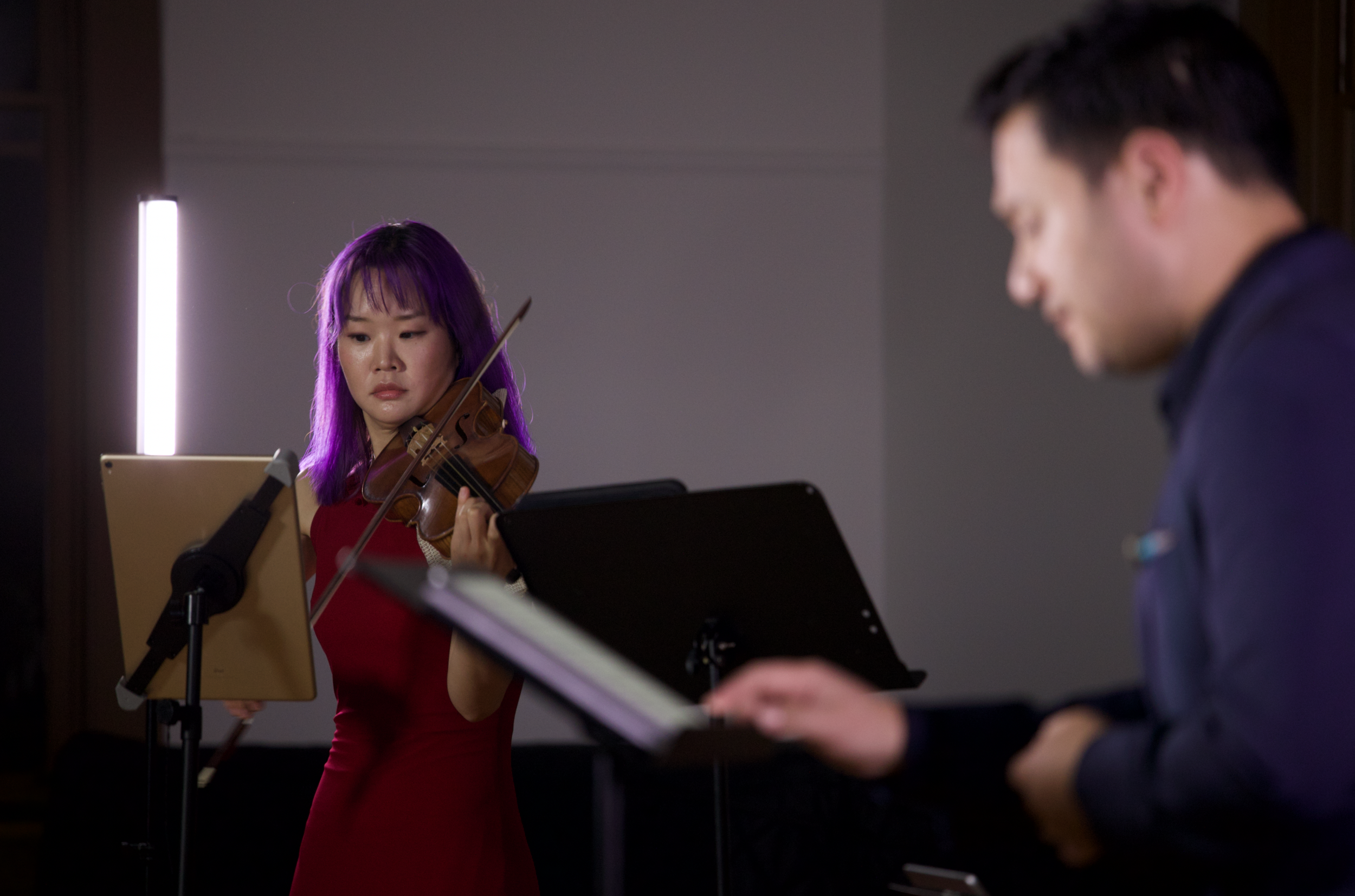
Herr, so weit die Wolken gehen from Gott, wie dein Name ist, so ist auch dein Ruhm BWV 171
PERFORMERS
Nicholas Phan, tenor
Katie Hyun, violin I
Owen Dalby, violin II
with Ruckus Early Music
Doug Balliett, viola da gamba | Clay Zeller-Townson, bassoon | Elliot Figg, harpsichord | Joshua Stauffer, theorbo
SOUND (BWV 171 only): Lolly Lewis | VIDEO: Clubsoda Productions
This episode was filmed in partnership with Noe Music.
This project is a fiscally sponsored project of FRACTURED ATLAS.
To find our more information and to make a TAX-DEDUCTIBLE donation to support the continuation of this project please click the button below
TRANSCRIPT
[00:00:00] S COOKE: And I think with Bach, his genius is otherworldly.
[00:00:05] AUDIENCE MEMBER 1: I think Bach's music is so transcendental.
[00:00:09] K HYUN: No, I, I know plenty of non-musicians, people who know absolutely nothing about music, and they've been drawn to Bach.
[00:00:16] S COOKE: It's just hard to not like Bach. I mean you know? I
[00:00:19] AUDIENCE MEMBER 1: mean, um, even my cats know about this. I had a cat that I named Chaconne.
[00:00:27] Too cute, so it became Chaconi. And Chaconi knew, knew what she liked. She knew that at the end of the night, I would play Bach. So she would, I would, I would... She would say, "Ah, on the horizon, Bach." And she would settle in. I had quite a nice stereo, and she would sit in the sweet spot of the stereo. So I think that's just another indicator of how Bach's music is universal and appeals to everyone and lets everyone know it's true, that the u- world is gonna be okay.
[00:01:06] N PHAN: Hi, my name's Nicholas Phan, and this is the Bach 52 Project.
[00:01:15] This week, I chat with pianist and author of the memoir Every Good Boy Does Fine, Jeremy Denk. Jeremy spoke with me about how Bach was a kind of get-off-my-lawn kind of person, in the sense that he was really working against his time. At a time when other things were becoming fashionable, he was really interested in doing his own thing and, in a way, was sort of looking backwards in time for inspiration, but somehow, paradoxically, in doing so, ended up looking forwards.
[00:01:50] It was a fascinating conversation, and I hope you enjoy our chat. And stick around for the aria at the end from Cantata 171. So thanks for doing this. Of course. I appreciate it. Basically, I'm going around asking people this question: Do you think the music of Bach is for everyone? And I know that the music of Bach is super important to you.
[00:02:13] J DENK: Mm-hmm.
[00:02:14] N PHAN: And so I- I'm really grateful that you're chatting with us today. I mean, I know you've just written a book about this, but let's start off pretty simply and, like, start with, you know, how did you get into music and how did Bach into your life?
[00:02:25] J DENK: Well, there was a piano in the house, a little upright piano, you know, and my parents had a record collection, and that's all it took.
[00:02:32] You know, my dad would have me listen on the couch with him to various records. He loves the Saint-Saëns Organ Symphony and Mahler Titan Symphony, and those scenes are in the book where we're, where I'm getting my really first doses of classical music. And I started playing at the piano, you know. I'm, I'm not sure what my very first Bach was.
[00:02:49] It was probably on that same, like, 100 greatest hits of classical music album. It was probably, uh, Air on the G String, but it could also have been, um- The Gounod Ave Maria, which was on the Barbra Streisand Christmas album that we always listened to. Uh, so those are the two possibilities. Yeah.
[00:03:08] N PHAN: And on that, those first listens, I mean, do you remember what your reaction was?
[00:03:13] J DENK: I didn't distinguish Bach yet in those days from any other, you know. Uh, really the composer that got me the most when I was a kid, when I was a really younger child was, was Verdi actually, Verdi operas, and Mozart piano concertos weirdly. Somehow I was able to find a voice into them. Bach probably, you know, of course I had to play him for competitions and for my teachers.
[00:03:35] Had to play the Minuet in G, and then I had to play, you know, preludes and fugues. You know, like even the one... That was one of the first ones I did. Um, it's pretty hard one actually.
[00:03:49] N PHAN: I think they're all hard. But-
[00:03:50] J DENK: They're all hard. But then I can see in my book we worked really hard on that one. You know, that was probably when I was, like, 12, 11 or 12 we were really working on that for finger independence.
[00:04:00] And so those pieces had an element of suffering to them, um, in those days. I think it wasn't until college, like Oberlin, that I started to really just rock out on Bach. And then weirdly I think it was, like, Ivo Pogorelich, uh, doing the Bach, the, the G Minor English Suite, you know? It was like this unbelievable forward energy of Bach that he had.
[00:04:30] Now when I listen to that recording it's a little bit maniacal, but it had, there was something great about it that I- Mm ... that I was like, "Oh, yes, now I'm beginning to get Bach." And then I got a little obsessed with the E Minor Partita. That's a longer answer to your question than you probably wanted.
[00:04:46] N PHAN: No, I want long answers.
[00:04:48] This is great. I mean, I think his music merits long answers,
[00:04:51] J DENK: and-
[00:04:52] N PHAN: Mm-hmm ... I think dialogue around any music merits long answers, but especially his.
[00:04:57] J DENK: Well, it was the kind of motoric element, and we all got that a little bit from Glenn Gould of course, who I, whose name I, I don't want to mention. It's sort of like Voldemort for me a little bit-
[00:05:06] 'cause everyone talks about him. But there was something about that sheer, which is an, a crucial part of Bach, the sheer, like, once it begins spinning out there's this, you know, unbelievable wealth of invention. Very few silences or places of stopping. Bach didn't like to stop, you know? Earlier Bach you see a lot of, a lot more repetition and stopping, but as he gets more mature he begins to cut that out, and it's all about for him the, the endless kind of elision, one invention springing out of the next, one voice springing out of the next.
[00:05:37] And I guess that was one of the things that caught me, you know, when I was in, like, college. And then, but the E Minor Partita, which I loved then, is the total opposite of that. Like, a really thorny, mm, pensive, kind of almost inscrutable piece in many ways. And then I was like, "Oh, yeah, I want to figure out that puzzle.
[00:05:56] What, what's he doing there?" Well, maybe that one was... You know, I was just attracted to the incredible What a great fugue subject, right?
[00:06:30] And, you know, and that's a s- a different kind of endless motor of Bach. But it was, then I was like, "Oh yeah, that's amazing. I can find so much to do in that and to think about in it," you know? Plus it's, it's like ineluctable, right? It just keeps drawing you forward.
[00:06:49] N PHAN: It's interesting. Yeah, I'm just thinking about something you said to me yesterday about, like, trying to find the why behind why you study music.
[00:06:59] J DENK: Uh-huh. Right.
[00:07:00] N PHAN: And, and for me, Bach has a lot of questions there. It's, I mean, I think there's... Maybe I'm still asking myself that, and that's probably why I keep coming back to it in some ways.
[00:07:10] J DENK: Mm-hmm.
[00:07:11] N PHAN: I wonder if that's similar for you, or if it's been music that's kind of explained that why to you, maybe?
[00:07:20] J DENK: Well, there are so many whys for Bach, you know, maybe more than for any other composer. Obviously, if you really think about him as a person in his context, right? Religion, devotion, the glory of God, you know, an incredible immersion and piety and, and music as, as, as worship, right? As a form of giving thanks and praise.
[00:07:46] But it is interesting to me because Bach seems more loved by the younger generation these days than almost ever, right? There was a period when it felt like Mozart was more, you know? Mm-hmm. And Bach appeals in a weird way, you know, like, as again, with, with Voldemort or Glenn Gould. Um, there's this kind of, um, element of Bach that's viral, like stream of data.
[00:08:10] Like it feels you know? It feels... And it also c- it can create this wonderful sense of mania, which is really relevant to, to modern life. It, you can go there, and then it can become incredibly meditative, which is also something that people are craving. So the, the why of Bach has changed for us, you know?
[00:08:29] Like the, the things we see in it, the things we value in it. Certainly he wouldn't probably recognize them, but I don't think that's inherently a bad thing.
[00:08:38] N PHAN: Sure.
[00:08:38] J DENK: Yeah.
[00:08:39] N PHAN: I mean, art continues to live beyond its creators and be in dialogue with... I mean, that's the part of the point of creating it,
[00:08:46] J DENK: right? Yeah, no.
[00:08:47] I was in this conversation with a musicologist who said we have to always respect, you know, the intent, you know? Um, we were in an argument of whether Bach was a rational- composer. And he says, "Well, actually, there's only one mention of reason in all of Bach, and it's one of, in one of the cantatas, and it's a, it's a biblical verse which condemns reason as a false god."
[00:09:09] Right? And Bach writes this very exaggerated, chromatic, thorny thing to indicate reason's kind of dead end or whatever. And I understood what he was saying, th- we shouldn't bear false witness to, you know, but it does seem, whether he meant to or not, that he communicated a kind of musical reason that has this beautiful emotional, obviously, relevance, you know.
[00:09:33] But he created a kind of language in which music came to feel less random. Do you know what I mean? Yeah. Yeah,
[00:09:41] N PHAN: yeah. I mean, I think, for me, that's part of the genius of it, right? It's, it's, it seems so chaotic on first listen or first glance on the score, but actually, there's such structure to it, and it always feels inevitable in a way to me.
[00:09:55] Always. That, I mean, is extraordinary 'cause it's kind of like making reason out of chaos. I don't know. When you think about the time he was living in, it was a great time of unrest and war and...
[00:10:07] J DENK: Yeah.
[00:10:08] N PHAN: And the world was going through a giant philosophical shift right around his lifetime, too.
[00:10:13] J DENK: Which, you know, to be fair, Bach was against his time, right?
[00:10:17] If any, if you think of him, he's, he's really get-off-my-lawn kind of. Especially by the end of his life, right? All the kids are writing this lighter, accessible, two-by-four bar, or two f- two bar or four bar phrase music, you know, music that's basically in a comic opera style. And he's like, "No, I'm gonna write The Art of the Fugue" or whatever, you know.
[00:10:36] He's not, he's not interested. Yeah. He gets more and more into the older arts. But he was a vehicle of the future whether he wanted to be or not. If you know what I mean. Yeah. Yeah, yeah. Totally. Yeah. I mean, I'm sure he understood the ways in which his music was more daring and more harmonically wild than, than many of his contemporaries.
[00:11:00] So he, he was forward-looking in that sense. But the, the constant love of past models, ancient models, things that were desperately outmoded, right, the, the old... He loved writing those fugues that are, you know, these sort of... Right? This kind of, you know, what we call the white note fugues, right? 'Cause those really slow values, right?
[00:11:25] Clearly something almost medieval or certainly Renaissance about it, right? And he loved to channel that voice, you know, so he was really plugged into centuries before him.
[00:11:43] N PHAN: You said that you think mus- Bach's music is really popular with young people today, more so than it has been recently, or in whatever, during your lifetime.
[00:11:52] J DENK: Mm-hmm.
[00:11:52] N PHAN: I would love to hear you say more about that. I find that fascinating. In my experience, I've noticed that too, but, you know, I go to these, you know, a, a Bach academy where people are coming to study the music of Bach with someone like Helmuth Rilling, and these 20, 22-year-old people come from all over the world, like Ecuador, China, you know, Finland, you name it.
[00:12:15] They all come to study Bach. It's like they're going to summer camp to stu- And then the whole thing is centered around Bach and his music, which to me is extraordinary, and I sort of see that. But then there's this... I feel like when I say to other people who are not us, "Oh, Bach, it's popular with young people," they're like, "What?"
[00:12:30] So I'm curious to hear about your experience.
[00:12:33] J DENK: Well, I wouldn't say I'm, like, an expert on the zeitgeist or whatever, but, um- I do see the, you know, people, for example-- And I, I love Mozart. Mozart is one of my holiest of holies, right? But younger people tend to see Mozart as fairly boring, and they feel the wig, you know, the, the, the powder and the wig and the courtliness, and they hear all the kind of conventions, you know, which are obviously a huge part of Mozart and the, and the sort of particular classical style which has this architecture and pomp, you know?
[00:13:03] And that feels old to them and boring and full of filler, and Bach doesn't feel that way to them at all. It's true Bach doesn't really have filler, per se, for the most part. Even, you know, mostly when he has accompaniment patterns, they have a deep interest, you know? With some exceptions, but he mostly, right, it's just all the voices are doing something.
[00:13:24] And there's very rarely those kind of typical... Well, Bach doesn't really like to write that many cadences anyway. But, you know, so Mozart's full of cadences, right, which feel like bows or curtsies or whatever, and you don't feel any of that in Bach either, right, for the most part. Bach has a better, in a way, rhythmic groove, although of course Mozart was pretty good at that too.
[00:13:46] But, like, in Brahms to younger people feels incredibly old and varnish covered and dusty and, you know, fat and, you know, full of... Whereas especially with all the amazing early music, you know, things that have been happening over the last 50 years, you know, which we love to complain about, all the, you know, the dogmas and the sort of slight exaggerations or whatever that, that happen.
[00:14:11] But that, that is a-- Has-- They've really rethought that music so that it sits in our time, and that's, that's kind of amazing.
[00:14:21] N PHAN: Yeah, it is.
[00:14:22] J DENK: Yeah.
[00:14:22] N PHAN: I mean, a lot of early musicians really approach it like a living thing, which as opposed to-
[00:14:27] J DENK: Maybe slightly more improvisatory. Yeah. Certainly when-- I've been listening to all those, you know, the wonderful Netherlands Bach Society, which has that all of Bach, right?
[00:14:35] And some amazing performances there, and, and some that are more what you might expect and one-- some that are wild beyond all imagining. And I, I tend to prefer, 'cause you feel the wildness of Bach, you know, with all the time. I mean, he wrote some of the most demonic- Passages. You know, for someone who was so pious, he wrote some of the most demonic passages of music ever, ever composed.
[00:15:01] N PHAN: So I mean, this is a totally unanswerable question that I'm asking everybody, but do you think it's for... Do you think his music is for everyone, or... And what does that question bring up for you?
[00:15:12] J DENK: I'll admit, I- I do think the question feels a little loaded somehow- ... especially, like, right now.
[00:15:16] N PHAN: Well, why right now?
[00:15:18] J DENK: Well, everyone's on the Twitter, you know, saying how much, you know, it's idiotic to say that music is a universal language. And, and I, I take their point, obviously, you know. Music does live in a context within a culture and, and it takes some... You know, it took me a lot of effort to absorb myself into this musical tradition, and I'm attached to it, but, you know, not everyone is gonna want to make that effort or needs to make that, right?
[00:15:42] It's... I feel there are lots of treasures, and I love keeping the flame alive of these treasures that I feel, but I don't... I guess I get very nervous trying to say that Bach, everyone should l- love Bach. And a lot of people do. It doesn't matter, you know? Um, he's, he's one of the most... It-- What I will say is he is as, as, uh...
[00:16:04] Events from his life. You know, he constantly transcribed pieces from one instrument to another millions of times. You know, he reused pieces. He rewrote them for different instruments. And if you... You know, I grew up with the Swingle Singers. That sounds ridiculously great to me, you know. Bach sounds amazing swung jazz vocal ensemble.
[00:16:23] Bach sounds amazing on an accordion. Bach sounds amazing in a brass choir. Bach-- The same piece, you know, sounds spectacular in, in an as- an astounding number of different instrumentations. I don't think you can say that as much about Mozart or Brahms or you know what I mean? The pitches themselves, the notes have a life that, that does seem unusually able to ignore what instrument it's on.
[00:16:51] Yeah. That's
[00:16:52] N PHAN: an interesting way of phrasing it.
[00:16:53] J DENK: Yeah.
[00:16:54] N PHAN: They find life everywhere they go, it seems.
[00:16:56] J DENK: Yeah, they're just notes, you know. I mean, it's so great when you confront... You, you, you know, probably your listeners, viewers know this, but, you know, there's very few markings in a Bach score, right?
[00:17:07] N PHAN: Yeah.
[00:17:08] J DENK: The entire Goldberg Variations has, like, two tempo markings, right?
[00:17:11] I get really mad when pianists don't do them. It's like there's only two of them. I was yelling at this poor girl at a, at this piano event, and she played the Goldberg Variations. It was quite stunning, but-- in many ways. And then she played the famous the 15th, the first minor variation which has slurs.
[00:17:36] There's almost no other slurs in the entire piece. Two by two. Uh, so it's like obviously this kind of slow progress. Let's say, you know, kind of Christ laboring up the Golgotha or whatever. It's this kind of- Very close attention to two notes at a time. And she didn't do that sl- she did so many other amazing things.
[00:18:00] She didn't do that one slur. Those brief moments aside, Bach tells you very little, and you can make him work in amazingly large number of tempos, characters.
[00:18:12] N PHAN: Yeah.
[00:18:12] J DENK: A piece can go, you know, shockingly different ways. I have a really hard time in The Well-Tempered Clavier 'cause there's a couple fugues that I still can't decide what tempo it's going to be in it-
[00:18:25] and what the character is, you know?
[00:18:26] MUSIC: Mm-hmm.
[00:18:27] J DENK: And it's amazing. It's very f- like this, the, um, this fugue, you know It can be played very beautifully. Right? Haunting, right?
[00:18:54] But it can also be quite funny. And it has a totally different life, also delightful. Yeah. And then I always start the fugue, and I'm like, I don't know which way I'm playing it today. I d- I, I still don't know what Bach meant because the slow way... Anyway, the point being, um, there's an intense interpretive freedom in this music that, that many other musics don't have either.
[00:19:32] Yeah.
[00:19:32] N PHAN: Yeah, I'm always fascinated by that because I feel like in many ways Bach is like Italian cooking. You know, you have people who believe it's supposed to go one way, and they think they're right, and people who believe that it's supposed to go another way, and they think that they're right.
[00:19:48] J DENK: Right.
[00:19:48] N PHAN: And, like, both people are right, kind of like, you know, you use garlic, and no, you never use garlic, and both people are right, kind of-
[00:19:54] in that sort of regional difference in Italy. And it's, it's-- I always kind of chuckle at that 'cause I feel the same way. Like, there's so much interpretive room, and in a way, that's kind of what's amazing about it. And he tells you so much just by the notes themselves. Like you say- Yeah ... he doesn't give you a ton of markings.
[00:20:10] But, like, the shape of a phrase or, like, where the notes go or, you know, how long they last, they-- There's a lot of information there, and that information provides you with choices, and lots of choices can work.
[00:20:23] J DENK: Yeah. And if you can't make your own decisions based on those beautiful notes, then you probably shouldn't be No, 'cause everyone develops...
[00:20:31] I-- That came out sounding annoying. But what I mean is y- as you play, you develop a feeling. You know, what, what is it? What's the groove of this piece? Bach, actually more than almost any other composer, depends on the right groove.
[00:20:44] N PHAN: Right.
[00:20:45] J DENK: What-- A choice of groove and then allowing that to animate events.
[00:20:50] Right. Maybe that's another thing that makes him- You feel the hidden drum track or whatever much more in Bach than you do in some other composers.
[00:21:00] N PHAN: So has what he's meant to you changed over the course of your life?
[00:21:05] J DENK: Yeah, no, every piece has come to mean different things to me. You know? I think, you know, one of the pieces that altered my life the most was the Goldberg Variations, which was a piece that I desperately did not want to play because everyone plays it.
[00:21:18] Mm. And it's also very treacherous and naked, and everyone knows it, and everyone has an opinion, and ugh. And my f- my f- friend who was running the festival in Seattle, Toby Sack, she had said, "This is going to be very important for you, this piece, and you should play it." I was like, "Okay." So I learned it for her festival in one panicky December, you know?
[00:21:36] You know, it changes your technique to play a piece like that, which is so much about two hands doing wild acrobatics, right? Mm-hmm. It changes the way your brain gets wired. And then... But you know, that piece, you know, everyone talks about various performances of it. I'm not sure any two that I've ever played have been remotely similar.
[00:21:58] I do feel part of the message of that piece that, that stuck with me over the years is, like, here you have something that is unbelievably sublime. Here you have something that's silly and ridiculous , you know? Here is something in the middle, something tender, something desperately tragic. And, and then you have this incredible sense of a thread through the whole possibility of human emotional life.
[00:22:23] That's pretty amazing to manage, you know? I'm not sure... You know, Beethoven tried to kind of, quote unquote, outdo the Goldberg Variations in his la- last sonatas. He did s- amazing things that went in another direction, but he, he couldn't quite get that universality of Bach, which is... It's hard to describe how, how Bach actually managed.
[00:22:45] There's a certain, like, not exactly remove, but Bach isn't up in your face, right? He's sort of allowing notes to dance around in various ways. And Beethoven is egging you on, you know?
[00:22:59] N PHAN: Yeah.
[00:23:00] J DENK: You know, looking for something, right?
[00:23:01] N PHAN: It's interesting 'cause he's, Bach's compositional style is very tightly controlled, but at the same time, like everything has its freedom and its own life.
[00:23:07] Like you say, he does allow them to kind of go where they're supposed to go.
[00:23:12] J DENK: Yeah. And he knows, he has an incredible sense of tone also, doesn't
[00:23:16] N PHAN: he? Mm-hmm.
[00:23:16] J DENK: Weirdly.
[00:23:17] N PHAN: Yeah.
[00:23:18] J DENK: Like the, the wistfulness of the Goldberg theme, you know, which everyone loves, you know, that sort of gloriously beautiful G major, and then this little faint into the minor right below, and then coming back out of it and this like...
[00:23:33] The control of, of not just musical materials but this kind of em- emotional rhythm of things. And people don't, maybe they don't talk about that quite enough as a... Which makes him kind of an op- uh, like a more, like the kind of values we tend to- Ascribe to great opera composers, knowing how to let a scene unfold-
[00:23:54] N PHAN: Mm-hmm
[00:23:54] J DENK: emotionally.
[00:23:55] N PHAN: It's interesting what you said, too, about Goldberg Variations and just changing your technique. Mm. Do you feel like it changed it for the better? Do you think it-
[00:24:01] J DENK: Yeah, no, it was very terrifying, but it definitely changed it. It changed, you know... But it also just forced me to discipline myself in certain ways, you know?
[00:24:08] And to take, also, courage. Mm-hmm. Whenever you start that piece, you know. But I had that experience recently with the, with The Well-Tempered, which is, you know, music that I played as a child, right? How do you get over that sense of terror from all the auditions and the things that you play it at, you know?
[00:24:24] And also the stultifying sort of, oh, teacher says, "Oh, you gotta do it this way, and, and articulate it that way." And it's like, no, I want to look at this music as what I think it is, which is a series of amazing lessons, and which is the ultimate, like, teach-- Do as you will teach or teach as you will do, you know?
[00:24:41] I'm going to teach you, but I'm going to also do and create this unbelievable, you know, vivid, one vivid inspiring musical lesson after another. And it won't be pedantic. It will be a demonstration of every, like a, like a Noah's Ark of every musical possibility, right? Two by two.
[00:25:01] N PHAN: Two by two into- Yeah. It's interesting, too, I mean, I feel like when, at least when I saw you play that in Boston, you also kind of drew this allegory of, like, finding the totality of life experience in the piece- Mm
[00:25:11] not dissimilarly to the Goldberg. Mm. And I'm ju- I'm fa- I'm fascinated to hear you say that about, um, just the technical thing, because m- most singers complain that Bach is, you know, unsingable, and it's not vocal and blah blah. It's too instrumental.
[00:25:24] J DENK: It does seem arguably more awkward for singers than it is for keyboardists.
[00:25:27] N PHAN: You know-
[00:25:27] J DENK: Yeah ...
[00:25:28] N PHAN: it is, and then at the same time, like, it, I've learned the same things that you describe from it. Mm. I actually find it to be very vocal at the end of the day, like, once you figure out what he wants and how to get there and how to do it, and it does challenge you and demand of you a discipline.
[00:25:42] But once you find that discipline, that bleeds into everything else that you do. It's great.
[00:25:47] J DENK: Yeah, of course it is.
[00:25:48] N PHAN: You know? And so it's... I'm, I'm kind of, like, a big advocate for a singer studying it even though everybody's sort of nervous about it. Except for Sasha Cooke. I was talking to her about it the other day, and she was like, "Oh, it's easy."
[00:25:58] And I was like, "Not fair."
[00:26:01] J DENK: Yeah, I don't, I've never, not really often heard singers say that Bach was easy. Yeah. It looks, on the page, like, can anyone sing that? It does, does look a little... I mean, the keyboard music is insanely virtuosic at times, and, and awkward, you know? But you know that he... This is all muscle.
[00:26:21] He knew how to do everything at the keyboard,
[00:26:23] N PHAN: right? Right.
[00:26:25] J DENK: And every kind of keyboard.
[00:26:27] N PHAN: Is there anything else you want to say about Bach? About your book?
[00:26:30] J DENK: There's a big passage about Bach and sex in the, in the book that, for newbies to music, that seems to be the most entertaining chapter for them. Yeah.
[00:26:40] N PHAN: Well, it's a surprising pairing, although to, I mean, to us it maybe is not so much. He had how many children, like- So
[00:26:46] J DENK: he had a lot of children. Yeah. So presumably he was able, uh
[00:26:53] N PHAN: He was well-versed.
[00:26:54] J DENK: He was well-versed. But, you know, Bach, it's all about how Bach marshals harmonic tension. I hope-- I think it's kind of funny.
[00:27:02] Yeah. In explaining, like how Bach uses seventh chords, which is-- I think it's-- I- it is important to say that, you know, Bach historically sits at a weird moment, right, when what we consider to be tonality, the way that harmony should go, is kind of just poking out of the womb, right?
[00:27:22] N PHAN: Yeah.
[00:27:23] J DENK: You know, late 1600s, sort of everyone's doing it, and everyone's, "Oh, yeah, every-- this is sort of makes sense," and people are having theories.
[00:27:29] And Bach kind of like... Yeah. And one of the real discoveries is this qual- they-- I mean, the seventh chords existed, of course, right? Right? All these different, you know, kind of tonali- these it always sounds so, like, lounge piano when you play a seventh chord all on its own. Um, but, but Bach, in that piece, seems to really want to tell you, "This is what these chords can do," and it's so visceral.
[00:28:00] Yeah? And even sexual in a way.
[00:28:03] N PHAN: Yes. They're sexy chords, especially when they remain unresolved.
[00:28:07] J DENK: Well, and Bach loves to sit on the unresolved ones for a long time- Yeah ... and do all kinds of amazing things, yeah. Yes, so the book has some tidbits about Bach, various
[00:28:18] N PHAN: things. Do you think people should care about Bach today?
[00:28:20] And if so, why?
[00:28:22] J DENK: Again, I, I feel like the question is slightly loaded. Although I, I do, I do think it's important for all of us who are in the classical music world, you know, to keep asking ourselves why? Why is this relevant? Why? Bach himself said that his works were intended for the, you know, the refreshment of the mind and spirit.
[00:28:42] Right? In the title page of the, I think his Opus One. That's pretty good. That's a pretty good reason to listen to-- I think many people find certain Bach works completely astonishing time after time, the way the notes unfold, you know? And it also creates a kind of flow state in the mind, takes you out of yourself and allows you to be part of this kind of weird abstract thought process that, that, that has amazing ups and downs.
[00:29:09] And then, and then it returns you to yourself filled with that thing. And over and above, like, the humanistic element of Bach, which is great, you know, this incredible sense of empathy and, as we talked about, all the different emotional things that Bach is able to be part of. He's an amazing composer for catharsis when, right, when you-- Many musicians play Bach in the morning because it's ultimately refreshing, right?
[00:29:31] And inspiring. I don't know. Does it need more of a reason than that to exist? I don't-- To be loved? No, I don't think so. Bach is unique. There's n- there's no question about it. And part of the uniqueness is reflected in the fact that- For now hundreds of years. I mean, Haydn learned to play the piano with The Well-Tempered Clavier.
[00:29:51] Mozart learned, Beethoven learned. Everybody learned to play, right, and think about harmony through these pieces. They, nobody gets mad about it, either, you know? That nobody argues, "Oh, you shouldn't learn music with Bach." We all ag- most people agree. It's like, oh, yeah, Bach's... It, it just creates a, a beautiful foundation for so many other things, too.
[00:30:14] N PHAN: Jeremy, thank you.
[00:30:15] J DENK: Of course, Nick.
[00:30:26] N PHAN: The aria for today's episode is taken from Cantata 171, Gott, wie dein Name, so ist auch dein Ruhm, which means, God, just as your name, so shall your praise be. The cantata was composed likely in 1728, and probably had its premiere in 1729 on New Year's Day. The aria is the second movement from the cantata, and it's scored for two violins and continuo and tenor.
[00:30:54] And the text of the aria is basically saying, "God, everywhere so wide in the world shall your name be praised by everything." Hope you enjoy the aria.
[00:31:43] Aria from BWV 171