EPISODE 14
Bach, Faith, and the Future of Classical Music
with Chad Smith | president & CEO, Boston Symphony Orchestra
Last August, the Tanglewood Learning Institute hosted the first live-filmed conversations for BACH 52. The first of these features Chad Smith, President & CEO of the Boston Symphony Orchestra, in a wide-ranging conversation about Bach, classical music’s evolving place in contemporary culture, and the role of major artistic institutions as civic and cultural stewards.
Bach, Spirituality, and the Concert Hall as Civic Space
Our conversation began, quite naturally, with biography. Chad spoke about discovering Bach through singing — first in the church, then in college — and through the cantatas that filled his Sundays at Emmanuel Music in Boston. Listening to him describe those formative experiences — and recalling my earlier BACH 52 conversations with Emmanuel musicians and clergy in Episodes 8, 10, and 11 — I am continually struck by the ripple effects of Emmanuel’s influence on our musical world.That world of devotion, community, and routine artistry left an imprint on him, and it informed the way he now thinks about ritual, faith, and the spaces where we gather to listen. From there, the discussion widened to touch on the concert hall as a kind of secular cathedral, the persistence of spiritual longing in an increasingly secular age, and the ways art can function as a public good.
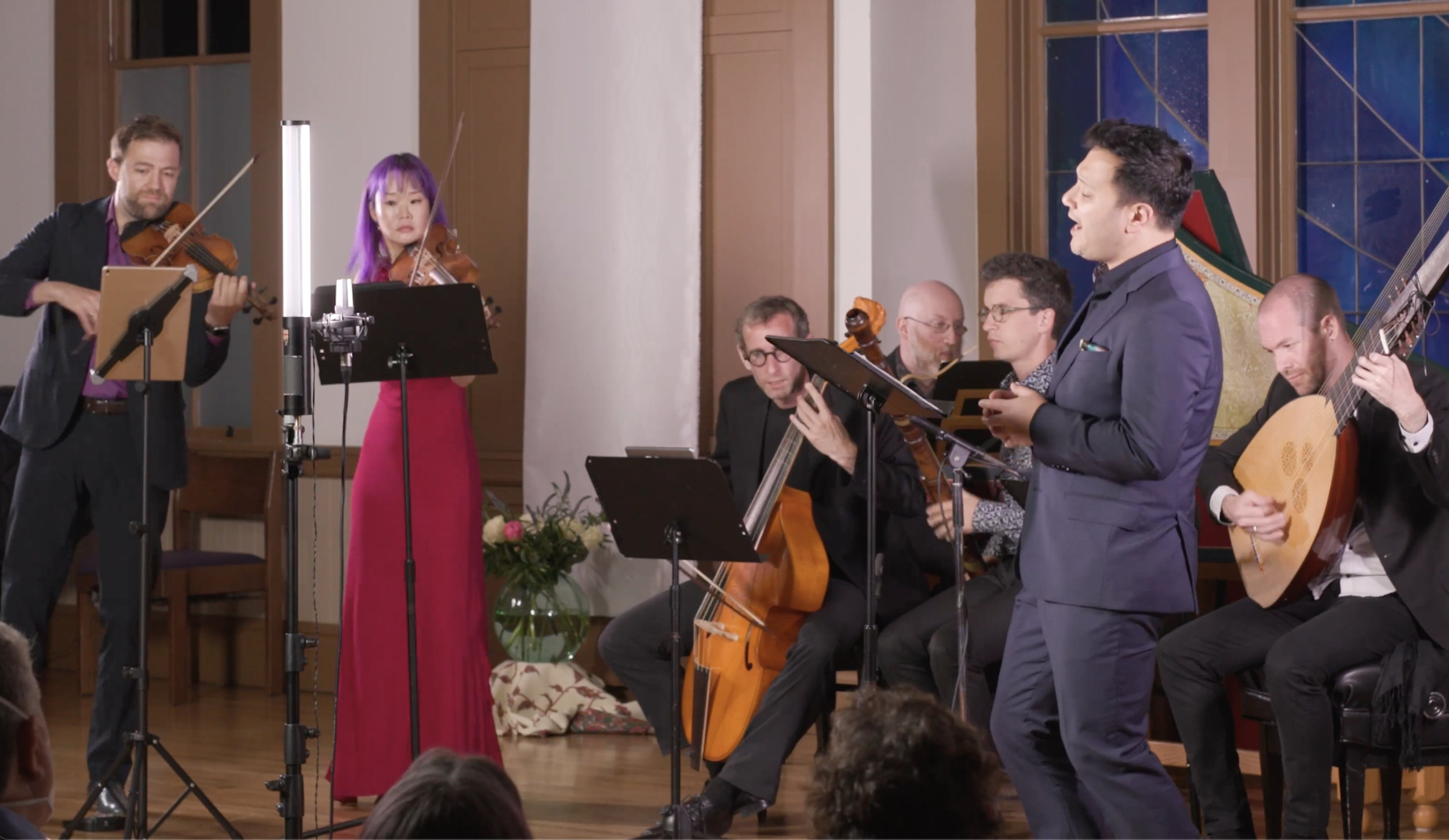
Because this episode was filmed live at Tanglewood, its structure mirrors the event itself, which contained more music than the pre-filmed webisodes normally do. The first aria comes from BWV 7, Christ unser Herr zum Jordan kam, a cantata written for the Feast of St. John the Baptist. Scored for tenor and two violins, it paints the scene of Christ’s baptism at the River Jordan with striking clarity. Its numerological symmetry and Trinitarian imagery evoke purification and renewal — both liturgical and human. This aria first appeared in Episode 1 of BACH 52, and makes a reprise here as the aria featured in my conversation with Chad.
The episode concludes with an aria from BWV 119, Preise, Jerusalem, den Herrn, written for the inauguration of the Leipzig town council. BWV 119 looks outward as a blessing for the city and its inhabitants, imagining civic life as something worthy of ceremony, festivity, and song. After a conversation about institutions, public ritual, and the artist as citizen, it felt fitting to close with a work that collapses the distance between sacred space and civic space, reminding us that Bach lived not only in the church but also in the life of a city.
ARIAS
Wohl dir du Wolk der Linden from Lob sei und Ehr dem höchsten Gut, BWV 119
PERFORMERS
Nicholas Phan, tenor
Les Délices | Debra Nagy, director
Oboes da caccia: Debra Nagy, Meg Owens
Viola da gamba: Rebecca Landell
Organ: Mark Edwards
SOUND (BWV 119 only): Joel Negus | VIDEO (BWV 119 only): Clubsoda Productions with Ken Wendt assisting
Des Vaters Stimme ließ sich hören from Christ unser Herr sum Jordan kam, BWV 7
PERFORMERS
Ruckus Early Music
Violins: Katie Hyun, Owen Dalby
Viola da gamba: Doug Balliett
Bassoon: Clay Zeller-Townson
Theorbo: Joshua Stauffer
Harpsichord: Elliot Figg
SOUND (BWV 7 only): Lolly Lewis | VIDEO (BWV 7 only): Clubsoda Productions
This episode was filmed in partnership with Noe Music, Les Délices, and the Tanglewood Learning Institute.
This project is a fiscally sponsored project of FRACTURED ATLAS.
To find our more information and to make a TAX-DEDUCTIBLE donation to support the continuation of this project please click the button below
TRANSCRIPT
N. PHAN
Do you think the music of Bach is for everyone?
A.TILBROOK
I know, I don't think so. I mean, I think I think it should be. I think some people are put off by the religious nature of it.
K. WHATELY
I think for me, the religious element of so much of his output isn't off putting, despite the fact that I'm not at all a religious person.
S. MCGINNIS
When you think about the choral writing, the and writing for The Voice, that of course is linked to text that there is a desire for a universality in that which I think is really moving.
J. BLUMBERG
I think there's there's a lot to learn from it. I think we put it in its context, and then we also need to scrutinize it as, as modern citizens of the world. I think it's too brilliant to cast aside as music of the past. I think it's it's ever new.
R. WILLIAMS
I don't suppose he's thinking this music is going to be, a standard for centuries to come.
I don't think he's thinking when they eventually put a probe, a deep space probe in space, they ought to put this piece of music in there as an example of what the human race is capable of. I think he's thinking this is needed for next Sunday. I'll write and oh, it works upside down. Oh, it works in retrograde.
Oh, look at, you know, look, if I do this at the fifth, I can do a canon and that's it. Like someone just solving a crossword clue at his table. If we had any way of saying to him, do you realize that your music is going to have this life after your death, that it's going to surround the globe?
Because that's how music can be disseminated in the future. And, and that people are going to be looking to you as, as the kind of father of music…I think… he would have laughed, I'm sure, because we it's only in a modern day that we begin to think about that, because we understand now that music can can reach everybody.
N. PHAN
I’m Nick Phan and this is BACH 52.
N. PHAN
Last summer we had the chance to take BACH 52 into the wild, as it were. We filmed two episodes live at the Tanglewood Learning Institute as part of their programming there last August. And the first of these conversations features Chad Smith, the president and CEO of the Boston Symphony. Chad was extraordinarily inspiring during this conversation, speaking about what he thinks arts and cultural institutions can offer our communities and our world and our society in today's increasingly secular world.
And also talking about why he thinks Bach, and by extension, Western classical music, are for everyone. As part of those performances at Tanglewood, we included a lot more music than we usually do for a Bach 52 episode. And I had the pleasure of working with the wonderful musicians of the Berkshire Bach Society. For those performances. Unfortunately for a bunch of very boring and logistical reasons, we weren't able to record those musical performances and include them in these episodes.
But what I've done is I've added one extra aria to this episode, taken from cantata seven, which featured in the middle of this performance. The aria from cantata seven is actually the aria that was featured in the very first episode of Bach 52. So it's getting a little bit of a reprise performance here in this episode, and you'll hear me and Chad talk about the challenges of being a tenor in the repertoire of Bach, because Chad himself is a former tenor. At the end of the episode. We will also feature another aria, as we usually do. This one taken from cantata 119. I hope you enjoy this conversation with Chad Smith.
N. PHAN
Bravi. You guys. So, let's get to the conversation. I, I don't think I need to introduce Chad Smith, the CEO and the president of the Boston Symphony Orchestra. Welcome, Chad.
CH. SMITH
Can we first start by saying how awesome that was? I, as a former tenor, like, listening to you that I'm like, thank God you're doing that and not me.
N. PHAN
Chad came backstage earlier and was like, what are we doing today? I was like, well, you are singing five arias by Bach.
CH. SMITH
Nobody wants to hear that.
N. PHAN
Oh I do. So I always start these interviews off just by asking: How how did Johann Sebastian Bach enter your life?
CH. SMITH
So I, I was a singer. I was, I grew up as a singer. I grew up in a church in the Presbyterian Church in Gettysburg, Pennsylvania. My mom was a pianist and a schoolteacher, but she she was a pianist.
And so. And she also, she directed the church musicals at the Gettysburg Presbyterian Church. So I played Noah at the age of four, parting the waters and singing. So church music, was always a really important part of it, but I was a Presbyterian, so good church music was probably not, like, not as it wasn't as high music as perhaps some of the other traditions that I but I but I have always appreciated that, that, that part of my training, like I came from a church musical background.
But I remember when I got to Boston and I came to school at, I went to school at NEC and Tufts and, very early on I got jobs in college, as a church musician. So I was hired as a singer, a tenor, to sing. I was kind of looking for all dollars to help me get through college.
So I sang at a Unitarian church on Friday nights. I sang at Temple Mishkan Tefila on Saturday morning, and I sang at a Congregationalist church on Sunday. Like, whatever God, I was prepared, right? But it was, again, this, this, this a real appreciation for for being what, what it meant to be a working church musician. And I tell you all of that because, about my third year in college, I was invited to go to Emmanuel, Music in Boston.
The church, just at the top of, Newbury Street. And, there was a, the music director there called Craig Smith, and, I, I went there because I had a couple of my friends were singing in the choir at Emmanuel, which was very famous, and Craig, did a Bach cantata every single Sunday, just for decades, every Sunday.
It was a Bach cantata. And what it was, whatever was 3 or 4 years, you would cycle through them. And I remember going and I was like, oh, no, this is, this is, this is church music. This is, this is church music. And I was hearing Lorraine Hunt Lieberson, who used to sing there occasionally, Sandy Sylvan, who used to sing there occasionally.
Jim Maddalena used to sing I'm Looking at you, Dawn [Upshaw] , because these were all people that you worked with when you were, when you would come through Boston. And I heard this music, so beautifully sung, so beautifully played and in the space that it was intended for. And, you know, I, I growing up, I, you know, I, my parents were deeply religious, I rebelled.
And you know, as I've grown older, you know, I've, you know, rediscovered that that tradition, in my own life. And I found it largely through a revisitation of the music of Bach, and, this deep connection that I have to the centrality of Bach's, faith, which is inescapable in his work. And so I know we're going to talk about like is Bach’s music for everyone.
I have I have certainly have lots of opinions about that, but I, I really, fell in love and kind of, have been on my own journey, my own faith journey that has really been propelled by the music of Bach. And again, one other one other thing, I, I again, it was my probably my last year in conservatory.
I was when I was an undergraduate or I might have been a graduate student and we did Bach, Matthew Passion, and I sang one of the tenor arias, and and again, that was, that was the first time I had sung a, a big Bach work. But it imprinted on me in a pretty intense way.
And from that year, which was 1996, every year since, Good Friday, I listened to a recording of the Matthew Passion that is just my own thing. My partner Bruce is like, I won't see you for 2.5 hours. Go listen to your Bach Matthew Passion. And it's funny because I started my first my first year, I started with, Herbert von Karajan’s recording of the Matthew Passion, which is a bit like, like driving a big Cadillac with deep, comfy seats and a suspension that doesn't let you feel anything.
It's that it's that kind of Bach. Like, I've since come to a much more historically informed, but, but it has been, it has been something that each year is really important to me.
N. PHAN
It's it's so interesting because, you know, most people say, oh, I encountered like like my story, like I encountered it as an instrumentalist or, you know, playing the cello suites or hearing playing a Brandenburg Concerto or hearing, you know, a violin concerto or playing the Bach double as a Suzuki student.
But you, you came through the cantatas. That's really interesting. Do you feel like you're kind of upbringing predisposed you to that kind of. Right? I mean, it sounds like your biography, sort of your life story in a way, leading up to that moment kind of predisposes you to this, this magical connection in that moment at Emmanuel.
CH. SMITH
Yeah. I think there was a lot like I was that was.
So I've always been deeply, concerned and interested in the humanities and how kind of history and how, different threads of the human experience and form art forms. And so for me, to the context of hearing Bach in a space that, where it wasn't a concert, right, but that it was prayer or that it was, that it was an act of devotion, and that it was an act of of of of a of real kind of, connected with, with faith for the people who were listening.
Not like I'm not buying my ticket to go to the Matthew Passion. I'm like, I'm at church. Was I think for me, helped me better understand that music. Right. That's. And that that was the great thing about the work that Craig Smith did. It brought these extraordinary singers. Right. You never know who who's going to show up, to sing some of these cantatas.
And then I was also struck by the fact that whatever there are, how many existing cantatas? 200 or so, 200 and some. Right. There used to be 300, and his son destroyed 100 of them or just didn't, you know, but you, the variety, the sheer diversity of sound and technique and and context, it's it was as diverse as the texts, from which they're on which they're based.
So it it hooked me. I was interested in the story of Bach. I was interested in understanding whatever it was 1727 when the Matthew Passion was being written. Like how you know what was happening in the world? What was what was his context? Who did he know? Right. Handel was what, 30 miles away. And they never met, like.
So all of these things just really captivated my my attention and curiosity. So normally I let people warm up to the question, but I'm going to just drop it on you. Do you think the music advocates for everyone? So like that's that. The short answer is yes. Right. Do I think the musical Bach is relevant? Yes. Do I see opportunities for, for for all people to to appreciate the musical box?
Sure. Do I in reality think that that is the case? Probably not right there. Probably. For who? People for whom this music is not. It's too esoteric. It's it's in a different language. It is not it is not accessible or it's not in a, in a on a genre that that resonates with there, you know, but what I, what I, what I think is I've come to is that the music of Bach one is so tight, right.
It is, it is impossible if you love this artform, if you love classical music or if you are interested, you cannot escape Bach. And nor do you want to like it. Is. It is. It is a moment. There are a couple of moments in history, right? Beethoven was another one, but Bach was one where, like, it feels like all music up until, let's call it the early 18th century was leading to that, to that moment, let's call it 1727.
And the Bach Matthew Passion for all music was leading to that moment. And then out of it exploded a multiplicity of possibilities for for music. And we saw that across the late Baroque period, we saw that through kind of the blossoming of, of really kind of diverse musical voices in the classical period that were defined by region. And then you saw it again in the early 19th century, this the sense that it was coming together.
These threads of history were coming together in Beethoven, the inevitability of Beethoven, the Third Symphony, that's like a kind of a spark or a fulcrum. So I think, you know, I do think that there is there are pathways into this music for everyone. And, and again, I could be, you know, I actually I, you know, it's not for everyone. Like plenty of my friends, like when I was living in LA it's not classical music is not for me. And then I remember one time when I was in Los Angeles, I was running the Hollywood Bowl at that time, and we invited Yo-Yo to come and do the six cello suites at the Hollywood Bowl. I don't know if any of you know the Hollywood Bowl. It's an 18,000 seat venue in the center of the city, right? Bustling Los Angeles. It is a place where on one night it will be Coldplay, and the next night it is, you know, the orchestra. On the next night it is, you know. No Elvis Costello. And the next night, right. And I, 18,000 people came. Literally 18,000 people came for Yo-Yo to play the cello suites. It was him on that enormous stage. One person, one cello and one spotlight for 2.5 hours. I have never heard a quieter audience and sure, right. Most of them came because of Yo-Yo, right? Like I'm going to go and hear Yo-Yo Ma, of course, but to hold an audience for 2.5 hours with a single instrument on that massive stage in a place where you know it is, it is so easily to be distracted. Reminded me of the power of this music. It's there's a reason, when you come to hear the Boston Symphony and a soloist plays a great concerto and they play an encore that 50% of the time it's Bach that they play.
N. PHAN
So I mean, to me, I'm really curious about the thought process leading up. I mean, we all know and love Yo-Yo Ma, so. Okay, great. But did it feel scary to say: we're going to invite one person and have him play the music of one composer in a town which, you know, is arguably maybe not at first, at first glance, a classical music town, (which I'm sure you'll disagree with because of your time there). But, you know, it's a Hollywood town.
I mean, the Hollywood Bowl is amazing because you like, look out and there's like, Julia Louis-Dreyfus sitting in the front row and, like, you know, whoever, but it's, it's, you know, Bach seems pretty–It seems kind of esoteric choice. And, I mean, at first glance. And did you think that or were you just really confident the whole time?
CH. SMITH
I think we look, I think when you're talking about a project with Yo-You you do it, you know, that's where he is.
Right? And so there's a there's a sense of doing that. What I didn't know is how the audience would respond. I didn't know how I knew that they would respond well to you, you know, but I didn't know how they would respond to that sense of quietude, that sense of, immersion in the music. Right. And the cello suites are interesting.
Right? So one of the there's so many things that I love about the music of Bach, right? It is that it is. He is the master contrapuntal ist. Right. You've heard it somehow, this multiple perpetual in this sense that the piece begins and it just is propelled forward by these lines that are spinning out melodies that are seemingly endless, but all the instruments are doing it, and at different times functional harmony is kind of playing out right at the at the time that these melodies are going this way, functional harmony is happening like this, and somehow that pulls us forward.
It pulls us in and pulls us forward. That is that is a a gift that, that, that he has. But he was also like, you know, he his, his life was you know, he wasn't like an itinerant musician. Right? It's not like he was he wasn't like Mozart doing the the grand European tours. Right. His life was was fairly contained within a, within a region.
Right. But somehow he, he absorbed these styles of France and these styles of Italy. And so things like the Bach Cello suites or the, the cheetahs or even the orchestral suites had these, these musical aromas like the Gigue, the Gavotte, all of these things found their way naturally into the music of Bach. And now for many of us, like the Gigue and the Gavotte is, I think of Bach when I think of those things.
The tarantella–not the tarantella–, that was not a Bach thing. But you know, there are. But some of these, these, these dances from so many different places. He so masterfully kind of absorbed and, and defined that now we think of those regional dances as, in my ears,his.
N. PHAN
So the you're kind of getting it where I want to go next, which is, you know, you're you're sitting at the top of this incredibly wonderful organization that has the potential for so much impact, not just in the state of Massachusetts, but like globally, you know, and, it's a classical music institution.
And as you as you've been kind of saying, you know, I compare a lot to Shakespeare. You know, there's for me the Saint Matthew Passion is Hamlet, right? That is just like the pinnacle in Western classical music, much like Hamlet is in Western literature. And there's like a before and there's an after, and everything is in dialogue with Bach, whether it wants to be or not and whether he wanted it to be or not.
And that's kind of an amazing thing. And so part of the reason I'm asking this question a little bit is like, we we kind of end up asking it of classical music in general. And so then that leads me to wonder here with this wonderful series of platforms that impact people in all sorts of ways, do you think classical music is for everybody? And how does that vision play out in the work that you're doing here?
CH. SMITH
Yeah. Again, I, I do Right?, I think, I think our, our, our challenge, is to explain the diversity of experiences that one can have with classical music. Right. I think one of the things that has defined in a narrower perspective what classical music is, is the experience by which people consume or attend.
Right? But what's wonderful is that there is the diversity of experiences by which we can engage with this art form is vast. And I'll give you an example. Two nights ago, Harry Christopher was here with, the Sixteen. And, you know, there have been amazing concerts this summer. Many of you have been to many of them.
The concert I was looking forward to most was that concert. And I love the Sixteenand I love the music of the Renaissance. That's just one of my, like, deep passions, talking about music that is not for everyone, right? Like I there are very few people who say Renaissance music. That's my jam, right? Said no one ever.
But, but for me, that is like, that is my happiest place. And there was this concert where the 16 sang the music of birds. So a 16th century, composer, and and paired with the music of Arvo Pärt, a 20th 21st century composer still is still alive. And there are similar there's there's similarities, right. They're deeply spiritual composers.
And they represent different, very different times by 500 years. But the experience of listen to what I was sitting there rapt in my seat. And one of my colleagues had her 19 year old son, who, you know, not it was just about to go off to college. And he said, you know, mom, I really want you to go out on the lawn.
I don't want to listen to this there. I want to kind of lay back on the lawn, and I want to listen to this concert. And and afterwards he said, like, that was amazing. Like I'd never I would never have listened to this music. But listening to it, seeing the stars above me, kind of feeling connected to the earth in this way, was, you know, was very, very powerful.
And that's that's classical music, right? That's classical music. As we are. In church or as we are in our, our synagogues or whatever faith traditions that we are in, there is music of praise that that is, is that that we connect with potentially. And so I, I, I do think it is I do think it is for everyone.
I think that we have to we have to we have to be open to the idea that, that there isn't a narrow way to present it or experience it. I always think about that at the Boston Symphony, like we give, let's call it 100 classical concerts a year. Our opportunity is to present that music in different ways for different people.
Some people want to come to temple, and I love that they want to come. They don't want to hear anything. They want to be sitting beside someone who is not moving right. They don't want to move. They want like this perfect, pristine environment that is important, right? That is an important way to hear our artform. There are some who want to come and bring their kids because they want to. That's the point they’re at in their life. Then they want to engage with us. But their, you know, their kids might move around a little. That's okay. We have to find ways for our art form to engage with families. There are some who who want to know. Absolutely. They want no talking. They don't even want program notes. It is blasphemous. I know everything I need to know about this music. Great, we've got that. But there are some who who say, like I did when I was a kid, like like, why was he writing this piece? Like, what was what? What compelled Schubert to write Winterreise? Like why he was only 31. That's a pretty dark set of texts. Oh, he was dying. Oh, okay. This is the last year of his life. Oh, okay. So for some people, there is that need or that desire to understand more. We just have to be more creative and more open to creating different experiences for people to fall in love with. This work.
N. PHAN
Thank you. On that note, I think we're going to take a bit of a break and we'll do, I'm going to call my musical colleagues back out.
Welcome back everyone. And, we're going to do one more aria for you, and then we'll come back and chat in a few minutes. This next aria is taken from cantata seven. The Bible reading that Sunday tells the story of the baptism of Jesus, which, incidentally, is the only time in the Bible that the Holy Trinity appears in one place. It's the only place where you see God, Jesus, and the Holy Spirit and practice this wonderful thing where he paints this picture and a really fun way. This is for two violins and tenor. And so there you have a three, right? The thing is, in a compound meter, it's in one like nine, eight. I think I could look at my music as soon as I get it set here.
And so that again is like a series of three and nine is divisible by three. Right. We get into this whole numerology nerdy situation. And then it's also the violins. Begin by outlining triads in A minor–A minor is like such a pure key. There are no sharps and flats, so it just means it's just all natural notes. There's no sort of shading on it if that makes any sense. For those who don't read music and yeah, it's, so it's kind of like a pure Trinity triad situation which represents this new beginning that that Jesus is experiencing in the story.
ARIA AND RECIT FROM BWV 7
N/ PHAN
Please welcome back. Chad. Yes.
You know, I–actually, the last time I sang that aria was at Emmanuel Music. Yeah. Which was a lot harder than because we were at 440 and not 415. So, yeah, true confessions I prefer at the lower pitch.
CH. SMITH
So that is, that is like a that's like a real thing. It is. It's a real thing like…the difference between 440 and…so...
So, you know, that's how many of you?...440 is when the pitch resonates at a certain level…t Hertz. And, it, it's gotten…the A has gotten higher and higher over the years. It's an issue for us at the orchestra, too, because I think we tuned to–I'm looking…I don't know if Tony's here?
We're at 441, so we're at 441. But for example, many European orchestras at like 443, Baroque orchestras are at like 415 . So it's super interesting. Like you have soloists come in, they have to kind of play slightly higher. Singers have to sing at a slightly different. It is it's like a real thing.
And I also think like as a tenor, like I remember the and again, I was you know, I was not Nick pond by any stretch, but it, it's, it's in a really, really awkward part of your voice at 440. It can. Yes. Right. So it's this, this part of your voice, the passaggio, which is really a place where, you know, you're singing.
It kind of narrows as it goes, as it goes kind of up into the head voice. And at 415 it's much more comfortable, obviously, and it feels more natural. And then at 441 it just like, yeah, it's I don't know how you do it, but you do it.
N. PHAN
You’re very sweet. I, it's, it feels a little like Verdi. And once we get into pieces like that, which I sit up there, some of them. It's okay.
CH. SMITH
Sorry we just, like, totally heard it out on Hertz and 440 and 441 apologies.
N. PHAN
All I have to say is how nice to know that you understand my struggles.
So we were having a conversation the other day in rehearsal about that Aria, actually, and someone's, you know, said, oh, wow, it's great. Aria. And I was like, yeah, it's great music. And then someone said, well, what's it about? And then we had a chat and they're like, oh, yeah, that's kind of strange. And it was this amazing thing where like, you know, it's this that that story about a baptism and the Holy Trinity and blah blah, you know, the monotheistic, polytheistic intersection of Christianity, you know, like we it's suddenly like, oh, is it for everyone to, like, kind of comes to that conversation and…You were talking a little bit about, sort of like your practice, for instance, every Good Friday to, you know, your thing is to listen to Matthew Passion, which I applaud that. That's amazing. I would do the same thing if I were home on Good Friday. That's fantastic.
CH. SMITH
You're usually probably performing the Matthew Passion
N. PHAN
Occasionally. And sometimes at 442. And it's the there is this thing about Bach’s music, right, where a lot of musicians talk about how it's a spiritual place for them.
It's a place where you know, we connect as artists with the spirit and the thing that's kind of bigger than us. So we maybe have ideas about what it is and maybe we don't know what it is. You know, my my first orchestra conductor, when I was like 11, you know, used to say she was a child and she would like, be like, If I'm having a bad day, the first thing I'll do is just lock myself in a room and play Bach cello suites.
CH. SMITH
Yeah, but but Bach was also, like, a pragmatist, right? His his employer was a church. So I mean, it helped that he was a deeply spiritual man and that that for him, his, his Christianity was like an it's to say that it was unshakable is just to to imply that there was any shake ability. Right. For him.
It was a it was a very, solid, like a marble column kind of thing. But there were times when he wasn't working for a church, right? There were times in his life, occasionally when he was employed secularly, by Prince Leopold, I think, and who was not a particularly, you know, spiritual man. And then Bach wrote a lot of music, which was not spiritual.
He wrote a lot of his secular works during that time. So so I think it is like that, that part of kind of the boss I also love, like he was a deeply pragmatic man. He was the son of a, of a of a musician. I think he was third or fourth generation like working musician. You know, he had 21 children. I mean, many of them died. So I think he had living who lived into adulthood or like 13 and some crazy number, like 6 or 7 of them were working musicians themselves and composers that we still think about. Carl Emanuel, you know, Johann Christian like we can his father for him, this work was was both spiritual, but it was also like…a paycheck .
N. PHAN
Yeah, he was he had a job to do. Right. This kind of leads me to this next question. I know that the Boston Symphony has pillars. Speaking of pillars and programing, and one of them next this this season, our next season is, faith and our time. Yes. So for me, I feel like in many ways, the world is sort of drifting into a more secular vein.
I mean, we may have these kind of like religious influences on our sort of politic and society that are still kind of rearing their heads. But by and large, like in large part, we are sort of drifting to a more secular vein as a society. And I kind of, as we do that, at least in this moment, you know, who knows if that's a permanent trend or not?
I have this feeling that this space, like the concert hall for us as musical artists, is a sacred space. In a way. It's becoming a place where we can engage with that spirituality. And it's, you know, I mean, art in general is a place that is kind of filling that gap. And I just, I wonder, you know, what was the in that spirit, what was the thinking in choosing to make that a pillar of the of the programing here?
CH. SMITH
Yeah. So, so, so part of it is how we think about, what is the role of an arts and cultural organization in our world today? And I, you know, why does the Boston Symphony exist like, why do we deserve to exist? Right. The Boston Symphony does not exist to perpetuate itself, right? We exist to serve. We are here to serve audiences.
We are here to serve artists, to amplify, and uplift their voices and let them tell their stories. And we exist to push our artform forward. That is why, after 143 years, we hope that we are still seen as good stewards of generations of of investment in this extraordinary institution. So at the if that is why we exist right to serve, then how do we do that?
We do that by exploring the ideas that artists must tell today. And that means centering in our work, ideas, questions. How can our arts organization, how can the Boston Symphony help all of you understand yourselves, each other, and the world better? And so it it gets back to a fundamental exploration of the humanities, those things that allow us to understand ourselves, each other in the world better.
And as we as an organization have spent a year really thinking about this idea, then we come down to, well, what are those burning questions in our world today? What are artists raising their flag about to say, hey, I'm concerned about this. I'm thinking about this because it's I'm pretty sure that if they're thinking about it, it's important to many people.
So, you know, we're exploring several themes. One of those themes is the natural world. And our environment. Right. As the environment changes it, we are looking at it anew. But for example, artists have been exploring kind of human interaction with the natural world since the mystic monastery days of Hildegard von Bingen. Right. So for a thousand years, this has been an exploration.
After the Fifth Symphony of Beethoven, he wrote the Sixth Symphony, but he wrote it as a pastoral, which was in so many ways the antithesis of the Fifth Symphony. So this is a big exploration climate in our world. The second is this idea of the American experience we're in, or we're an organization that exists in Boston in a time of the 250th, you know, celebration, commemoration, marking of this democracy's, Bi-Quin-Centennial.
Right. Artists are talking about the American experience. How does our world understand this place differently than Copland did or differently than than the part songs of William Billings in the 17, whatever that is 1730s in Boston. And the third big one that we were seeing is that, yes, I think in many ways our world is parts of our world, our secular rising right at the same time that parts of our world are not, and that within our communities we're seeing kind of tribalism within, within faith traditions, that is playing out in many different ways.
And artists and I, I actually see composers and artists exploring faith traditions and grappling with the, with the divine as something that is, is, is happening more regularly, whether that is, you know, John Adams over the past decade writing or two decades writing El Nino like a reconsideration of the Nativity story or the Gospel of Saint Mary as a reconsideration of the resurrection, whether that is, you know, Carlos Simon writing a gospel mass, whether that is Sophia Gubaidulina writing, you know, her passions. These are things that even today, artists are exploring. So shouldn't we allow for our spaces to be places of exploration, as they have been in the Western tradition for a thousand years? Right. And that's that's a big thing we can go back to, to Bach, like Bach is a Western composer, right?
He's a he's a Saxon composer. Saxony. Our art form, up until about 120 years ago was largely a European art form. There is no escaping that. Nor nor do we want to escape that. That is our art form. In the past 120 years, it has changed dramatically. It has become a global art form, arguably the biggest audiences for classical music now are not in Europe, in the United States, but in Asia, in China, Korea, Japan, Taiwan, Singapore.
We could so our our world is changing and the art form is changing. And our the conversations that our art form can now have are so much broader. So for for me, the idea is kind of faith in our time is like, let's look at these things. You know, I'll, I'll preview. We have a really wonderful composer who's writing a new version of the creation, which will be next year, paired with Haydn's Creation.
And how do we explore this idea of creation? There are many different creation stories that have actually been told in classical music. More, indigenous, creation stories that, Villa-Lobos, put to music so many different ways that we can explore this, this, this topic. So and that's exciting to me. That is, that is where we can have rich conversations.
And ultimately, I think arts and culture spaces are places where we want to be able to have those rich conversations. At times when the Zocalo is becoming more, divisive, our arts and culture spaces, we hope, can be places where we can really have thoughtful conversations around, how artists are perceiving our world.
N. PHAN
That's fantastic. I mean, it's so moving to hear you talk about opening the doors and opening the lawns, you know, so that you can hold a space for us to explore things and approaching everything is kind of making it accessible for people to meditate on and take it or leave it, or to grow from it in whatever way it impacts them.
That's really beautiful. Is there anything else you'd like to add to this conversation?
CH. SMITH
Can I just add how awesome it is to hear you sing Bach arias? Seriously?
And I, you know, it is the, you know, to do this. I think you were where you were in California, what, two days ago? Yes. So it is like, whatever it is, 10 a.m. your time? Like this is not easy. This is not easy. But I will just say, Nick and I, we are so grateful to have you, leading this exploration.
We are so grateful for your artistry. You and I have known each other for a long time. Done a lot of projects together. But it is so clear how passionate you are about this and how personal it is. And that's that's ultimately what excites me about running a place like the Boston Symphony. It's not what I want to do. It's not. It is what you want to do, right? We are a platform. We have aggregated these resources for artists. So to the extent that box 52 is where your passion is, we want to be your partner in telling the stories. So thank you.
N. PHAN
Thank you. I'm very grateful.
Chad Smith everybody.
N. PHAN
Throughout my conversation with Chad as he was talking about how arts and cultural institutions today can sort of function as a civic square, and our increasingly divided world. I kept thinking about this aria from cantata 119. Cantata 119 is a church cantata, but it was not composed for a specific Sunday. It was actually composed for a ceremony that inaugurated the new town council in Leipzig.
The piece is sort of a blessing to the city and its inhabitants, and also a musical blessing for these new city council members in Leipzig. You'll hear me throughout the aria refer to the people of the linden trees. This is a bit of a reference to the fact that Leipzig itself was called the City of Linden trees. Also, linden trees are commonly found in the town square in Germany, and it's a very easy place for people to meet up when they're looking for each other.
I hope you enjoy this aria from cantata 119.
ARIA AND RECITATIVE FROM BWV 119