EPISODE 3
FOR EVERYONE WHO WANTS IT
with Ellen Exner
doctor of musicology
former Vice-President, American Bach Society
Is the music of Bach for everyone?
ARIA
O du von Gott erhöhte Kreatur from Christum wir sollen loben schon BWV 121
PERFORMERS
Nicholas Phan, tenor
Debra Nagy, oboe
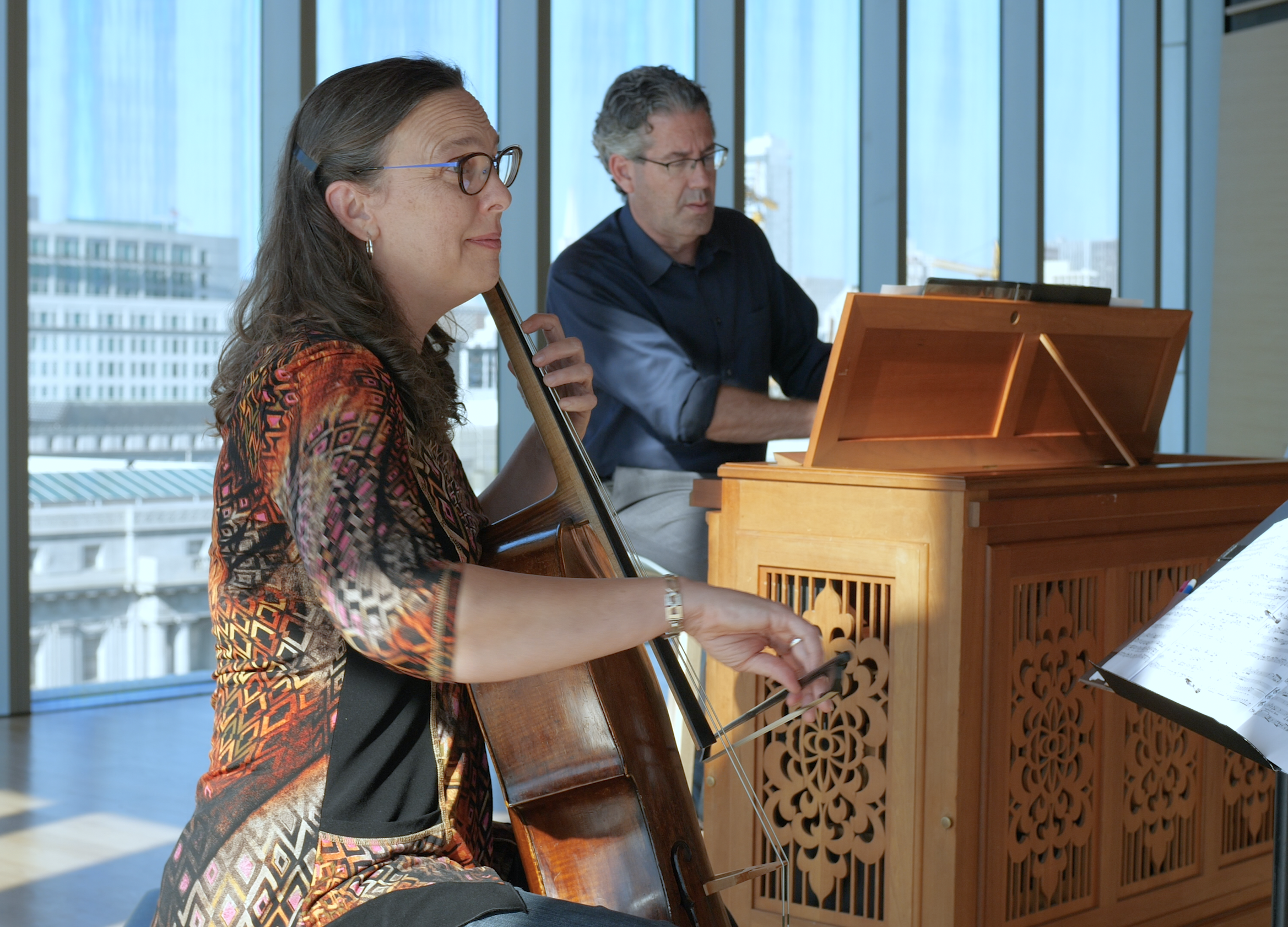
Elisabeth Reed, cello
Corey Jamason, organ
SOUND (BWV 121 only): Lolly Lewis | VIDEO: Clubsoda Productions
This episode was filmed in partnership with Les Délices and the San Francisco Conservatory of Music.
This project is a fiscally sponsored project of FRACTURED ATLAS.
To find our more information and to make a TAX-DEDUCTIBLE donation to support the continuation of this project please click the button below
TRANSCRIPT
[00:00:00] D NAGY: One of the things that we're hearing from so many artists as they approach Bach is how infinitely challenging- ... that music is, that you feel like your work is never done.
[00:00:12] K HYUN: It strikes the balance between challenging, but also with a purpose.
[00:00:16] C JAMASON: It's so honest- Mm ... and real, and I think that's part of the challenge of it.
[00:00:22] That's part of what makes it very difficult to play and very satisfying.
[00:00:25] K HYUN: Uh, he's not making it difficult to make our lives difficult. It's difficult because he wants to achieve a certain effect. When, once we get there, it's so satisfying.
[00:00:34] C JAMASON: You never feel, "Oh, I've got it." You never feel that way. There's always something more to discover, something more to think about, something more to treasure, and that, I think, is an arc over a whole lifetime of this music, which is really special, and not always the case with every composer,
[00:00:54] N PHAN: I think.
[00:00:54] Hi, my name is Nicholas Phan, and this is the Bach 52 Project.
[00:01:03] This week's guest is Doctor of Musicology and vice president of the American Bach Society, Ellen Exner. Ellen and I sat down for a fantastic conversation in December of 2022 when I was in Philadelphia performing with the Philadelphia Orchestra. Ellen and I spoke about questions of canon in the classical music repertoire and Bach's place in it.
[00:01:26] We also spoke about Bach's music and how it was not popular shortly after he passed, and took a while to get back into the revered place in which we hold it today. And we also spoke a little bit about questions of what his intentions were for this music. It was a fascinating conversation, and I hope you
[00:01:46] enjoy watching the interview, and stick around for the aria at the end from Cantata 121, Christum wir sollen loben schon.
[00:01:53] So the thing that I'm really trying to, uh, explore and dig into is, in general, the sort of unanswerable question, is the music of Bach for everyone? Obviously you can go in a lot of different directions from that, but I'm really interested in your musicological perspective and, um, let's just start pretty basically, you know, how did you get into the music of Bach?
[00:02:15] How did it enter your life?
[00:02:17] E EXNER: Uh, well, I think I came to it the way most people do, um, through listening. And as a musician. My parents had a pretty broad collection of LPs when I was a kid, and my mother and father loved music, and they would put on, we'd have Handel's Water Music, and we would have the Bach Brandenburg Concertos, and we'd have these things always.
[00:02:37] And when I became an oboe player, I started getting more and more interested in Baroque repertory, which is just one of the great treats of being an oboist. And eventually you sort of can graduate to playing Bach's music. It's so complicated. It's so rewarding when you get it right. There was a particular draw just to the sound and the experience of playing it for me, and that's how I came to wanting to know more.
[00:03:03] And eventually, that wanting to know more, uh, grew into the desire to go to graduate school and to get a PhD. And I was lucky enough to be accepted to Harvard to study with Christoph Wolf, who is, you know, the author of so many wonderful things, including the, um, the latest biography on, on Bach's life and works.
[00:03:22] Then from there, just having the opportunity to work with him and to go to the Bach Archive in Leipzig and work with those guys who were, many of them were Harvard students, a lot were not. But there's a, there's sort of a connection and a... It becomes a little bit of a family. For anybody who is willing to, you know, do the hard work to learn the German, to learn to read the old script, to learn to love looking at old manuscripts and figuring out what they n- they mean, it's sort of...
[00:03:48] It, it, so the, the, the listening is the gateway drug. Mm-hmm. And then there's the performing and then there's the curiosity. Doing that work and, and, uh, really digging into the repertory and continuing to play, um, these things were all sort of just mutually fueling. And that's how I got to Bach.
[00:04:05] N PHAN: I love the way you describe it as a gateway drug.
[00:04:07] You know? It's, it's funny, a lot of the people I've been speaking to, uh, particularly the instrumentalists, they all talk about there's this physical sensation of playing it that just kind of invites you to wanna learn more. And everybody talks about that complexity, but there's something about that complexity that is inviting as opposed to-
[00:04:27] E EXNER: It...
[00:04:27] I think that the complexity is inviting to a particular kind of a challenge-loving person. Um, sometimes that complexity can be off-putting, and I perfectly well understand that. Um, but there's also something to, if this, if this is your, your fuel, there's something to really owning that complexity. Um, I remember the first Bach cantata I ever got to play.
[00:04:50] It was, of course, on modern instruments, and I play a lot more of them baroque instruments now, but I couldn't believe I had, I, I had that kind of luck to be able to sit and do this. And then somebody offered me money to come and play Bach cantatas. Are you kidding? You'll pay me for... I would pay to do this.
[00:05:06] Every week. I would pay to do this. And that's the kind of... Well, you know, it's the kind of experience that it's, it's not replaceable. And it's either you have it or you don't. But really grateful for the people around you who also wanna do it, and the people who wanna hear it, and the people who wanna pay for it, and the people who just wanna keep it all going because there is something so energizing and so special about playing music of this particular caliber.
[00:05:33] And it tends to draw people who also want to do that. And that takes a pretty high degree of training and discipline and, and love to pull it off. So maybe that's part of the calculus as well.
[00:05:45] N PHAN: It's interesting. I mean, he's, he's lived in a sp- very specific time and a very specific place. You know, in, in particular with the oboe, he was composing...
[00:05:52] He's the only person really to compose, or it's the only region that features music for the oboe d'amore, for instance. Mm-hmm. Like, it's a very specific thing, and yet it's this thing that people from all over the world get drawn to, and I'm just kind of, I'm so curious to unpack those layers, and I'm wondering if in your research you've come across people you wouldn't expect maybe to, you know, be- who have been influenced by his music.
[00:06:16] E EXNER: I don't know whether I have anything particularly interesting to say about the people who have been influenced by it apart from other composers. Just generations of composers following, um, Bach's example once his works became exemplary for other composers, and there was a, a long time where that wasn't the case.
[00:06:34] So there are lots of interesting layers to Bach reception and to thinking about how that thread was relatively thin in the 50 years following his death. Not, not non-existent, but relatively. And then it sort of blossoms in the 19th century with a different set of sort of priorities and a different way of looking at the repertory.
[00:06:55] That all becomes really a, a fascinating and complicated and occasionally kind of difficult thing to reckon with. Is Bach for everybody? I don't think, I don't think there's anything that's man-made that is for everybody.
[00:07:09] N PHAN: Right. Right.
[00:07:10] E EXNER: We all need water. We all need love. We all need food. But in terms of what kind of m- is Bach for everybody, I think Bach is for everybody who wants it.
[00:07:19] I don't think anyone should ever feel badly or forced to think that they should love something that, that maybe they don't. If you don't love Bach, that's okay. A lot of people in Bach's time didn't love Bach. Um, a lot of people found his music overly complex and too long, not stylish enough. Fine. I think that anybody who wants Bach should be enabled to overcome the, the, the barriers of, of finance of- or of culture to be able to access it, to be able to study it, to be able to learn it.
[00:07:55] Those things are things that we can, we can help with that. Whether everyone should have Bach- Hmm ... I don't think that's... If they want it, great. If they don't want it, walk away, you know? It's- Right. Um-
[00:08:09] N PHAN: Should be a consenting relationship.
[00:08:10] E EXNER: It's a consenting relationship. And, um, I think you had mentioned something, you had...
[00:08:15] when we were speaking about d- having this conversation about repertory and access and all of those kinds of things. And having been a professor at New England Conservatory for a while and having taught at universities for the last, you know, decade, there's a lot of thinking right now about what belongs in a curriculum, and what belongs in the repertory and, you know, what's it all for.
[00:08:38] I think that Bach is- Bach's mastery of counterpoint and the kinds of the genres that he participated in, and understanding the legacy for composers and performers of his compositions, that to me is something you can't do away with in a curriculum if you're wanting to be a student of Western art music or notated European tradition or whatever you want to call it, because it's so foundational.
[00:09:04] And if you want to understand the logic of counterpoint, you want to understand the logic of how 18th century music is put together, and then how early 19th century music is put together and how things change, I mean, these are the, the basic sort of literacy building blocks. If that repertory is something that you want to understand in this particular way, then it's indispensable.
[00:09:23] You don't have to like it, but it's a set of tools for understanding how composers sort of, sort of trained, how they think about how compositions are put together, and how they reflected on a legacy that they were very self-conscious about. They-- Those who studied Bach's music in the 19th century were pretty aware of what was possible contrapuntally, what these works can communicate, and sort of how you can, how you can think through a, a large scale composition.
[00:09:56] So I think those building blocks are sort of... I would consider them relatively essential. Are they the only standard? Absolutely not. But they are a standard. And if that's what you want to do, then that's something you should endeavor to hold on to in your, your teaching and your learning. But that doesn't have to be for everybody.
[00:10:18] It comes back to who's this for? Whoever wants it.
[00:10:22] N PHAN: That's a, that's a really wonderful framing. I mean, the thing about art, right, is it's all sort of in dialogue with other art and the world around it. And I mean, Bach's music, it's interesting, this conversation about what should be in canon and what should be sort of in the core curriculum and, you know, I think you're right.
[00:10:40] Like, at the exclusion of everything else, maybe not. But is it necessary that it be there? Of course, because there's so much-- there's such a vast amount of music that is in dialogue with it. And also, I mean, students have the opportunity to be in dialogue with it- Absolutely ... too. I mean, that's, that's the glorious thing about being a musician.
[00:10:59] It's a living art form. And so, you know, Bach's manuscripts may look really beautiful on the page, but they don't actually come to life until we interact with it or choose not to interact with it. And- Absolutely ... it's funny that that's actually a really empowering concept, I think. Yay. Yeah, no. Thank you for that.
[00:11:19] That's wonderful. I would love to hear more about, uh, sort of that fifty years after where you said people weren't so interested in Bach and kind of why and what's problematic about it, what's sort of crunchy about it, like-
[00:11:33] E EXNER: Well, the, the answer why people weren't particularly interested in the 50 years after his death is that this music was not fashionable.
[00:11:42] Um, the style ... We have an idea of a canon of, of timelessness, of masterworks and ... But anything that's ... Y- you need, things need time before they can shed the, the trappings of what was stylish and what was unfashionable before they become fashionable again, in a way, if that makes sense. So liturgy changed in Bach's time.
[00:12:06] The function of music in services changed. The, the musical styles simply changed, and this stuff was old-fashioned even in its own time in lots of ways. And, um, the types of theology and the types of roles of cer- of music in worship just, they went out of style. And there wasn't a way to use that music in a church function for a pretty long time, and the idea of doing this stuff as concert music didn't really exist.
[00:12:34] There were works that were s- sacred works that were written for public spaces that weren't necessarily liturgical. Bach didn't write a whole lot of those. So h- his, his keyboard music was, was around. People were, who were, um, teaching and, and working in and around Germany, they ... His keyboard piece, The Well-Tempered Clavier, was kind of around.
[00:12:55] But the vocal music, the sacred vocal music just didn't have ... There was no place to slot it. It didn't have a, a function. His sons and a lot of his students ended up working for, um, courts in around Berlin, King Frederick's court and the satellite courts around there. And they were definitely interested in the learnedness of their teacher or father's music, and they encounter a lot of other people who are sort of interested in learning the learnedness and collecting.
[00:13:29] It was kind of a new idea. But it, it took a while for that music to actually have a, an audience that wanted to hear it or to build people who wanted to hear the vocal music. Um, it just, it had to completely run a course of being so obsolete as to be being, as to become, to become, um, a, a desired commodity that people would be interested in.
[00:13:56] And so that's the sort of the, that's a r- relatively simple answer to that. But then, you know, how does this stuff come into the concert world? And it's really in and around, um, in, in Germany. So there's ... Mendelssohn does the Matthew Passion in Berlin, and that's a very famous story. There were other places, other people who were doing that stuff too.
[00:14:21] As for the cantatas, that took a bit longer. So, I mean, that, that gets you into the 19th century, but it's still, it's ... It has to be removable from its original Sacred liturgical context in this one, these, this one section of churches in this one little part of Germany to sort of transcend that function to be, um, concert hall music.
[00:14:45] That's a big, that's a big leap.
[00:14:47] N PHAN: Yeah. No, it's-
[00:14:48] E EXNER: And that's where we get the friction of, who is this for now? Yeah. How does this fit?
[00:14:55] N PHAN: Interesting, 'cause I feel like a lot of instrumentalists wax poetic about the humanity of Bach's music and how it's for everybody because, you know, they don't have to contend with these words.
[00:15:04] And- I- ... that's part of the reason why I'm focusing in this particular project on only arias from the church cantatas, not even the passions. Th- those seem so specific to their function. And s- but, you know, we do create a lot of time for them. I mean, we, we perform cantatas. I perform cantatas at the Kimmel Center- Mm-hmm
[00:15:23] you know, in a very secular context, and with that giant organ. And, you know, it's, it's, it's something that I as a singer have to grapple with in a secular context. You know, how do I come to this music? And, you know, I was teaching a class, uh, recently up at Boston Conservatory on oratorio repertoire, and one of the students raised a hand and was like, "You know, I, you know, I don't believe in these texts.
[00:15:47] I don't b- I'm not a Christian. I don't believe in, you know, all of this dogma. How do I get into that? You know, how do I get behind these, these works when I have to perform them?" And, you know, it's an interesting question. And then of course the easy answer is like, it's your job, so you can either say no to the job or you can do your job and kind of get there.
[00:16:06] But it's, I think it's a much more... There's so many, there's so much more room for that. And it's so interesting to hear the per- historical perspective of that, that also the pieces themselves needed that time in order to kind of be divorced from their function a little bit so that they could just be valued as music.
[00:16:22] E EXNER: They become a curiosity.
[00:16:23] N PHAN: Yeah.
[00:16:24] E EXNER: And they were so different in style from the kinds of popular pieces that were out there for people. They were almost an antidote to the, the, the simple, the top 40s of the time. Because music, concert music, operas, things like that were, they lasted a season. Things were-
[00:16:42] N PHAN: Mm-hmm
[00:16:43] E EXNER: these things become more like ancient music in a way. And it, that's a, that's a really cool facet of history to look at as well. And we, we have a pretty fast-paced disposable world at the moment too, and the things that you can find to hold onto that are real, that seem timeless somehow, that seem not of our, you know, our disposable world, have a particular great value.
[00:17:10] And Bach's music does seem to keep filling that function. Um, we're not the first generation of people to think that. Uh, we might at this moment be much more attuned to how Bach's music is not for everybody, and how disenfranchising it can be, and how- Like, the, the student who retired, he's like, "I don't believe this stuff.
[00:17:32] How can I, how can I go out and sing this?" Well, you can vi- it's like, well, it, it's a job. It's a performance. I always say when I'm teaching courses in, in these pieces in the cantatas or in the passions, like, I would never ask you to believe it. That's not actually what we're here to do. That is what Bach wanted his congregation to do 'cause what these pieces were designed for was to teach, to teach people how to feel about the story that's being told.
[00:18:02] To, to put your emotions literally in the place of this reflection on the liturgical events, the biblical events, the, the teachings of that Sunday. What we can... The way we can use those as teaching pieces now, because I think they were all, like I say, they were always meant to teach us, we've actually... What they teach now is the things that we need to do better than Bach's culture did, that we need to do better than the past couple hundred years have done.
[00:18:27] Like, we have an opportunity to use these as teachable pieces, to talk to each other about those things that are so disenfranchising and uncomfortable. And I think if we use them that way, which is actually the spirit in some ways in which they were intended to teach, you know, the, you know, love thy neighbor as thyself.
[00:18:49] Like, go for it. Let's be better. Let's talk our way through this stuff. If you are a person who's deeply uncomfortable performing it, don't. You don't have to. It doesn't ha- You don't have to do it.
[00:19:04] N PHAN: Right.
[00:19:04] E EXNER: I think the rub comes in where, where there's any insistence that one must love Bach, that Bach must be for everybody, that Bach must be studied, that Bach must be venerated.
[00:19:16] I don't particularly believe any of that because this is the work of a human being, a flawed human being, who happened to have extraordinary compositional skill and imagination, who had an, a, a long, lively legacy. And if you want it, there it is. But you, we are going to, to be responsible, to be caring, to make sure this music has a future if we love it.
[00:19:42] We do have to take the stuff on that is undesirable and do better.
[00:19:48] N PHAN: Right.
[00:19:48] E EXNER: But, you know, do you ever... I, I mean, there are people who take roles as actors of absolutely terrible people. That doesn't mean you are that person. That's the role you are playing. I mean, and musicians play stuff all the time. You sing stuff all the time.
[00:20:01] You don't have, you don't have to believe it.
[00:20:04] N PHAN: No, I, I mean, I fall in a similar place if I'm confessing my true feelings. I mean, you know, and I think that there's a lot of value in that, and it's interest- you said something about m- this music being composed in that spirit or these pieces being created in that spirit, and I think there is something about his aesthetic and the things that he's asking.
[00:20:22] I mean, h- you know, some of these arias, you know, you're being asked to make, m- become comfortable with Death and, you know, the inevitability of death and the unknown-ness of what happens after and the beliefs about that. And, you know, I mean, he's asking people to become, uh, to reconcile and to sit with very complicated and very uncomfortable aspects of life and its end.
[00:20:44] I don't know that he's always looking for an answer. I think that's part of the complexity for his music, and I think that s- there's value in that in a way.
[00:20:53] E EXNER: I- if we th- if we study the cantatas in terms of what the theology that they're meant to, you know, espouse and, and teach, those are actually of a piece.
[00:21:06] So Bach does actually have an answer for what death means-
[00:21:10] D NAGY: Mm ...
[00:21:11] E EXNER: in his own tradition. He said if you wanna really crack these pieces open and understand what, what parts of the message of how to cope are in there, then you, you do have to sort of start grappling with, or you can start grappling with, well, what were, what were the teachings on this in the time and place.
[00:21:28] And, you know, death as sleep is a recurring concept, and it's a Lutheran concept. It's not Bach's own. And death is something that's joyous because it's gonna be okay in the Christian tradition, in the Lutheran way of looking at things. Like, it was not something to be feared. It was something to... Y- you mourn, but then you're als- you also find the joy, the bitter and the sweet.
[00:21:50] There's all these paradoxes. Lutheran theology loves a paradox, and Bach's music is full of them, too. And to really understand sometimes the, the, you know, the instrumental introductions which lead into the vocal lines which actually, you know, the, the instruments are often playing what the voice is saying, you'll get these contrasting pairs of ideas in the first few words, in the first line of text.
[00:22:14] And it's also in the ritornello, and it's... Then you get into Bach's imagination of how do I create these little micro contrasts, and a lot of times these just get plowed over, um, because we're making a long line or, you know, just in love with our sound or we don't actually know what the text is. If you're an instrumentalist, sometimes you show up to a gig with no idea what the words are that the singer is singing.
[00:22:35] They're in German, and you just got the piece yesterday, and here you go. It's like the words matter profoundly.
[00:22:40] N PHAN: Mm-hmm.
[00:22:41] E EXNER: Bach's close attention to the, the active pieces of text matter profoundly, and they all would originally link into what the teaching was for that day. And if it's about death, then it has a message for us that was specific to his tradition.
[00:23:00] But I guess the, you know... Is Bach's music for everybody? Well, we will all die. So in that sense, here's one way of thinking about it, and here's how one composer from one time and one place and one location wrote about that. How-- Here's how he found musical expression for these complicated and painful things that, in his tradition, that actually it's the sweetness of it if you've led the life that you've led
[00:23:25] N PHAN: been
[00:23:25] E EXNER: asked to lead and, you know, all that kind of stuff.
[00:23:27] So that's the part was like the, that's the big if Right. That's where you're going, "Oh man, if only he could leave that out." He never thought of this music as for everyone. That's the uncomfortable truth, right? I mean, it was for a very specific... He thought of this music for the people around him, for the job that he had, for
[00:23:47] N PHAN: the- Right
[00:23:49] E EXNER: function it served.
[00:23:50] N PHAN: And yet in that is this weird paradox that to him that probably was everyone.
[00:23:55] E EXNER: Exactly.
[00:23:55] N PHAN: I mean, he didn't... I'm about to do the Matthew Passion in Hong Kong, and, you know, it's like can you imagine him thinking ab- that his music would be performed in Hong Kong by, you know, the Hong Kong Philharmonic and it- that's such a foreign and exotic thing.
[00:24:10] But at the same time I also find myself wondering was he even aware that that part of the world existed? You know, I mean, you know. Well,
[00:24:16] E EXNER: yes, but I can't imagine that he... I can't imagine he ever thought or he could ever conceived of where his music is now. I, I don't think it ever crossed his mind. How, how could it?
[00:24:31] N PHAN: Yeah. Well, that'd be pretty daunting. It seems like a recipe for like writer's block. Yeah.
[00:24:38] E EXNER: Well, I, I think he was, I think he was very proud of his skills, but I think as a human he was actually probably fairly hum- like he had humility in that regard. He knew he was mortal and-
[00:24:49] N PHAN: Mm-hmm ...
[00:24:50] E EXNER: you know, we're the ones that made him an immortal.
[00:24:51] It wasn't
[00:24:52] N PHAN: him. Um,
[00:24:54] E EXNER: I think he never would have... How could he possibly have imagined?
[00:24:57] N PHAN: Yeah. So. Just out of curiosity, what was that first Bach cantata that you played?
[00:25:02] E EXNER: It was 140.
[00:25:04] N PHAN: 14- okay. Okay.
[00:25:06] E EXNER: Yeah. And it was, actually I was an undergraduate, and I was, you know, just playing the, that very bottom sort of now English horn part and just...
[00:25:15] Amazing. And it's my very first experience with it and I, I will never forget it. It was, it was so special. I, I, I mean, in full disclosure, I grew up going to an Episcopal church and, and hearing all... Like, this music I always, I already knew the hymn tunes. I already knew it. But I never had experienced how they get worked into a cantata and how you get little snippets of it in every single way.
[00:25:41] So it was a, it was a pretty good one to start out with.
[00:25:43] N PHAN: Right.
[00:25:44] E EXNER: I think there could be cantatas that were not, would not be as attractive to start off with. I feel really lucky that that was my, my entrance into playing this stuff, and we... It was probably pretty good now that I look back on it. The people who were involved in it and what we were doing
[00:26:00] N PHAN: and...
[00:26:01] It sounds like it was an excellent experience.
[00:26:02] E EXNER: It was, it was very special, and when I, when I teach cantata classes with my, um, when I was teaching them at NEC, we always capped the course with a performance of one of the pieces that would fit into our, um, course because- It, it, I discovered that most of my students had never done one Hmm.
[00:26:22] N PHAN: I know. Well,
[00:26:23] E EXNER: wait a minute. We can talk till we're blue in the face with it all semester, but let's actually play one. Let's just do this, experience the sweep of it. They all comment that that's their favorite part of the semester. It's like, mine too, actually Um, because that's, that's the payoff, right? And- Yeah
[00:26:42] an understanding performance, a per- a performance that really comprehends what the text is and what it's meant to do and how the, the drama works and how the education works and how the, the twists and turns all work, and really being thoughtful about playing the words.
[00:26:57] N PHAN: Hmm.
[00:26:58] E EXNER: That to me is, that's the dividing line between a performance that's pretty and a performance that's good.
[00:27:04] N PHAN: Right. Um, so. Those are the ones that transform us.
[00:27:08] E EXNER: The ones that transform, the ones that actually communicate. The, the words were very important to Bach.
[00:27:14] N PHAN: Hmm.
[00:27:15] E EXNER: And they have to be perform- important to the performers.
[00:27:17] N PHAN: Yeah.
[00:27:18] E EXNER: Yeah.
[00:27:18] N PHAN: Well, I can't thank you enough.
[00:27:20] E EXNER: Thank you.
[00:27:31] N PHAN: This week's aria is taken from Cantata 121, Christus, wir sollen loben schon, or We Should Already Be Praising Christ. The cantata is a chorale cantata, and the entire thing is based on a hymn tune by Martin Luther, the founder of the Lutheran Church. Bach wrote this in 1724 when he was working in Leipzig, and he composed it for the second day of Christmas.
[00:27:55] The Bible reading that day tells the story of the shepherds coming to visit Jesus and Mary in the manger right after he's born. They've been told by an angel that the Messiah has come, and they're told where to go, so they flock to the manger and visit Mary and this promised Messiah to adore him. The aria is composed for tenor and oboe d'amore, an instrument that Deborah Nagy spoke about in last week's episode.
[00:28:22] Check out episode two if you haven't already. It's the second movement of the cantata. The translation is, "Oh, you exalted creature of God, do not understand, no, no. Just marvel. God will earn the salvation of the flesh through flesh. How great then is the creator of all things, and how pitiful and insignificant you are, that through these means are saved from damnation."
[00:29:12] MUSIC