EPISODE 8
Bach, Faith & Radical Welcome: How Sacred Music Holds Space for Everyone
with Reverend Pamela Werntz | rector, Emmanuel Church
Is the music of Bach for everyone?
Is Bach's sacred music only for believers? Reverend Pamela Werntz, Rector of Boston's Emmanuel Church, thinks otherwise. In this episode of BACH 52, she shares how Bach's cantatas create space for an extraordinarily diverse community — from musicians and scholars to people sleeping in the church garden — and why that radical welcome is at the heart of what this music can do.
Emmanuel Music has performed Bach cantatas in their liturgical context for over 50 years. Their Bach Institute brings emerging professional artists to study this music not just as performance, but as living spiritual practice.
ARIA
Ich steh mit einem Fuß im Grabe from Ich steh mit einem Fuß im Grabe, BWV 156
PERFORMERS
Chea Kang, soprano
SFCM Baroque Ensemble | Elisabeth Reed & Corey Jamason, directors
Violin 1: Cynthia Black (leader), Luke Chiang, Eliana Estrada, Carla Moore
Violin 2: Pauline Kempf, A;exandra Santon, Annemarie Schubert
Viola: Jennifer Redondas, Caitlin Keen
Cello: Elisabeth Reed, Kyle Stachnik
Bass: Farley Pearce
Organ: Corey Jamason
Thanks to Julian Bullitt for his photography of the Emmanuel Music Bach Institute events.
SOUND (BWV 156 only): Chanho Han & Jason O'Connell | VIDEO (BWV 156 only): Clubsoda Productions with Edgar Garcia assisting | VIDEO (Interview): Nicholas Phan
This episode was filmed in partnership with Emmanuel Music and the San Francisco Conservatory of Music.
This project is a fiscally sponsored project of FRACTURED ATLAS.
To find our more information and to make a TAX-DEDUCTIBLE donation to support the continuation of this project please click the button below
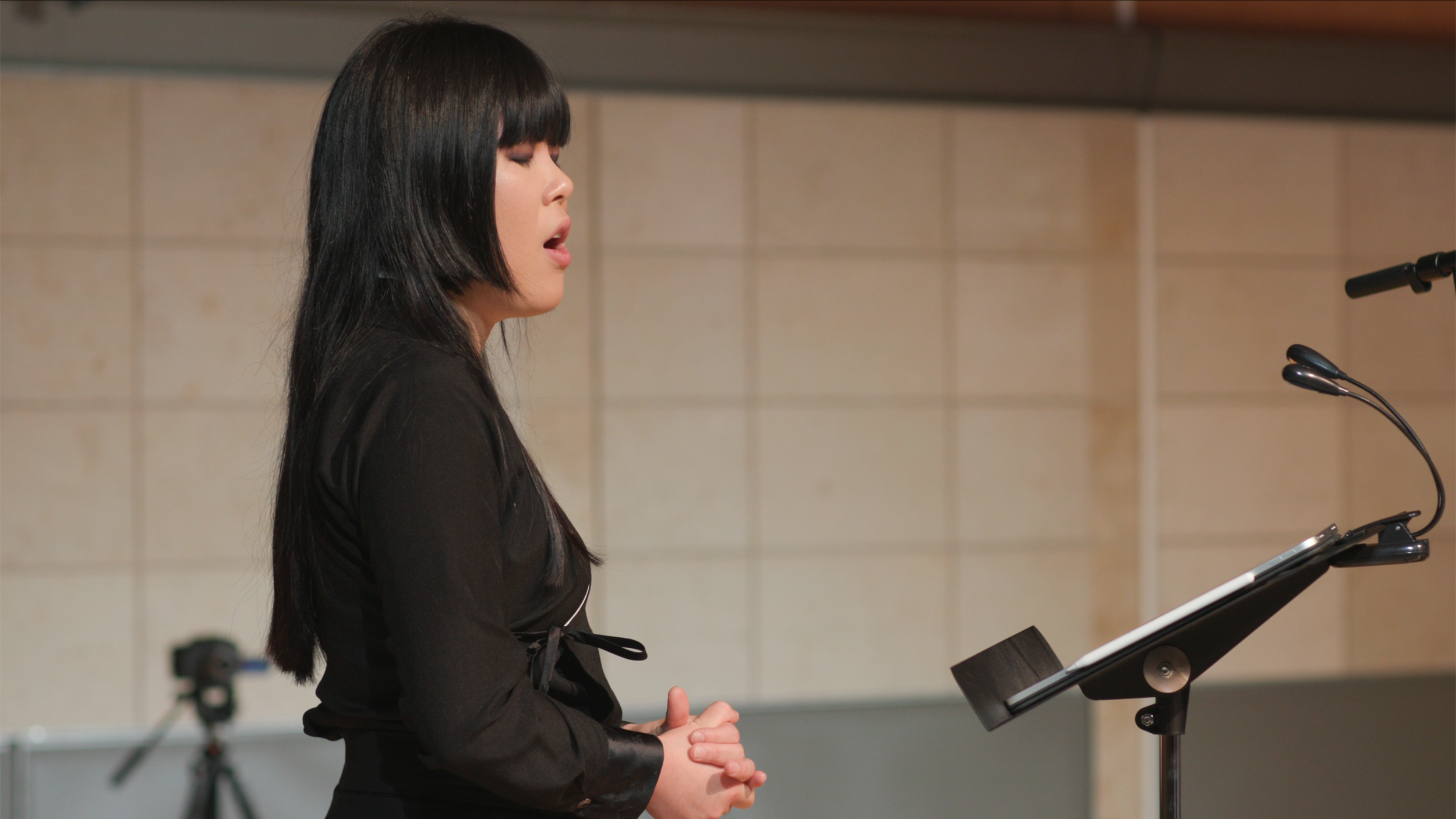
soprano Chea Kang during the recording session
TRANSCRIPT
[00:00:00] N PHAN: Were you raised in a faith tradition?
[00:00:01] STUDENT 1: Um, I was technically raised Catholic, but my mother was Methodist, so she decided that Jesus would rather be skiing on Sundays as well. My family was Catholic. Growing up, my parents are now Jehovah's Witness and I'm Buddhist. So there's a lot, a lot of stories to tell and a lot to unpack there.
[00:00:22] STUDENT 2: Yeah. I was raised in a sort of, um, like Pentecostal evangelical church, so my dad's side of the family's Catholic and my mom side of the family, they're Hindu and I didn't. Really like take to a religion strongly. Like I kind of assumed Christianity, so to speak, like just by default, but never really went to church regularly.
[00:00:48] STUDENT 3: No religion, but I do. I feel that I've been connected to religion through Bach more recently. When I, when I'm playing Bach music, it really speaks to me and I feel the presence of something greater and it's become a way for me to sort of remotely access my faith in the most meaningful way, meaningful way for me, I'm, I'm someone who my spirituality and faith are.
[00:01:15] Quite present in my life as is music. So I, I think like all of my music is a reflection of that spiritual journey. The text and box music really does feel divine in my opinion, and it makes me. Emotional and it makes me feel connected to my soul and I feel more spiritual after I practice
[00:01:43] STUDENT 4: as a Christian. I, I think that so much of what I'm singing, I believe, you know, I, I might not be as dogmatic as, as an 18th century Lutheran. The whole idea of, of Jesus kind of being this anchor between. Humanity and divinity and us trying to find our place in the midst of that is something that I think about every day of my life.
[00:02:08] And I think that Bach is just always talking about this and always like, you know, struggling to sort of make sense of all these things. And I think to be a Christian is to have to wrestle with a lot of those things and to main have to maintain a great sense of mystery. And also a great sense of assurance at the same time, and those things get wrestled out in Bach music.
[00:02:37] N PHAN: Hi, I'm Nick Phan, and this is Bach 52.
[00:02:46] The guest for this episode is the Reverend Pamela Werntz, the Rector at Boston's Emanuel Church. E Emmanuel Church is a unique place for the music of Bach because the ensemble in residence there. Emmanuel Music has been performing Bach Church Tatas in the liturgical context for which they were intended for over 50 years.
[00:03:09] Since 1970. Each year. Since 2011, Emanuel Music has been offering a Bach Institute that is an opportunity for young, emerging professional artists. To study the music of Bach with members of the Emmanuel Music Ensemble. I had the pleasure of joining the Bach Institute this year in January, where I participated in some panel discussions, had the chance to work with some of the young artists, and also had the opportunity to join the ensemble in their performance of Bach, Tata seven, which was the Tata at that Sunday's church service.
[00:03:46] I've had the chance to perform box music in a lot of churches. Over the course of my 20 plus year career, including many of the churches in which Bach worked during his lifetime in Germany. This experience at e Emmanuel Music was my first time being able to perform a Bach Tata in the context for which it was intended as part of a Sunday church service.
[00:04:05] Being immersed in the community at Emanuel over the course of a very cold weekend in January and Boston was revelatory. It was amazing to see how box music. Is integrated into a church community that embraces it like Emmanuel does. My interview with the Reverend Warrants was really moving. She talks a lot about how box music helps hold space for an incredibly diverse community that comprises the community at Emanuel, and also talks about how box music provides an important opportunity for the congregation to digest the messages of compassion and fellowship.
[00:04:47] That are preached every Sunday at e Emmanuel. Over the course of the next couple episodes, I'm gonna be interviewing other members of the Emmanuel Music community, as well as just like at the beginning of this episode, featuring snippets of my conversations with the many wonderful, talented young artists who were at the Bach Institute this year studying.
[00:05:05] I hope you enjoy this interview with Pamela s. Stick around for the aria at the end. Taken from Tata 1 56 featuring the San Francisco Conservatory of Music, Baroque Ensemble, and a special guest from the SFCM Voice Department. So this series is about Bach. Let's just start pretty simply. How, what has your journey been with Bach like how did his music enter your life?
[00:05:36] P WERNTZ: I mean, was it from childhood or, so? I think the music of Bach entered into my life through the Anna Magdalena book. My mother was a pianist and we got a piano when I was five, and I loved to listen to her play and I wanted to learn to play, and that was the music that I wanted to learn. Hmm. And I studied piano until I was 12 or 13.
[00:06:04] And then I decided what I really wanted to do was learn to play the pipe organ, and I wanted to learn the organ music of Bach, and that's all I wanted to learn. Um, by the time I had learned some kind of like the basic skills of, of the manual of organ playing, and I had gone through my exercises and I wanted to start learning to play Bach, we had moved.
[00:06:27] To a new state in a new town, and the Oregon teacher that I wanted was expensive enough that my parents could not afford to pay for the lessons. I was the oldest of four kids and they were, you know, we weren't poor, but there wasn't a lot of extra money to go around, and so I got a job at McDonald's working for $2 and 35 cents an hour.
[00:06:54] And eight hours of work at McDonald's equaled one lesson. Whoa. So it was quite a commitment. I was in high school, but I would, I would open on a sun a Saturday morning at McDonald's, and I would work for eight hours and that would pay, then I'd go to the church and practice and practice every day. And I only wanted to learn the music of.
[00:07:15] And that my teacher insisted that I had to learn a full repertoire of music. So he would, you know, assign some Bach things and then other music. And I just never practiced the other music 'cause I didn't like it and I didn't wanna learn it. And I felt entitled because I was paying for this lesson that he should teach me what I wanted to learn.
[00:07:37] And he, we just could not ever see eye to eye. And I, I quit. And I just thought, I thought that I was gonna go to a music conservatory and be an organist, and he insisted that I couldn't be an organist if I only played Bach. And I thought, well then I'll learn everything that Bach wrote for the organ, and then I'll learn other music.
[00:07:58] How about if we just start with Bach? But I couldn't get anywhere with him, so I quit and I ended up, I just dropped. I dropped music altogether. I guess it freed up a lot of time and I was a teenager and so that seemed not that bad. I went to a college that didn't even have a music major by my sophomore year.
[00:08:22] I was really bereft, I was really missing music, and my grandmother offered me a chance to go study in Vienna for a semester. I went to, I did all kinds of things in Vienna, um, musically, but every Wednesday at noon at Stefan Dome, there was an organ recital, and the organist almost always played it, at least one Bach piece.
[00:08:49] And I thought, oh, I'm coming home. I'm coming home to this music, and I just wanna listen to it. I don't, I didn't feel the need to play it anymore. I just felt like I wanted it to be a part of my life. I secretly celebrated or observed Bach's birthday every year. I didn't tell. It was so, you know, nerdy and uncool.
[00:09:09] And I didn't know anyone who loved classical music the way I did and, and especially the music of Bach. So I just had this kind of private life where I listened to box music whenever I could, um, had recordings and. Went to concerts and mostly slipped in and out of places that I didn't have to pay a ticket for.
[00:09:31] You know, I didn't have to buy a ticket. And then I had a career in business and had kids and my life went on and found myself feeling called to ordained ministry in the Episcopal church, moved up here to go to seminary in, um. 1996 and heard about Emmanuel Church and Emmanuel Music and visited a couple times, but I was really busy with grad school and busy with my kids, and I got here a few times and just was wowed by the tatas, but it didn't seem accessible to me on a regular basis because of my other commitments.
[00:10:16] I got ordained and my first call was at a church in Brookline. And after I'd been there five and a half years, the Bishop's office called and said, we would like you to consider being interviewed for a position at Emanuel Church. And then there was this pause and they said, you know, they have that thing about Bach.
[00:10:40] And I said, oh, I do know that. I do know that. And that was, that was not on my resume. The fact that I had learned German was not, you know, that was, that was just. Something that had happened earlier in my life that just didn't seem to apply anymore. And so I said I did want to interview. I was very interested in interviewing and, um, then I learned that in order to get this job that I wanted, I had to interview with the vestry, which is the, the board of an Episcopal church.
[00:11:14] I also had to interview with Pulitzer Prizewinning composer, John Harbison, and I had to interview with the rabbi, who was the rabbi of Central what, what was then Boston Jewish spirit at Central Reform Temple. And I think I'm the only priest in the world that has ever had to pass muster with a rabbi and a Pulitzer Prize winning composer.
[00:11:35] But I did, I, I could talk with them because I, I knew things and I was interested, and it's amazing. Amazing. That is so fortuitous. It's so, so fortuitous, so lucky. And one of the first things that happened to me when I got here 16 years ago was that one of the, um, musicians kind came to meet with me. Kind of had in hand to, to ask if it was possible to use the church parish hall for a Bach birthday party.
[00:12:05] And I said, are you kidding me? And I said, yes, that would be possible. And you know, that became my job to allow a birthday party for Bach to happen in the parish hall. Suddenly you can, uh, have your private celebrations and my, it's become a communal experience. That's, that's right. That's right. And, and I, you know, I let the music company offer Cantatas in a service.
[00:12:37] It's just, that's astonishing to me. It's the most amazing thing. Wow. So you have this great love for it, the universe, fortuitously. Mm-hmm. You know, attached to like Yeah. Brought all the threads of your life together. And this. I mean, some people call that God, I'm agnostic. I'm an agnostic priest. But if I were really sure that I believed in God, I would say that God has done this, um, amazing thing.
[00:13:03] That's so interesting. I would love for you to say more about being an agnostic priest, because that sounds like an interesting combination of words. Well, it's an, it's an interesting position or stance to take, especially with relationship to box music, because. Bach wrote everything solely for the glory of God.
[00:13:23] You know? And so I think when I hear his music, I hear how much he believes in God and I'm, it's very compelling to me. So I think, yeah, maybe, maybe I feel agnostic because I just don't know. You know, an atheist knows that there is no God, right? And a, a believer, especially in a Lutheran sense, knows that there absolutely is God and, and kind of how God works and what God is, and I'm somewhere in between those things.
[00:14:01] I'm willing to stake my life on it, on the possibility that God exists. I'm very drawn to people who, whose faith is, is so strong and I think. I'm, I'm also drawn to people whose absence of faith is strong. I'm, I'm very interested in, in being in conversation, and that makes me a good fit for Emanuel Church too because there are many, many people in this congregation at Emanuel Church who are drawn by the beauty of the liturgy, by the beauty of the music, by the beauty of the space.
[00:14:39] They're not quite sure what they're doing there, but not just the beauty of the space and the liturgy, but also the beauty of the community. And the way the community cares for one another. For 160 years, this church has, has positioned itself as a place of respite and care for people who are very poor, people who are addicted, people who are find, who find themselves on the margins of religion or, or politics or social life.
[00:15:11] And there's some ebb and flow to that over the years, but it's not your average Episcopal church. It's a place where on any given Sunday, a good number of people are probably not baptized. They're probably, they would not consider themselves believers, and they are in pews with other people who feel very, very strong faith and very, very strong sense of belief.
[00:15:37] In my experience, that doesn't happen in many faith communities.
[00:15:39] N PHAN: No. I mean, I was raised Greek Orthodox and there's no room for that. Yeah. I mean, you're not allowed in the building, right. You have to be in a special part of the building. That's right. You know? That's right. It's a, it's a very exclusionary
[00:15:52] P WERNTZ: and orthodoxy in any flavor, whether it's Christian or Jewish, or Muslim, or you know, is.
[00:16:00] It's not like that.
[00:16:02] N PHAN: Yeah. I mean, it's just there's not a lot of, there's not a lot of room for Right. Doubt. That's right. And, and I'm someone who needs a lot of elbow room. Mm. I mean, that's beautiful. It's the way you describe it, it also kind of creates a room for humility towards whatever might be there.
[00:16:19] P WERNTZ: Mm-hmm. Which I heard, I heard a, um, now deceased bishop who I loved. Answer a question about how she knew that God had called her or wanted her to be a bishop, and her response was, oh, I don't have any idea what God wants. I hope that God is pleased because I'm having such a good time. And I thought, oh, I love hearing a bishop say that.
[00:16:47] I love hearing a bishop say, I don't, I don't know. Right? I don't know what God wants. I mean, how could we, how could we, how could we? Yeah, I
[00:16:58] N PHAN: would love to know, um, more just for, you know, the people who are watching and listening, uh, just about the history of the cantatas here, if you were able to speak to that a little bit.
[00:17:08] P WERNTZ: It was, I think 1970. The Sunday service at Emanuel Church was in kind of an eide. It had gotten very small. The kinda main event was a Thursday night Eucharist that gathered people of all ages, but particularly young adults. There was a. Uh, kinda a booming Thursday night service and a meal, but not a lot going on on Sunday morning.
[00:17:32] And Craig Smith was, uh, a tenor in the choir and, and maybe at that point, I'm sorry, I don't know the answer to this. He might've been the music director as well, and he was studying at. New England Conservatory and learning about Bach Tatas, and he and his friends said, wouldn't it be cool to do this in the context of a liturgy the way Bach intended it to be?
[00:17:59] You know, in my mind they all kind of heaved a sigh of like, isn't that too bad that we could never do that? And he said, I have an, you know, I think we might be able to do it in a manual. So he talked to the rector. Then my understanding is that Craig went to him and said, could we. Could my friends and I offer a cantata and a Sunday service?
[00:18:21] And Al said, sure. And they did it. And, and everyone was so pleased with it that they said, could we do it again? And, and then could we do it again? And they just started doing it. And they were students at the time. John Haron and his wife Rosemary, both played in that first cantata. There are other people.
[00:18:40] There was, there's several people here today. Who played in that first cantata, they just kept doing it. I, you know, I don't, this is a funny connection to make, but I, I just learned something I hadn't known about the Montgomery bus boycott when Martin Luther King Jr. Organized the bus boycott. They just planned it for one day, and it was so wildly successful that they thought, well, we should try it tomorrow too.
[00:19:07] And they just, they did a bus boycott that ended up being a. A year and a half long, maybe. Mm-hmm. Day by day. Just because it, they were so surprised that it, that it worked. And I feel like that's what happened with the Cantata program here, that we, they did it on a Sunday and then they did it on another Sunday, and then they did it on the next Sunday, and then they just kept doing it.
[00:19:29] And then the students, like Craig graduated and needed to be employed, and so then they needed to raise money, so then they started raising money for doing it because. You know, the musicians after it was an academic exercise, it needed to be, you know, they needed to professionalized, they needed to professionalize it, they needed to put food on the table and have a place to live and mm-hmm.
[00:19:53] They became their own 5 0 1 C3 to help with fundraising and, and to make a distinction between the church and the music company. Were like. Co-joined twins, the, the church and the music company. We may one could maybe survive with the, the other, but we wouldn't want to try. So you still see it as a good fit?
[00:20:13] N PHAN: Yes. Yeah. It's a beautiful fit. Uh, it's inter, I mean, so it was a real privilege to be a part of the service this morning and to be able to do one of these in this context. It's actually, I mean, I've sung these in. Many churches, including the churches where Bach worked himself. Mm-hmm. But never as part of a service.
[00:20:31] Mm-hmm. And it was, I mean, it's a wild experience to get up there and to like sing a Bach rest of the tea from the lectern and like, you know, it really inspires a different kind of delivery. I know, I feel like I wanna interview you about that. Well, but I, it's, it was a wild experience and I, I, and I just am so curious from your perspective, you know.
[00:20:56] P WERNTZ: The value it adds for the congregation and for the community and for the service itself. Well, one of the things that happens when a cantata is offered after Eucharist is, and this is something I'm very interested in in scripture, that you know, an ancient literature, there is a castic, um, art form of putting pieces together that have a beginning and an end, but that emphasize the middle point.
[00:21:25] Is the keystone or the, the capstone. So ancient literature is written that way and music is also written that way. And, and the liturgy, when we have a bachant after Eucharist is kind of, the liturgy gets written that way. Where we enter there, there's an entrance, right? And we hear scripture and hear a spoken sermon, spoken scripture read and a spoken sermon.
[00:21:53] And. Then the centerpiece becomes the great Thanksgiving, the beginning of the Eucharist. And then we receive communion, and then we have a musical sermon. Hmm. And then we have an exit. Right. And so it becomes this, this kind of labyrinth or, or arch or, or something where the moment of the, the center point of the service is.
[00:22:21] The great Thanksgiving, I've always felt, I don't know if I knew this until I started hearing the offering of a cantata after communion, that the service without a cantata in it, you know, so every other Episcopal church in the world, people receive communion and they say a post communion prayer, and they're out the.
[00:22:42] And some people leave even before the post communion prayer. They just, they come for communion. They receive communion, they gotta go, you know, they gotta, there's a brunch, you know, reservation or you know, I don't know. I don't know what people do on Sunday mornings. So to receive communion and then have a 20 to 30 minute meditation.
[00:23:04] N PHAN: On the scripture on the day that, you know, whatever day in the church calendar is being observed today, the baptism of our Lord, that is this moment to savor of what has been received, what has been offered. It's funny, I really wanna a answer the question that you've been asking about his Bach for everybody.
[00:23:25] P WERNTZ: I don't know if that was, we'll get there. Will we get there? But go for it. I mean, well, well, what I, what I think, I mean, I, I think the answer's yes. I, I. Know that I should not speak for everybody 'cause I don't actually even know everybody, but, but I think it's an offering for everybody. It's a gift that Bach is giving that the musicians who perform Bach music are offering.
[00:23:53] Mm-hmm. And it's so clearly an offering when it comes in this context of a worship service. It's not a performance. I mean, it is a performance, but it's a performative offering that, you know, the, the mo the movement in the church is from the people in the nave to the front to offer something. They offer a reading or they offer a sermon, or they offer bread and wine.
[00:24:20] They offer gifts that get collected and, uh, monetary gifts, they offer offer prayers. So the musical offering. Is a gift that, you know, on any given day, someone you love might give you something that you just, it isn't you. It doesn't fit, it doesn't, it's not where you are. It doesn't like you already have one.
[00:24:43] I don't know. You know, there's all kinds of ways that gifts can be given and not fully appreciated or, or received. And that doesn't, shouldn't take anything away from the gift. It just means. It's, you know, it's not quite the time, so, so I wanna say, you know, I think Bach is for everyone, but maybe not yet.
[00:25:05] I was thinking like the oceans of this earth are a gift for everyone. Not everyone gets to the ocean or likes going to the beach or gets in a boat to, you know, to travel on the ocean. But if the ocean didn't exist. Like life would come to an end on this planet. Right. I feel like box music is like an ocean, that it's a gift that it, it informs and benefits everybody kinda, whether they know it or not, whether they've got sand in their shoes or not.
[00:25:37] You know? Yeah. That, that it is this enormous, enormous gift that affects all kinds of things that we can be aware of or not aware of and, no, I like that. I mean, it's. So much of our discourse in today's society because we're, you know, most of it is 140 characters on something that used to be called something else.
[00:25:57] Yeah. You know, it's, it's so, it can be so reductive and we think very immediate. Immediately it's like very sort of quid pro quo quote, cut and dry, you know? Right. We think in sort of simplistic terms about things where it's like immediate cause and effect and, and so transactional. Yes. And. W what you're talking about though is that there's more complexity.
[00:26:20] Mm-hmm. You know, like we live in ecosystems and the things that are in those ecosystems right. Are things that affect us in ways we don't know. I mean, I love your metaphor of the ocean because, you know, you may hate, like we go on vacation, my partner and I go on vacations with some good friends and the husband of the couple really hates going to the beach.
[00:26:36] Mm-hmm. And you know, that said, he, he's. Like he breathes the air that he breathes because the oceans exist, right? Like Right. It's intrinsic. And so yeah. You don't have to say, I'm gonna go, you know, play beach volleyball, or I'm gonna go put my sand in my, you know, my towel in the sand and get a, you know, get some sun.
[00:26:58] That's one way to love the ocean. Yeah. But it, it affects the air that we breathe and the food that we eat and the, the temperatures that, you know. It affects everything. I feel like box, box music is like that. It, it definitely is. I love the idea of this, I mean the, the, this, this, thinking about these cantatas in the context of the services and musical offering to, I mean an offering as part, like the rest of the services and offering, I mean, again, we give back to this idea of humility too.
[00:27:29] Mm-hmm. It's. Growing up in the Greek Orthodox Church, you know, my, I was really active as a, as a boy and a teenager and, you know, it would drive me nuts that, you know, people would get up and sort of, it's, it's a performance. I mean, that's extremely high church, very, I mean, everything's behind a screen. Yep.
[00:27:48] It smells and bells to the nth degree, but it's also very prescriptive and very, um, very tightly controlled in the ways in which, I mean, 'cause they're trying to. Stay as traditional mm-hmm. As possible. Mm-hmm. Whatever that mm-hmm. They think that that means. Mm-hmm. And you know, these, you talk about the people who leave like right after communion and whatnot.
[00:28:09] N PHAN: It's, there are a lot of people in all, I think all churches that do that. Mm-hmm. And, and again, it's very transactional. And if you don't have that moment to think about what these lessons are and then how do you get to the complexity, the thing that you're talking about, right. It's a really interesting idea to me and I, I mean I to experiencing that today for the first time I was, it really dawned on me in any way.
[00:28:32] P WERNTZ: Yeah, I think, I think it changes. I mean, even if, even if you're not looking at the words, you don't understand German, what you know, you don't wanna learn German or you don't. You're not a believer and it's, it's a song about faith, um, or a song about what God says or God, what God wants. I was thinking the, in the castic structure, your aria was the centerpiece, and that's where the, like the message of Luther is like right in the middle is like, this is what God said.
[00:29:09] This is what Jesus did. You must believe, right, that Trinity has set this up for us. You know, like that's. That's a in elegant, um, summary of, of your beautiful, actually, I wish that, I wish that more people could think of it that concisely 'cause we need that level of specificity as performers. But that's, that's it for, for Luther and I think for Bach, that's, that is it, that's what it's all about.
[00:29:36] Right. And that might not be it for me or, or even for you as a singer, right. That doesn't, it doesn't have to. It doesn't ha, that doesn't have to be the way you think about it in order for it to have some effect on you, right to C to create a dialogue to say, well, what is it Then, you know what, what would I stake my life on?
[00:29:57] If not that? Is there anything, you know, to be in conversation I think is so rich. My wife, joy often. Has bones to pick about a scripture reading. And she likes to be a lecter. And so she'll, she'll get her assignment and she'll think, Ugh, you know, you have to read this. I don't believe this. And some years ago it dawned on her that she could read it as if it was someone's favorite reading, someone who was listening to it, it was their favorite reading, and that she didn't need to like, believe it, believe it in order to read it.
[00:30:36] In a way that offered it as a beautiful, beautiful reading that someone was having a, an experience or could have an experience of, oh, I'm so glad I'm here today, because they needed to hear that. And I, we often feel that way as singers. I mean, performing this stuff. Yeah. 'cause you know, sometimes it gets really dogmatic.
[00:30:56] Yeah. There are certain areas where I'm like. Oh, right. You know, the, the famous Arian, the St. John Passion for the tenor. It's like, you know, it's a very baroque image of looking at the Right, the, the, the whipping wounds on Yeah. Right. Jesus' back and how beautiful. And it's like a rainbow and it's like, ooh, this feels, you know, right, wrong.
[00:31:16] And it causes, and or invites you as a singer or me as a listener to be in conversation with that. Which I think is so important, right? That we need experiences that help us learn how to be in conversation with ideas that are not our own. Yes. And to, uh, it forces us to ask questions. Yeah. And, and maybe to even appreciate different points of view that we don't share that, you know, we could ag agree to disagree.
[00:31:51] Yeah. It's, I mean, all the things you're saying, it, it, it's, it just seems to me like there's an ethos of creating sp holding space mm-hmm. That is accessible to all. Yes. And that's so unusual in this day and age. Yeah. And, and it's accessible to anyone who walks in off the street, but it's also accessible.
[00:32:14] It is this place, I think, and, and Emmanuel music is a very important part of this place. It's accessible to the musicians. Because we're, we're offering the music on modern instruments with modern tuning, so you don't have to have a, a historically, I don't even know what you call an historic, historically informed violin.
[00:32:35] You don't have to have two violins. You can just have one. Right. And you can play that you, you can enter in, you know, the Bach Institute fellows can come in. Without having like the access to, to instruments that maybe sometime in their career they're gonna wanna have, and I, you know, I hope they get them.
[00:32:58] But the, but there's something about, there's something about the generations that are, that are offering music together. My youngest kid was, Hmm, eight or nine years old when I, I think that's right. Maybe 10, I don't know. Was was a approaching middle school when I took the job here and decided with their mom that they were gonna go to another church.
[00:33:27] They weren't gonna come here. And after about four or five weeks of visiting other churches, they decided that they were kind of tired of looking around and they would just come here and they kind of heaved a big sigh. And, um, grace decided, well, I do like the Cantatas. And Grace had this idea that, that Emmanuel Music should create, um, baseball cards that had everyone's stats on them, the arias that they had sung, you know, a picture.
[00:33:57] That's so cute. Isn't that adorable? I couldn't get anyone to make 'em, but, but you know, so, so you can put play in an ensemble like today with people who, even, even you, who are, you know, very seasoned professional, you've performed. Much of this repertoire and you, but you're doing it for the first time in a worship service, which is not the same as just doing it in a church, as you pointed out.
[00:34:23] It's, it's different. There's, there's something qualitatively different and, and there were other Bach Institute fellows who were doing that for the first time. And then there were people in the orchestra who were at, at that first cantata who played in that first cantata. And everywhere in between, there are people who, who are engaging this music.
[00:34:42] And every time it's different. There's, there's some, there's kind of a jazz quality to it, I think of, of people stepping out of the ensemble and then stepping back into the ensemble and, you know, week after week and encountering this, these sacred texts and hearing different things or experience feeling different things because of the, the time and the space and that particular community that's different every time.
[00:35:11] I preached about, um, about beginnings today, about how it's a new day. You know, we're, we might have done it before, but we haven't done it with this group of people this way. And that's an opportunity for growth, for depth, for, you know, I don't know. Some, some things get more clear, some things get more murky, but, but it's, it's really alive.
[00:35:36] Yeah, it's really alive. Keeps us always in transition. Mm-hmm. Well, and it's, you know, from, from a musician's point of view. 'cause I mean, I have certainly worked in a fair number of churches in my day. Mm-hmm. It's this holding the space and the way that you're describing it, I think does really, it invites the musicians here.
[00:35:59] And I'm, I'm sure this is what I mean from my external point of view, what part of what makes it so special and like what the, the musical work that's done here is so special is. It invites the musicians to engage with this material on a completely different level. Mm-hmm. Without requiring belief or not requiring an adherence to dogma.
[00:36:20] Right. Just more come and explore, see what this means for you. Right. Come and see. Yeah. That's very beautiful. Mm-hmm. It's very moving chat that's really moving to hear your life story and thank you. Hear the vision you hold for this. Space in this community and this organization and the world. I mean, like Peter Sellers gave an interview about the St, I think the St.
[00:36:46] Matthew passion and talked about his experience as a young, a young professional, uh, with the e Emmanuel Music, uh, Cantata program, and talked about what it was like to be rehearsing this very, very challenging music about. The human struggle, kind of human condition and, and knowing that 12 step meetings were going on in this building, that there was a homeless shelter for women who were unhoused because the of mental illness, that there are the people in the sanctuary, some of them sleep in the garden, have slept in the garden for 10 years.
[00:37:29] You know, there's something about putting all that together in a worship service. That is so profoundly different than a concert hall, you know, that it, yeah. It's just staggering to me and and beautiful. And I just feel very, very lucky to be able to be here. Well, it seems also like it's mutual luck. It's mutual luck.
[00:37:57] It's working out. Yeah. It is extraordinary to think about. Those things that you just mentioned in terms of the communities that inhabit the space mm-hmm. And who these things are for. Mm-hmm. You know, it's one of the things that I have found so mystifying my entire life about Christianity in particular, is that so much of the teaching is about those people you just described.
[00:38:21] Yeah. And holding space and giving love and for those people. And so much of Christianity seems to be focused on other things. In practice. In practice. Right, right. And yeah, it's very troubling. I, I, I feel like, you know, shaking my fist and saying like, have you read the gospels? You know, yes. But, and, but, and this goes back to the point that you, I mean, your sort of vision for why the cantata is an important part of the service.
[00:38:50] It's, it requires time Yeah. To meditate on these things in order to, I mean, it's uncomfortable to hold space sometimes it's for, especially with the narratives we're told about. The unhoused population, right. One of my favorite, um, pieces of wisdom that I get reminded of all the time and then I try to try to extend to other share with other people is that, you know, the people who are living on the street or who are addicted or really struggling with alcohol or drug addiction or mental illness, they are not our problems to be solved.
[00:39:22] They are people to be loved, and that's what we're called to do. Whether you do that because you're a Christian or you do it because you're a human, you know, or you're a Jew or you're a Muslim, or you don't know what you are, you know, you're, it doesn't to me in the end, it doesn't matter what you call yourself, it matters how you behave.
[00:39:47] Being loving is what we're called to do. We're not like, kind of called to solve the problem. Jesus never said like, solve the problem of the poor. He said, love them. You know that. That takes, that takes a lot of guts and, and strength and ultimately a community because none of us can do that by ourselves.
[00:40:12] That is true. It's really hard work and it's really great work. Yeah. Amazing. I cannot thank you enough. Oh, I'm delighted to talk with you. This is, this is a great conversation. I'm to talk with you. This is a really wonderful conversation. Thanks. I'm super moved and thanks. Super grateful.
[00:40:42] N PHAN: The aria for this week's episode is taken from Cantata 1 56. It's the opening aria, which happens right after the Symphonia.
[00:40:53] Which means. I'm standing with one foot in the grave. This cantata most likely first had its premier in late January of 1729 in life sake, and it was composed for the third Sunday after epiphany. The Bible reading for that Sunday is taken from the gospel according to St. Matthew, chapter eight, and it tells the story of one of Jesus's many miracles.
[00:41:14] In this instance, Jesus meets a leper on the street. And heals him. And then a centurion seeing this asks for Jesus to heal a servant of his who is ill, and Jesus does. So at the end of the reading, Jesus praises the centurion for his steadfast faith. This idea of illness and faith is really present in this aria from this Tata.
[00:41:40] The opening motives in the upper strings, which are all playing in unison and the opening motive in the tenor. Both jump up to an F natural that's sustained over the course of many bars, and underneath that there's a baseline that descends, but it descends in this really irregular way. It's unsteady, it's syncopated.
[00:42:01] It never happens on the beat. And the juxtaposition of these two ideas paints this picture of a person who clearly is faltering in their steps and is unable to walk. On the ground, on the earth, but still maintains a devout faith in heaven and God above. Another really special aspect of this aria is that Bach weaves in a soprano choral tune that weaves in and out of the arias texture.
[00:42:31] As the aria develops the text that the tenor sings translates as I'm standing with one foot in the grave, soon my ailing body will fall in. Come. Dear God, if it pleases you, I have already set my house in order only let my end be happy. The translation of the Soprano choral tune is Do With Me God, according to your goodness.
[00:42:56] Help me in my sorrow what I request. Do not deny me when my soul must depart. Lord, take it in your hands. Everything is good. When the end is good, there's something really powerful for me. About the way Bach juxtaposes these two texts in this aria. The soprano choral tune is kind of like a communal wish.
[00:43:18] It's a tune that would've been sung in unison by the entire congregation if it had been excerpted from the aria. And the tenor aria is like a very personal plea. Along the very same lines, death is something that comes to all of us. At some point, and most often it's out of our control, and there are infinite ways it can happen that are violent, painful, and awful to die.
[00:43:46] A good, easy death is perhaps the ultimate privilege one can have in life. And there's something about the way that Bach structures this aria that drives home, that universal nature of that wish. To have an easy, happy end on your terms.